

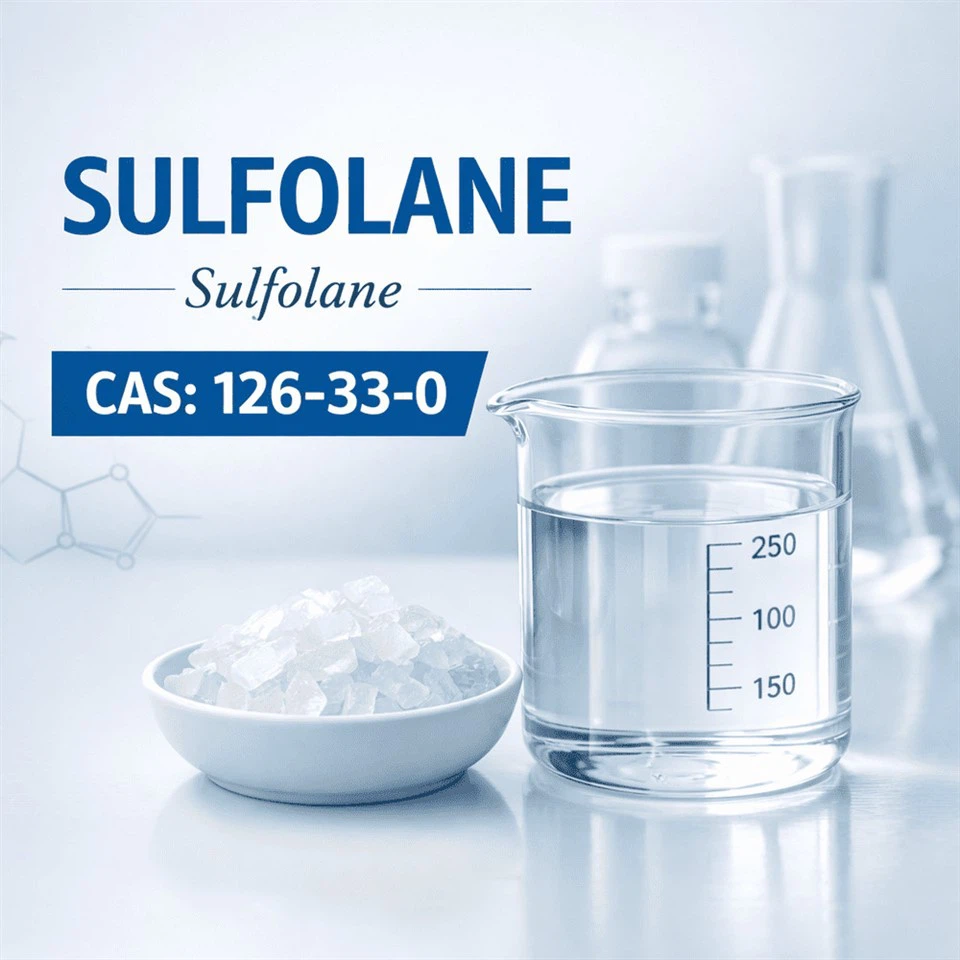
Polar Aprotic Solvent
Sulfolane
(Tetramethylene Sulfone / Sulfolane Anhydrous)
| CAS No. | 126-33-0 |
| IUPAC Name | thiolane 1,1-dioxide |
| Synonyms | tetramethylene sulfone, sulfolane anhydrous, cyclotetramethylene sulfone, 1-oxothiolane 1-oxide |
| HS Code | 2930909090 |
| Molecular Formula | C₄H₈O₂S (O=S(CH₂)₄) |
| Molecular Weight | 120.17 g/mol |
| Grade Available | IndustrialReagentElectronic |
What Is Sulfolane? An Overview
Sulfolane (tetramethylene sulfone, CAS 126-33-0) is a colorless, odorless polar aprotic solvent widely used in the petrochemical, electronics, fine chemical, and new energy industries. Its stable five-membered cyclic sulfone ring (O=S(CH₂)₄) delivers outstanding thermal stability, very low volatility, and excellent chemical resistance under standard acid/alkali conditions.
Sulfolane dissolves most organic compounds, polymers, and inorganic salts, and is fully miscible with water, aromatics, and alcohols - yet remains immiscible with saturated hydrocarbons, which is the key property enabling its use in BTX aromatics extraction. With a boiling point of 285°C and flash point ≥176°C, it is the solvent of choice wherever high-temperature separation or reaction stability is required.
As a professional export trade company partnering with leading Chinese manufacturers that use advanced butadiene–sulfur dioxide synthesis technology, we supply Industrial, Reagent, and Electronic Grade sulfolane at competitive sulfolane prices with flexible packaging - from small HDPE drums to IBC totes and full tank trucks - serving buyers in Europe, North America, Southeast Asia, and the Middle East.
Physical & Chemical Properties of Sulfolane
Sulfolane Specifications - All Grades
| Specification | Industrial Grade Aromatics Extraction |
Reagent Grade | Electronic Grade Battery / Semiconductor |
|---|---|---|---|
| Purity (GC) | ≥ 99.0% | ≥ 99.9% | ≥ 99.99% |
| Water Content | ≤ 0.3% | ≤ 0.05% | ≤ 0.01% |
| Color (Pt-Co) | ≤ 30 | ≤ 10 | ≤ 5 |
| Melting Point | 26–28 °C | 27.0–27.5 °C | 27.2 ± 0.2 °C |
| Boiling Point | 283–287 °C | 285 ± 1 °C | 285 ± 0.5 °C |
| Flash Point (Open Cup) | ≥ 176 °C | ≥ 176 °C | ≥ 176 °C |
| Metal Impurities | Not specified | Single ion ≤ 10 ppm | Single ion ≤ 1 ppb |
| Shelf Life | 12 months (sealed, <30°C) | 18 months (N₂-sealed) | 24 months (N₂-sealed) |
| Packaging | 200L steel drum 1000 kg IBC tote Tank truck |
20L HDPE drum 200L steel drum |
180L quartz-lined drum (N₂-sealed HDPE) |
Complies with REACH & TSCA. COA, SDS/MSDS, and third-party test reports available on request.
Sulfolane Uses & Applications
1. Petrochemical Industry - Aromatics Extraction & Gas Purification
Sulfolane is the dominant solvent in the UOP/Shell Sulfolane extraction process for BTX aromatics (benzene, toluene, xylene) separation from reformed gasoline and cracked naphtha, accounting for over 70% of total global sulfolane consumption. Its aromatics solubility (≥50% at 20°C) and high selectivity deliver final BTX purity above 99.9% - significantly outperforming diethylene glycol ether solvents.
In natural gas and syngas purification, sulfolane efficiently removes H₂S and CO₂. Its regeneration energy consumption is 30% lower than MDEA solvents, making it especially cost-effective for high-sulfur shale gas and coalbed methane fields.
Reference: Honeywell UOP Sulfolane™ Process ↗
2. Electronics & Semiconductor - High-Purity Cleaning Solvent
Electronic-grade sulfolane (metal ions ≤1 ppb) is used for photoresist stripping and semiconductor wafer cleaning, avoiding contamination of precision components and improving chip and LCD/OLED display yields. Its chemical stability and low residue level meet the stringent cleanliness requirements of leading semiconductor fabs.
Reference: The Electrochemical Society (ECS) ↗
3. Lithium Battery Electrolyte Additive
Adding 5–10% sulfolane to lithium-ion battery electrolyte formulations markedly improves high-temperature stability (60°C), extending cycle life by up to 2× and reducing short-circuit risk. Compatible with NMC (ternary) and LFP (lithium iron phosphate) battery chemistries. Electronic Grade purity is mandatory to avoid electrochemical side reactions.
The wide electrochemical stability window of sulfolane also makes it a promising co-solvent for next-generation solid-state and high-voltage battery electrolytes.
Reference: PubChem - Sulfolane (NIH) ↗
4. Fine Chemicals & High-Performance Polymer Processing
As an inert high-boiling reaction solvent (150–250°C) for aromatic alkylation and cyclization (e.g., synthesis of pharma intermediate quinoline), sulfolane does not react with Lewis acid catalysts and reduces by-product generation to below 5%. It is also used as a chlorinated derivative (chlorosulfolane) to synthesize ionic liquids, replacing corrosive strong acids in esterification and nitration.
Sulfolane dissolves high-performance polymers including polyimide (PI) and polyphenylene sulfide (PPS), enabling fabrication of flexible circuit board substrates and high-temperature filter fibers.
5. Coatings, Heat Transfer & Textile Industries
Used as a co-solvent for high-temperature anti-corrosion coatings (silicone resin systems); coating films cured above 200°C pass 1,000+ hour salt spray tests. As a medium-temperature heat transfer fluid (service range 100–250°C), sulfolane offers 15% higher thermal conductivity than mineral oil with annual volatility loss below 1%. In textiles, it improves dye uptake rate and color fastness.
Reference: ECHA REACH Registration ↗
How Is Sulfolane Made? Manufacturing Process
Sulfolane is produced commercially via a two-step synthesis. In step one, 1,3-butadiene and sulfur dioxide undergo a [4+2] cycloaddition (Diels-Alder reaction) to form 2,3-dihydrothiophene 1,1-dioxide (sulfolene). In step two, sulfolene is catalytically hydrogenated to yield the final product - sulfolane anhydrous (tetramethylene sulfone). The crude product is then purified through multi-stage distillation, decolorization, and impurity removal to meet Industrial, Reagent, or Electronic grade specifications.
Our partner manufacturers operate advanced continuous synthesis lines with strict quality control from raw material intake to finished product, ensuring consistent purity and competitive sulfolane pricing across all batch sizes.
Sulfolane vs DMSO - Key Comparison
| Property | Sulfolane | DMSO |
|---|---|---|
| Boiling Point | 285 °C | 189 °C |
| Thermal Stability | Excellent (stable to ~220°C) | Moderate |
| Odor | Odorless | Garlic-like odor |
| Dielectric Constant | 43.3 | 46.7 |
| Primary Industrial Use | BTX aromatics extraction, gas treatment | Pharmaceuticals, polymer synthesis |
| Skin Absorption | Low | High (penetrates skin readily) |
Sulfolane Storage, Stability & Safety Handling
Storage Conditions
Store in a cool (5–30°C), dry, ventilated warehouse away from heat sources and direct sunlight. Sulfolane is hygroscopic and decomposes slowly above 220°C releasing SO₂; maintain storage temperature below 30°C. Industrial grade: sealed steel drums or IBC totes. Reagent/Electronic grades: nitrogen-sealed HDPE or quartz-lined drums. Segregate from strong oxidizers, strong acids, and acyl halides. Stack 200L drums maximum 3 layers high.
Thermal Stability Note
Sulfolane shows excellent thermal stability up to ~200°C. Decomposition temperature is approximately 220°C. Do not heat above 200°C in open systems; equip with exhaust gas treatment for high-temperature processes.
Safety & Handling (SDS / MSDS Summary)
Sulfolane toxicity: slightly toxic (oral LD₅₀ in rats: 1.54 ml/kg). Wear chemical-resistant gloves, safety goggles, and protective clothing. Avoid inhalation of vapors at elevated temperatures. Keep away from food and pharmaceuticals.
Spill response: Isolate area (≥50 m), cut ignition sources, absorb with sand or inert material. Dispose in sealed containers; do not discharge to sewers or soil.
First aid: Skin contact - flush with water. Ingestion - induce vomiting, seek medical attention immediately. Full SDS/MSDS available from our sales team.
Sulfolane Price - 2025 Market Reference
The sulfolane price varies based on purity grade, packaging, and order volume. The following are indicative 2025 market reference prices for China-origin product (ex-works basis):
≥99.0% Purity
≥99.9% Purity
≥99.99% Purity
Frequently Asked Questions about Sulfolane
Q: Is sulfolane liquid or solid at room temperature?
Sulfolane's melting point (freezing point) is 27–28°C, so it is a solid just below typical room temperature and becomes a clear colorless liquid above 28°C. Because the melting point is close to ambient, Industrial Grade is often transported as a 3% aqueous solution (sulfolane aqueous) for easier handling. Pure (anhydrous) grades should be handled with mild heating if solidified.
Q: What is the difference between Industrial Grade and Electronic Grade sulfolane?
Industrial Grade (≥99.0%) is used for bulk petrochemical processes with no specific metal ion restriction. Electronic Grade (≥99.99%) requires individual metal impurities below 1 ppb - critical for semiconductor cleaning and lithium battery electrolytes where trace metals degrade performance. Electronic Grade also requires nitrogen-sealed packaging to prevent moisture and contamination.
Q: What is the sulfolane extraction process (UOP Sulfolane Process)?
The UOP Sulfolane extractive distillation / liquid–liquid extraction process uses sulfolane as the selectivity solvent to separate BTX aromatics from non-aromatic hydrocarbons in reformed gasoline. The rich sulfolane phase is stripped to recover pure aromatics; the lean solvent is regenerated and recycled. Shell and Chevron operate similar licensed variants. This process produces the benzene, toluene, and xylene feedstocks used across the petrochemical industry.
Q: Does sulfolane have a formula / chemical structure?
Yes. The molecular formula is C₄H₈O₂S (molecular weight: 120.17 g/mol). The structural formula is O=S(CH₂)₄ - a five-membered saturated ring with one sulfur atom bearing two oxygen atoms. The SMILES notation is O=S1(=O)CCCC1. The cyclic sulfone ring is responsible for sulfolane's high thermal stability and strong polarity.
Q: What are the sulfolane SDS / MSDS details?
Key SDS highlights: GHS Category - slightly hazardous; oral LD₅₀ (rat) 1.54 ml/kg; skin irritation: mild; eye irritation: mild; not classified as carcinogenic. Storage: sealed containers, 5–30°C, away from oxidizers. PPE: gloves, goggles, protective clothing. Emergency: flush skin/eyes with water; induce vomiting if ingested. Full SDS/MSDS PDF available on request from sales@sinolookchem.com.
Q: What is the sulfolane CAS number and HS code?
The CAS number for sulfolane is 126-33-0. The CAS number for sulfolane anhydrous is the same: 126-33-0. The HS Code (Harmonized Tariff Code) for China export is 2930909090. For customs classification assistance, please contact our trade team.
Q: What sulfolane alternatives exist, and when is sulfolane preferred?
Common sulfolane alternatives for aromatic extraction include diethylene glycol (DEG), N-methylpyrrolidone (NMP), and N-formylmorpholine (NFM). Sulfolane is preferred when higher thermal stability, lower solvent losses, and higher aromatic selectivity are required. For battery electrolytes, fluorinated sulfones or DMF may be used but at significantly higher cost. For general polar aprotic applications, DMSO is a lower-boiling alternative but lacks sulfolane's thermal stability and is not suitable for high-temperature processes.
Industry References & Standards
Comprehensive physicochemical data, toxicology, safety classifications and regulatory information.
Global leader in BTX extraction technology; originator of the commercial sulfolane extraction process.
Official EU REACH dossier: hazard classifications, exposure scenarios, and regulatory restrictions.
Industry benchmark for reagent-grade sulfolane quality parameters and analytical testing standards.
Request a Sulfolane Price Quote
We supply Industrial, Reagent, and Electronic Grade sulfolane (CAS 126-33-0) with flexible packaging and competitive pricing. Contact our team for a tailored quote, SDS/MSDS, or application consultation.
Related products: DMSO · NMP · 2-Methyltetrahydrofuran · Other Polar Aprotic Solvents
Hot Tags: sulfolane, China sulfolane manufacturers, suppliers, hmds hexamethyldisilazane, propionyl chloride molecular weight, sulfolane, sulfolane molecular weight, potassium hexamethyldisilazane, propanoyl chloride structure


