
Your Professional Plasticizers Supplier
Since its establishment in 2010, Sinolook has been deeply involved in the energy and chemical sectors and has become one of the leading base oil and petrochemical traders in China and Asia. In the niche field of fine chemicals, we have a deep understanding of the characteristics and application scenarios of each type of product.
-
![Tetraoctyl Pyromellitate(TOPM)]() Tetraoctyl Pyromellitate(TOPM)Tetraoctyl Pyromellitate (TOPM / TEHPM, CAS 3126-80-5) is a four-ester aromatic synthetic ester — formula C₄₂H₇₀O₈, MW 703.01 g/mol, flash point ≥265°C — and the highest-performance monomeric ester
Tetraoctyl Pyromellitate(TOPM)Tetraoctyl Pyromellitate (TOPM / TEHPM, CAS 3126-80-5) is a four-ester aromatic synthetic ester — formula C₄₂H₇₀O₈, MW 703.01 g/mol, flash point ≥265°C — and the highest-performance monomeric ester -
![Tri(octyl, Decyl) Trimellitate (TM810)]() Tri(octyl, Decyl) Trimellitate (TM810)Tri(octyl, decyl) trimellitate (TM810, CAS 68515-42-4) is a mixed C8/C10 linear trimellitate ester plasticiser — average MW ~570 g/mol, pour point −46°C (actual; spec ≤−40°C) — with the lowest pour
Tri(octyl, Decyl) Trimellitate (TM810)Tri(octyl, decyl) trimellitate (TM810, CAS 68515-42-4) is a mixed C8/C10 linear trimellitate ester plasticiser — average MW ~570 g/mol, pour point −46°C (actual; spec ≤−40°C) — with the lowest pour -
![Isononanoic Acid (INA) — CAS 3302-10-1 / 26896-18-4, 3,5,5-Trimethylhexanoic Acid 99.93%, Metal Ions ≤5 mg/kg]() Isononanoic Acid (INA) — CAS 3302-10-1 / 26896-18-4, 3,5,...Sinolook supplies isononanoic acid (INA) — 3,5,5-trimethylhexanoic acid, CAS 3302-10-1 (commercial registry 26896-18-4), C9H18O2, MW 158.24. Single-isomer grade: 99.93% 3,5,5-TMH by GC, Pt-Co 3.2
Isononanoic Acid (INA) — CAS 3302-10-1 / 26896-18-4, 3,5,...Sinolook supplies isononanoic acid (INA) — 3,5,5-trimethylhexanoic acid, CAS 3302-10-1 (commercial registry 26896-18-4), C9H18O2, MW 158.24. Single-isomer grade: 99.93% 3,5,5-TMH by GC, Pt-Co 3.2 -
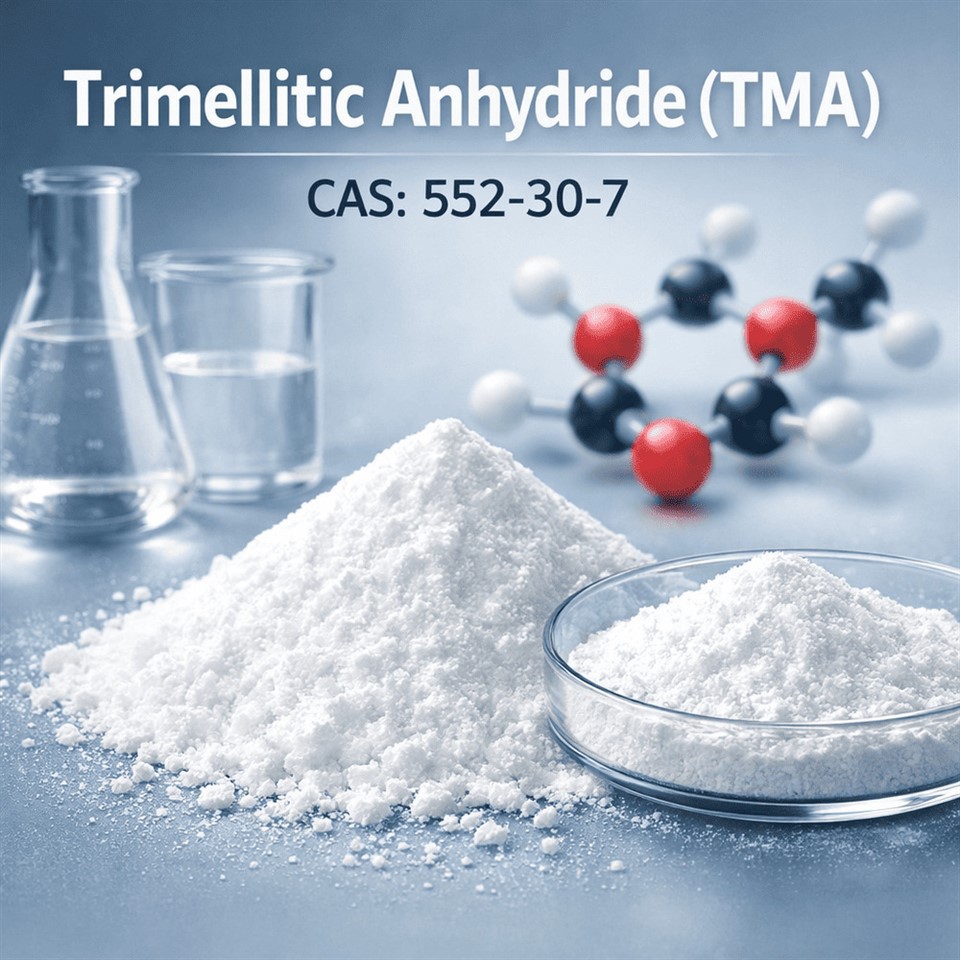
![Trimellitic Anhydride]() Trimellitic AnhydrideTrimellitic anhydride (TMA, CAS 552-30-7) is an aromatic trifunctional intermediate — formula C₉H₄O₅, MW 192.13 g/mol, melting point 164–168°C — containing both an intramolecular anhydride ring
Trimellitic AnhydrideTrimellitic anhydride (TMA, CAS 552-30-7) is an aromatic trifunctional intermediate — formula C₉H₄O₅, MW 192.13 g/mol, melting point 164–168°C — containing both an intramolecular anhydride ring


Why Choose Us
Reliable Global Logistics
We integrate international logistics resources to build a cross-border supply chain network covering major ports, and can provide flexible logistics solutions such as door-to-door, multimodal transportation, warehousing and distribution according to customer needs to ensure that goods arrive safely and on time to global destinations.
Integrated solution
We are committed to providing global customers with accurate, efficient and reliable integrated solutions for fine chemical procurement and logistics.
Fast Response & Professional Support
Our experienced sales and logistics teams provide responsive communication, technical assistance, and efficient service support throughout every stage of cooperation.
Strict Quality Control
We Comprehensive supplier evaluation and quality inspection procedures ensure product consistency, compliance, and reliable performance throughout the supply chain.
What Is a Plasticizer
A plasticizer is an additive added to polymers, such as polyvinyl chloride (PVC), to make them softer. This low-volatility substance can also be added to rubber, concrete, and cellulose-based products to enable them to be shaped into various products.
Types of Plasticizers
Primary Plasticizers
Primary plasticizers are the most commonly used type of plasticizers and are essential in achieving the desired flexibility and softness in the material. They are typically high molecular weight compounds and are added in large amounts. Examples include phthalates, adipates, and sebacates.
Secondary Plasticizers
Secondary plasticizers, on the other hand, are used in smaller quantities and have a more limited effect on the material’s properties. They provide additional benefits like improving the processing characteristics or enhancing specific material features (e.g., fire resistance or weatherability).
Improved Flexibility: Plasticizers make polymers much more flexible, which is essential for products that need to bend, stretch, or conform to different shapes.
Enhanced Processability: The addition of plasticizers can improve the processability of polymers, making them easier to mold, extrude, or form into the desired shapes without causing excessive stress or cracking.
Cost-Effective: Plasticizers are relatively inexpensive additives that can help manufacturers reduce the amount of raw material needed for the production of flexible products, making the end products more affordable.
Durability and Longevity: Plasticized polymers often exhibit improved resistance to wear, weathering, and cracking, which increases the durability and lifespan of products made from these materials.

Ways to process plasticizers
Plasticizer is mixed with resin
Plasticizer penetrates and swells the resin particles
Polar groups in the PVC resin are freed from each other
Plasticizer polar groups interact with the polar groups on the PVC chain
PVC structure is re-established upon cooling with full retention of plasticizer
Plasticizers increase material flexibility by lowering the Glass Transition Temperature (Tg). Tg is the temperature at which a polymer material transitions from a hard, brittle state, like glass, to a soft, elastic state, like rubber.
With the addition of plasticizers, the material remains flexible at lower temperatures. Also, plasticizers improve tensile strength and impact resistance, preventing the material from cracking or breaking easily.
As a result, plastics and rubbers containing plasticizers become more flexible and suitable for various applications, such as manufacturing water hoses and vehicle interior components.
While most plasticizers are used in PVC-based products, they also show up in rubber (such as vehicle tires and shoe soles), synthetic rubber, and other polymers like acrylic, polyethylene, polyurethane, and polypropylene.
Common Applications of Plasticizers
Construction Materials: Plasticizers are commonly used in construction materials like concrete, where they are added to improve workability and reduce the water content required in mixes. This helps create stronger, more durable concrete with better flow properties.
Consumer Products: Many household products, such as flooring materials, wallpapers, and inflatable items, rely on plasticizers to maintain their flexibility and durability. Vinyl flooring, for example, is often made from PVC that has been plasticized to enhance its softness and workability.
Medical Devices: Plasticizers are often incorporated into medical-grade plastics to ensure that devices such as tubing, IV bags, and catheters are flexible and easy to handle. The flexibility provided by plasticizers is essential for these products to conform to the needs of medical professionals and patients.
Packaging Materials: Flexible packaging materials, such as food wrap films, are often made from plasticized polymers to improve their pliability and tear resistance. The ability to stretch and form around products is made possible by the addition of plasticizers.
Toys and Sporting Goods: Many toys and sporting goods are made from plasticized materials, which provide flexibility and safety. For instance, vinyl toys are often soft and flexible due to the plasticizers added to the PVC during manufacturing.
FAQ
As one of the most professional plasticizers manufacturers and suppliers in China, we're featured by quality products and good service. Please rest assured to buy high-grade plasticizers made in China here from our factory. For price consultation, contact us.
trimellitic, isononanoic acid, trimellitic anhydride