

Your Professional Coatings and Inks Supplier
Since its establishment in 2010, Sinolook has been deeply involved in the energy and chemical sectors and has become one of the leading base oil and petrochemical traders in China and Asia. In the niche field of fine chemicals, we have a deep understanding of the characteristics and application scenarios of each type of product.
-
![Waterborne Hydroxyl Acrylic Resin — 2K Polyol, OH 1.0–3.3%]() Waterborne Hydroxyl Acrylic Resin — 2K Polyol, OH 1.0–3.3%Sinolook supplies waterborne hydroxyl acrylic resin (WAR) at 45% solids (±2 wt%) in three hydroxyl levels — 1.0, 2.4 and 3.3 wt% — the acrylic polyol half of a two-component waterborne polyurethane
Waterborne Hydroxyl Acrylic Resin — 2K Polyol, OH 1.0–3.3%Sinolook supplies waterborne hydroxyl acrylic resin (WAR) at 45% solids (±2 wt%) in three hydroxyl levels — 1.0, 2.4 and 3.3 wt% — the acrylic polyol half of a two-component waterborne polyurethane -
![Waterborne Polyurethane Dispersion (PUD) — Anionic, Aliphatic]() Waterborne Polyurethane Dispersion (PUD) — Anionic, Aliph...Sinolook supplies anionic aliphatic waterborne polyurethane dispersions (PUD) at 22-35% solids, covering polyester, polyether, polycarbonate-modified and acrylic-modified backbones. Aliphatic
Waterborne Polyurethane Dispersion (PUD) — Anionic, Aliph...Sinolook supplies anionic aliphatic waterborne polyurethane dispersions (PUD) at 22-35% solids, covering polyester, polyether, polycarbonate-modified and acrylic-modified backbones. Aliphatic -
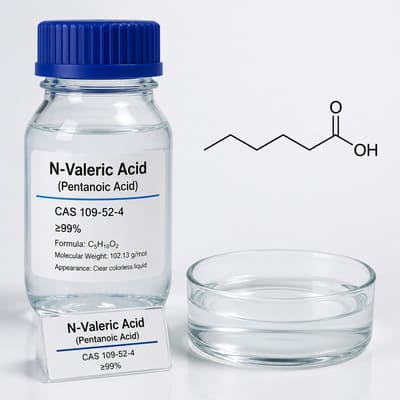
![N-Valeric Acid (Pentanoic Acid) — CAS 109-52-4, ≥99%]() N-Valeric Acid (Pentanoic Acid) — CAS 109-52-4, ≥99%Sinolook supplies n-valeric acid (pentanoic acid), CAS 109-52-4, C5H10O2, MW 102.13 — the linear C5 acid used to build polyol ester refrigeration lubricants, valerate esters and valeryl chloride.
N-Valeric Acid (Pentanoic Acid) — CAS 109-52-4, ≥99%Sinolook supplies n-valeric acid (pentanoic acid), CAS 109-52-4, C5H10O2, MW 102.13 — the linear C5 acid used to build polyol ester refrigeration lubricants, valerate esters and valeryl chloride. -
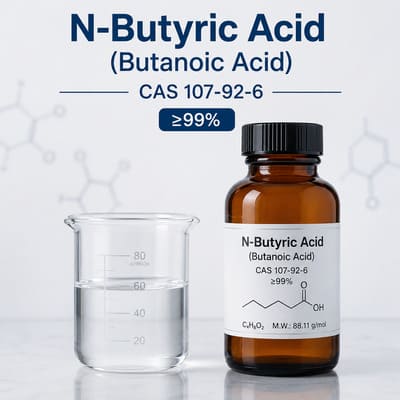
![N-Butyric Acid (Butanoic Acid) — CAS 107-92-6, ≥99%]() N-Butyric Acid (Butanoic Acid) — CAS 107-92-6, ≥99%Sinolook supplies n-butyric acid (butanoic acid), CAS 107-92-6, C4H8O2, MW 88.11 — the C4 straight-chain acid behind tributyrin, sodium and calcium butyrate, butyrate esters, butyric anhydride and
N-Butyric Acid (Butanoic Acid) — CAS 107-92-6, ≥99%Sinolook supplies n-butyric acid (butanoic acid), CAS 107-92-6, C4H8O2, MW 88.11 — the C4 straight-chain acid behind tributyrin, sodium and calcium butyrate, butyrate esters, butyric anhydride and -
![Ethylene Glycol Monomethyl Ether Acetate]() Ethylene Glycol Monomethyl Ether AcetateEthylene Glycol Monomethyl Ether Acetate (EGMEA, CAS 110-49-6), also known as 2-Methoxyethyl Acetate, is a high-solvency ester solvent with molecular formula C₅H₁₀O₃ (MW 118.13 g/mol). A colorless
Ethylene Glycol Monomethyl Ether AcetateEthylene Glycol Monomethyl Ether Acetate (EGMEA, CAS 110-49-6), also known as 2-Methoxyethyl Acetate, is a high-solvency ester solvent with molecular formula C₅H₁₀O₃ (MW 118.13 g/mol). A colorless -
![Ethylene Glycol Monomethyl Ether Methacrylate]() Ethylene Glycol Monomethyl Ether MethacrylateEthylene Glycol Monomethyl Ether Methacrylate (EGMEMA / 2-Methoxyethyl Methacrylate, CAS 69769-38-8) is a reactive polymerizable monomer — not a solvent — combining a methacryloyl group
Ethylene Glycol Monomethyl Ether MethacrylateEthylene Glycol Monomethyl Ether Methacrylate (EGMEMA / 2-Methoxyethyl Methacrylate, CAS 69769-38-8) is a reactive polymerizable monomer — not a solvent — combining a methacryloyl group -
![Ethylene Glycol Monoethyl Ether Acetate]() Ethylene Glycol Monoethyl Ether AcetateEthylene Glycol Monoethyl Ether Acetate (EGEA / Cellosolve Acetate / CAC, CAS 111-15-9) is a high-solvency ester solvent — formula C₆H₁₂O₃, MW 132.16 g/mol, bp 154–160°C — with the slowest
Ethylene Glycol Monoethyl Ether AcetateEthylene Glycol Monoethyl Ether Acetate (EGEA / Cellosolve Acetate / CAC, CAS 111-15-9) is a high-solvency ester solvent — formula C₆H₁₂O₃, MW 132.16 g/mol, bp 154–160°C — with the slowest -
![Diethylene Glycol Monoethyl Ether Acetate]() Diethylene Glycol Monoethyl Ether AcetateDiethylene Glycol Monoethyl Ether Acetate (DEGEAC / Carbitol Acetate, CAS 112-15-2) is an ultra-high-boiling ester solvent — formula C₈H₁₆O₄, MW 176.21 g/mol, bp 213–223°C — with the slowest
Diethylene Glycol Monoethyl Ether AcetateDiethylene Glycol Monoethyl Ether Acetate (DEGEAC / Carbitol Acetate, CAS 112-15-2) is an ultra-high-boiling ester solvent — formula C₈H₁₆O₄, MW 176.21 g/mol, bp 213–223°C — with the slowest -
![Propylene Glycol Monoethyl Ether Acetate]() Propylene Glycol Monoethyl Ether AcetatePropylene Glycol Monoethyl Ether Acetate (PGEA / PEA, CAS 54839-24-6) is a P-series glycol ether ester solvent — formula C₇H₁₄O₃, MW 146.19 g/mol, bp ~155–158°C — and the closest
Propylene Glycol Monoethyl Ether AcetatePropylene Glycol Monoethyl Ether Acetate (PGEA / PEA, CAS 54839-24-6) is a P-series glycol ether ester solvent — formula C₇H₁₄O₃, MW 146.19 g/mol, bp ~155–158°C — and the closest -
![Propylene Glycol Monomethyl Ether Propionate]() Propylene Glycol Monomethyl Ether PropionatePropylene Glycol Monomethyl Ether Propionate (PGMP / PMP, CAS 148462-57-1) is the premium slow-evaporation P-series ester solvent — formula C₇H₁₄O₃, MW 146.19 g/mol, bp ~160–163°C — produced by
Propylene Glycol Monomethyl Ether PropionatePropylene Glycol Monomethyl Ether Propionate (PGMP / PMP, CAS 148462-57-1) is the premium slow-evaporation P-series ester solvent — formula C₇H₁₄O₃, MW 146.19 g/mol, bp ~160–163°C — produced by -
![Ethylene Glycol Monoethyl Ether Propionate]() Ethylene Glycol Monoethyl Ether PropionateEthylene Glycol Monoethyl Ether Propionate (EGEPR / ECP, CAS 14272-48-1) is a high-boiling specialty ester solvent — formula C₇H₁₄O₃, MW 146.19 g/mol, bp ~168–170°C — and the slowest-evaporating
Ethylene Glycol Monoethyl Ether PropionateEthylene Glycol Monoethyl Ether Propionate (EGEPR / ECP, CAS 14272-48-1) is a high-boiling specialty ester solvent — formula C₇H₁₄O₃, MW 146.19 g/mol, bp ~168–170°C — and the slowest-evaporating -
![Dimethylformamide (DMF)]() Dimethylformamide (DMF)Dimethylformamide (DMF, CAS 68-12-2) is a high-purity polar aprotic solvent with purity ≥99.9%, widely used in synthetic fiber spinning, pharmaceutical API synthesis, agrochemical production,
Dimethylformamide (DMF)Dimethylformamide (DMF, CAS 68-12-2) is a high-purity polar aprotic solvent with purity ≥99.9%, widely used in synthetic fiber spinning, pharmaceutical API synthesis, agrochemical production,


Why Choose Us
Reliable Global Logistics
We integrate international logistics resources to build a cross-border supply chain network covering major ports, and can provide flexible logistics solutions such as door-to-door, multimodal transportation, warehousing and distribution according to customer needs to ensure that goods arrive safely and on time to global destinations.
Integrated solution
We are committed to providing global customers with accurate, efficient and reliable integrated solutions for fine chemical procurement and logistics.
Fast Response & Professional Support
Our experienced sales and logistics teams provide responsive communication, technical assistance, and efficient service support throughout every stage of cooperation.
Strict Quality Control
We Comprehensive supplier evaluation and quality inspection procedures ensure product consistency, compliance, and reliable performance throughout the supply chain.
What is Coatings and Inks
Coatings and inks are specialized chemical formulations applied to surfaces to provide decoration, protection, or specific functional properties (like conductivity or adhesion). Both are comprised of similar core raw materials—colorants, resins, binders, and solvents—but are engineered for different application methods and end-uses.
Tactile: Inks and textured coatings can add a tactile effect to packaging. Whether seeking a smooth and soft touch or a rough and gritty feeling, adding texture to packaging brings dimension to the package and further enhances the consumer experience.
Glow-in-the-dark: Using glow-in-the-dark (GID) ink can be an attention-grabbing effect year-round, but it is especially powerful during Halloween and Christmas when brands want to create a novel and interactive effect.
Metallics: It is possible to create an array of metallic colors—from silver to gold and all the colors in between—some high gloss and others low gloss. Our high-performance ink is exceedingly suitable for printing on aluminum foil and is often used in food wrappers, pharmaceutical packaging, and more.

Pearlescent and/or Shimmering: UV inks can create shimmering hues, reflective light, and a pearlescent look and feel. These inks are often used to send the message that a product is high-end or luxurious.
Color-Changing, Thermochromic: Inks that are activated by temperature, ultra-violet light, and/or sunlight can change color – either temporarily or permanently. Thermochromic inks can be used to indicate whether a product has changed temperature.
Bold Color: The rise in e-commerce has forced brands to rethink their package design to connect with consumers outside the traditional retail environment.
Natural and/or Organic: There are times when a brand owner wants their product and packaging to have a natural and organic appeal. Using softer, more natural colors (and substrates) can help brand owners appeal to the environmentally conscious consumer.
Different Types of Chemical Coating and Ink
For Silicone
Silicone rubber coating and ink is film-forming material made with silicone oils and NCO. The silicone rubber coating is mainly sprayed on the object’s surface, gloss or matte state effect.
For Plastic
Plastic ink is a chemical ink used to print all kinds of materials such as PET, ABS, PC, ABS+PC, and high-temperature-resistant substrates. The features of plastic ink include high color concentration, slow drying speed, smoothness, and thickness.
Fluororubber Soft Touch Coating
Fluorofubber soft-touch coating is a kind of coating material that is applied to the plastic substrate. This soft touch plastic paint can create and durable and soft surface, increasing the smoothness of the product surface.
Extender Pigments for Coatings and Inks
Extender pigments are added in order to reduce the cost of a paint formulation. They are also used to modify the flow (viscosity), sedimentation stability and film strength.
Most extender pigments appear white and possess a refractive index similar to commonly used binders.
Most of the extender pigments occur naturally and others can be produced synthetically.
Aluminum silicate, magnesium silicate (talc), silica, calcium carbonate (synthetic and natural) and barium sulfate are some commonly used extender in paints and coatings.
Applications of Chemical Coatings and Inks
Electron Industry
The electron industry is the industry with the greatest demand for silicone rubber coating and ink. Silicone rubber coating and ink can be applied to 3C electronics such as keyboards, wearable devices, computers, home appliances, etc. In addition, it can provide enhanced smoothness and safety for the product.
Packaging and Printing Industry
Chemical coating and ink have a wide range of industrial use in the packaging and printing industry, such as high-temperature tape, heat resistance labels, and tire vulcanization labels.
Health Supply Industry
Chemical coating and ink in the health supply industry can be applied to adult products.
FAQ
As one of the most professional coatings and inks manufacturers and suppliers in China, we're featured by quality products and good service. Please rest assured to buy high-grade coatings and inks made in China here from our factory. For price consultation, contact us.