
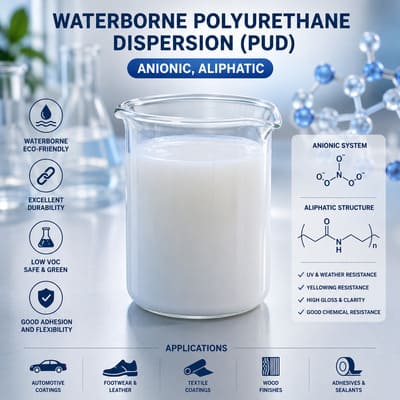
Waterborne Polyurethane Dispersion (PUD)
Solids 22–35% (±2 wt%) · Polyester, polyether, polycarbonate-modified and acrylic-modified backbones · Substrate-specific grades
🧭 Start Here: Backbone Chemistry Decides Everything
Every PUD is an isocyanate reacted with a polyol, carrying built-in carboxylate groups that let it disperse in water without an external surfactant. The isocyanate choice governs yellowing. The polyol backbone governs almost everything else - and it is where most specification mistakes happen, because a resin that performs beautifully on a test panel can fail in service for reasons that were decided at the backbone.
| Backbone | Mechanical strength | Hydrolysis resistance | Relative cost |
|---|---|---|---|
| Polyester | High ✅ | Poor ⚠️ | Low |
| Polyether | Moderate | Excellent ✅ | Low |
| Polycarbonate-modified | High ✅ | Excellent ✅ | High ⚠️ |
| Acrylic-modified | Moderate–high | Good | Moderate |
⚠️ The failure mode nobody warns you about: polyester hydrolysis.
Polyester-backbone PUDs give the best adhesion and mechanical strength for the money, which is why they dominate the market. But ester linkages hydrolyse. In a temperate indoor application that may never matter. In humid tropical service, in anything exposed to standing water, or in a product with a five-year warranty, it eventually does - and the failure looks like the coating turning tacky and losing cohesion, usually long after the panel test that qualified it.
If your product ships to Southeast Asia, the Gulf or coastal humid regions, or carries a long warranty, specify polycarbonate-modified and accept the price. It costs meaningfully more and it is the honest recommendation. Do not qualify a polyester grade on a dry-lab panel test and discover this in the field.
☀️ Why every grade here is aliphatic.
Aromatic isocyanates (TDI, MDI) are cheaper but their films yellow under UV - an aromatic PUD topcoat on a white synthetic leather will go visibly cream within months of sunlight. Aliphatic isocyanates (IPDI, HDI, H12MDI) cost more and cure more slowly, but the film stays colour-stable. For a topcoat, a light-coloured substrate, or anything that sees daylight, aliphatic is not optional. If you are coating a dark article that never sees UV and are buying purely on price, an aromatic PUD may genuinely be the better commercial choice - tell us and we will say so rather than upsell you.
📊 Grade Range by Chemistry and Substrate
All grades are anionic aliphatic dispersions. Solids tolerance ±2 wt%. Full technical data sheets, viscosity, pH, particle size and minimum film-forming temperature are supplied on enquiry for the grades that match your substrate.
| Grade type | Solids | Appearance & key character | Primary substrates |
|---|---|---|---|
| Fine-particle high-gloss aliphatic | 22% | Slightly yellow transparent; small particle size, high gloss, good abrasion resistance | PVC synthetic leather finishing |
| ⭐ Polycarbonate-modified aliphatic | 35% | Milky white; strong adhesion, excellent water resistance, fast surface dry | PVC, ABS, uPVC, stainless steel |
| Flexible aliphatic (co-solvent bearing) | 35% | Translucent blue cast; high flexibility - contains ~10% solvent | TPU, polyester fabric |
| Light-metal adhesion aliphatic | 35% | Pale yellow translucent | Aluminium and aluminium alloys |
| ⭐ Acrylic-modified | 29% | Creamy yellow; outstanding adhesion to a notoriously difficult substrate | Polypropylene |
| ⭐ Polyether-based self-matting | 30% | Milky white; full matte without matting agent, superior hand and skin feel, blends with other emulsions | Leather, synthetic leather, packaging paper, wood |
| Peelable aliphatic | 35% | Translucent blue cast; clean peel-off, high tensile strength, excellent water resistance | Temporary protection, most substrates |
| High-resilience aliphatic | 32% | Translucent blue cast; high elongation and tensile strength | Textile coating, water-based ink |
| Soft-elastic low-absorption aliphatic | 32% | Translucent blue cast; soft elastic film, low water absorption | Textiles, printing |
| Abrasion-resistant fine-particle | 30% | Translucent bluish; small particle size, scratch resistance | Wood coatings |
| High-build sandable | 35% | Translucent blue; high fullness, anti-stacking, easy sanding | Wood coatings |
ℹ️ On the blue cast. The faint blue tint in several grades is not a colourant - it is Tyndall scattering from a fine particle size, and it is generally a good sign. Fine-particle dispersions give higher gloss, better film clarity and better penetration into porous substrates. Coarser, milky-white dispersions dry faster and suit absorbent substrates better. Neither is superior; they are different tools.
🌍 "Waterborne" Does Not Mean Solvent-Free - Ask the Co-Solvent Question
Most PUDs are made by dissolving the prepolymer in a co-solvent before dispersion. Some of that solvent is stripped afterwards; some is deliberately left in as a coalescing aid, because without it the film will not form properly at ambient temperature. One grade in the range above openly declares about 10% solvent content. We have left that figure on the table rather than quietly omitting it.
This matters beyond your VOC calculation. The traditional co-solvents for PUD synthesis - NMP and NEP - are both classified as reproductive toxicants and both sit on the REACH SVHC Candidate List, with NMP additionally restricted under REACH Annex XVII. If a dispersion carries either above the relevant threshold, that flows into your finished coating's classification, labelling and supply-chain disclosure obligations. Switching from NMP to NEP does not solve this; it changes which entry you are dealing with.
Ask every PUD supplier - including us - for the co-solvent identity and its content, in writing, before you qualify a grade. A supplier who answers "it's waterborne, it's low VOC" has not answered the question. We will state the solvent and the level on the technical data sheet, and tell you which grades in the range are the lowest-solvent options for your application.
🔗 Background on the co-solvents themselves: NMP (N-Methyl-2-pyrrolidone)
⚙️ Applications
👜 1. Synthetic Leather & Leather Finishing
Topcoats and finishes for PVC and PU synthetic leather, and for genuine leather. This is where PUD replaced solvent-borne systems most completely, driven by workshop VOC limits and by the fact that a waterborne finish can be built thin and still deliver gloss and abrasion resistance. The self-matting polyether grade is the one to look at for hand feel - it reaches full matte without a matting agent, which avoids the chalky surface and the settling problems that silica matting brings.
🪵 2. Wood Coatings
Furniture, flooring and cabinetry. Two distinct grades serve two distinct jobs: a high-build sandable dispersion for the sealer coat, where fullness and easy sanding decide how many passes the line needs, and a fine-particle abrasion-resistant dispersion for the topcoat, where scratch resistance and clarity matter. Anti-stacking behaviour is worth checking specifically if your product is packed shortly after cure - blocking between stacked panels is the classic waterborne wood coating complaint.
🔩 3. Plastic & Metal Substrates
PVC, ABS, uPVC profile, stainless steel, aluminium and aluminium alloys. Polypropylene deserves separate mention - it is a low-surface-energy substrate that most waterborne resins simply will not stick to, which is why the acrylic-modified grade exists. If you are coating PP, start there, and still expect to need flame or plasma pre-treatment. No resin removes that requirement entirely; anyone who tells you otherwise has not run it on a production line.
🧵 4. Textile Coating & Water-Based Ink
Binders for textile coating, pigment printing and water-based ink. The high-resilience grade brings elongation and tensile strength for fabrics that must stretch and recover; the soft-elastic grade adds low water absorption for garments that will be laundered. TPU and polyester fabric take the flexible aliphatic grade - note that this is the one carrying declared solvent content, which may or may not suit your VOC position.
🛡️ 5. Peelable Temporary Protection
Strippable protective films applied over finished surfaces during transport, storage, fabrication or construction, then peeled cleanly at handover. The engineering problem is a narrow one: the film must adhere well enough not to lift in transit, yet release without residue or substrate damage after weeks or months. Peel strength drifts with substrate energy, film thickness and ageing time, so test it on your actual substrate after realistic ageing, not on a fresh panel after 24 hours.
📦 Storage & Handling - Where Dispersions Are Fragile
A polyurethane dispersion is not a solution. It is fine polymer particles held in suspension by carboxylate charge, and there are four ways to destroy that suspension irreversibly. All four are avoidable and all four happen regularly.
❄️ 1. Freezing. The single most common way a PUD arrives ruined. Freezing forces the particles together and they do not re-disperse on thawing - you get irreversible coagulation, and no amount of stirring recovers it. Store and ship above 5 °C. If you are importing into northern Europe, Canada or northern China in winter, specify a heated or insulated container. A drum that froze in transit is a total loss, and it will not always be obvious until it is in your mixer.
💧 2. Hard water. Anionic dispersions coagulate on contact with polyvalent cations. Calcium and magnesium in ordinary tap water will do it. Use deionised water for dilution - this is the most frequent cause of a "your resin was faulty" complaint that turns out to be the dilution water.
🧪 3. Acid. The stabilising groups are carboxylate salts. Drop the pH and they protonate back to free acid, the charge disappears and the dispersion crashes. Keep acidic additives and acid-functional resins away unless compatibility has been demonstrated, and add anything acidic slowly and under agitation.
🌀 4. High shear and foam. Excessive shear can destabilise the dispersion, and PUDs foam readily. Stir gently with a low-shear paddle rather than a high-speed disperser, and use a defoamer suited to waterborne systems.
🌡️ Storage: 5–35 °C, sealed original containers, out of direct sunlight, away from frost. Keep containers closed - a skin forming on the surface indicates water loss and will show as seeds in the applied film.
📅 Shelf life: typically 6 months from production in unopened packaging - materially shorter than a solvent-borne resin, so plan order quantity against consumption rather than buying a year's supply on price. Stir gently before use; slight settling on standing is normal and re-disperses.
🦠 Microbial stability: waterborne dispersions support microbial growth. Do not return decanted material to the drum, keep transfer equipment clean, and if you dilute in advance, use the diluted material promptly.
👷 PPE: gloves and eye protection. These are not corrosive materials, but check the SDS for the specific grade - co-solvent content and any residual free monomer differ between grades and drive the classification.
📦 Packaging: 25 kg or 50 kg drums and 200 kg drums; IBC for volume users. Confirm the option that matches your intake, and remember that a PUD's shelf life makes IBC quantities a commitment.
🧪 Formulation Notes
⚗️ pH adjustment. Anionic PUDs are supplied neutralised, typically with a volatile tertiary amine so that the amine leaves as the film dries and the coating becomes water-resistant. If you need to adjust pH during formulation, use the same class of amine rather than a fixed alkali - sodium or potassium hydroxide leaves a permanent hydrophilic salt in the film and will degrade water resistance.
🔗 Crosslinking. Single-component PUD films are thermoplastic. For chemical and solvent resistance, add a water-dispersible polyisocyanate or a carbodiimide or aziridine crosslinker as a two-component system - accepting the pot life that comes with it. Judge whether you actually need it: many synthetic leather and textile applications do not.
🎨 Blending. The self-matting polyether grade is specified as compatible with other emulsion types, which makes PUD/acrylic hybrid formulation practical - PUD for toughness and feel, acrylic for cost and hardness. Always run a compatibility check at your intended ratio before scaling; anionic systems from different suppliers do not always co-exist happily.
🌡️ Film formation. Note the minimum film-forming temperature for your grade and make sure your application environment clears it with margin. A waterborne coating applied below its MFFT gives a cracked, powdery, mechanically worthless film - and cold-morning application in an unheated workshop is exactly how this happens in practice.
❓ Frequently Asked Questions
Q1. Which grade should I start with?
Tell us the substrate first, then the service environment, then the finish. Substrate narrows it to two or three grades immediately - PP goes to the acrylic-modified, aluminium to the light-metal grade, PVC leather to the fine-particle high-gloss. Service environment then decides the backbone: humid or long-warranty applications go polycarbonate-modified. Finish and feel decide the last step. We will send data sheets for the two or three that fit rather than the whole range, which is not useful to anyone.
Q2. Can a waterborne PUD really match solvent-borne PU performance?
On appearance, flexibility, feel and abrasion resistance, modern PUDs are genuinely competitive. On solvent resistance and chemical resistance a single-component PUD is still behind a two-component solvent-borne polyurethane, and closing that gap means adding a crosslinker and accepting a pot life. On drying speed, water evaporates more slowly than solvent and is far more humidity-sensitive, which is a real line-speed consideration. The honest summary: for most decorative and protective work the performance is there; for the most chemically aggressive service it is not yet a straight swap.
Q3. My dispersion coagulated in the tank. What happened?
In order of likelihood: tap water used for dilution instead of deionised; something acidic added too quickly; the drum froze in transit or in an unheated warehouse; or excessive shear from a high-speed disperser. All four are irreversible - coagulated dispersion cannot be recovered. Tell us which of the four applied and we will help you rule the others out, but check the dilution water first, because that is the answer most of the time.
Q4. Is a higher solids content always better?
No, and it is a common purchasing error. Higher solids means less water to evaporate, so faster drying and lower freight cost per kilogram of resin - genuinely valuable at scale. But solids content is set by the chemistry, not chosen freely: the fine-particle high-gloss grade sits at 22% precisely because that particle size and stability cannot be held at 35%. Comparing two grades on solids alone will lead you to the wrong one. Compare on dry film performance for your substrate and price per kilogram of solids.
Q5. What documentation can you provide for REACH and VOC compliance?
SDS for the specific grade, technical data sheet with solids, pH, viscosity, particle size and MFFT, co-solvent identity and content stated explicitly, VOC content by the calculation method your market requires, and REACH SVHC declarations. If your application is food-contact packaging, toys or textiles with skin contact, tell us - those carry their own requirements and we will confirm what can be certified before quoting rather than after.
Q6. What are sample, MOQ and lead time?
Laboratory samples of the two or three grades that fit your substrate, with data sheets and SDS. Commercial MOQ is typically one drum per grade; IBC for volume. Send substrate, application method, service environment, finish requirement, target annual volume and destination port. We reply within 24 hours - and if none of the grades in the range is right for your substrate, we will tell you that instead of sending a sample that will fail.
📚 Related Products
Dimethylethanolamine (DMEA)
The volatile tertiary amine used to neutralise carboxylate groups in anionic PUD synthesis and to adjust pH in formulation.
View product →NMP (N-Methyl-2-pyrrolidone)
The traditional PUD synthesis co-solvent - and the regulatory status you need to understand before specifying a grade that contains it.
View product →Waterborne Hydroxyl Acrylic Resin (WAR)
Hydroxyl-functional waterborne acrylic for two-component systems and for hybrid formulation alongside PUD.
View product →Also available: Tetraoctyl Pyromellitate (TOPM) · Isononanoic Acid - alkyd modifier and drier acid · All Coatings & Inks Chemicals
📩 Request Grade Recommendation, Samples & Data Sheets
Send us four things and we can narrow the range to two or three grades immediately: your substrate, your application method, the service environment the finished article will live in, and the finish you need. We reply within 24 hours with data sheets, SDS, co-solvent content stated explicitly, VOC figures for your market, and lab samples. If your winter shipping route risks freezing, tell us and we will arrange protected transport rather than let a drum arrive ruined.
Xiamen Sinolook Oil Co., Ltd. - Anionic Aliphatic Waterborne Polyurethane Dispersion (PUD). Technical data is typical and provided for guidance only; confirm against the data sheet and COA for the specific grade supplied. Do not allow to freeze.
Hot Tags: waterborne polyurethane dispersion (pud) — anionic, aliphatic, China waterborne polyurethane dispersion (pud) — anionic, aliphatic manufacturers, suppliers