
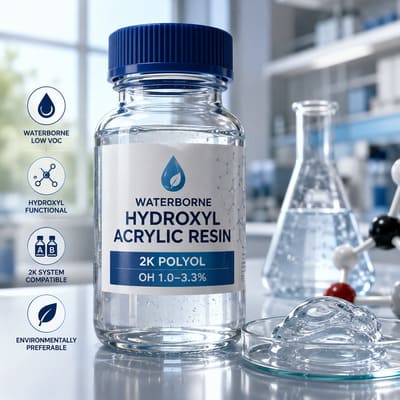
Waterborne Hydroxyl Acrylic Resin (WAR)
Solids 45% (±2 wt%) · Hydroxyl content 1.0 / 2.4 / 3.3 wt% · Accepts both conventional and water-dispersible polyisocyanate hardeners
🎚️ Hydroxyl Content Is the Only Dial That Matters
These three grades share the same solids and the same basic chemistry. What separates them is hydroxyl content - and since every hydroxyl group is a site where the polyisocyanate hardener will attach, hydroxyl content is crosslink density, and crosslink density is the film. Turn it up and the film gets harder, tougher and far more resistant to chemicals and solvents. Turn it up too far and it gets brittle, the pot life shortens, and your hardener bill climbs.
| Grade | Solids | OH content | Film character | Where it fits |
|---|---|---|---|---|
| Low-OH | 45% | 1.0 wt% | High gloss, flexible, forgiving; lowest hardener demand and longest working window | Flexible substrates, plastics, decorative topcoats, cost-sensitive lines |
| Mid-OH | 45% | 2.4 wt% | Balanced - gloss with genuine hardness; the general-purpose choice | Wood furniture, general industrial, most 2K work |
| High-OH | 45% | 3.3 wt% | Highest hardness and gloss with good chemical resistance; least forgiving | Kitchen and bathroom furniture, flooring, industrial metal, demanding service |
Pick by service condition, not by instinct. The reflex is to buy the highest hydroxyl grade because the datasheet reads best. That is usually the wrong call. Chemical resistance you do not need is paid for three times over - in resin price, in the extra hardener the higher OH demands, and in the flexibility and impact resistance you give away.
A decorative topcoat on a flexible substrate is better served by the 1.0 grade. A kitchen worktop edge that will meet hot pans, cleaning chemicals and standing water needs the 3.3. Most work sits at 2.4. If you are unsure, tell us the service condition and the substrate and we will say which one - including when the cheaper grade is the right answer.
🧮 Working Out Your Hardener Demand
This is where most first-time 2K waterborne formulators lose time, so here is the arithmetic in full.
Step 1 - hydroxyl equivalents in your resin charge.
OH equivalents = (resin weight × solids fraction × OH% ÷ 100) ÷ 17.008
Step 2 - isocyanate equivalents you need.
NCO equivalents = OH equivalents × NCO:OH index
Step 3 - convert to hardener weight.
Hardener weight = NCO equivalents × (4202 ÷ hardener NCO%)
Worked through for 100 g of each grade as supplied, using a 17% NCO aliphatic polyisocyanate at an NCO:OH index of 1.5:1:
| Grade | OH equivalents per 100 g | Hardener at 1.5:1 | Hardener at 1.0:1 |
|---|---|---|---|
| OH 1.0% | 0.0265 | ≈ 9.8 g | ≈ 6.5 g |
| OH 2.4% | 0.0635 | ≈ 23.5 g | ≈ 15.7 g |
| OH 3.3% | 0.0873 | ≈ 32.4 g | ≈ 21.6 g |
⚠️ Confirm what the hydroxyl figure is measured on before you use it.
Hydroxyl content for waterborne acrylics is normally quoted on solid resin, and the table above assumes that. But some suppliers quote it on the dispersion as supplied. At 45% solids the two conventions differ by a factor of about 2.2 - which means getting it wrong roughly halves or doubles your hardener charge, and you will not discover the error until the film fails a hardness or resistance test days later.
Our figures are on solids. Ask any supplier - us included - to state the basis in writing on the technical data sheet, and re-check it whenever you change source.
💧 Why the index runs above 1:1 - and what that costs you.
In a waterborne system the isocyanate has a competitor: water. Some NCO is consumed by hydrolysis to an amine, which reacts onward to a urea and releases carbon dioxide. That reaction is unavoidable, so formulators run an excess - commonly between 1.2:1 and 2:1 - to make sure enough isocyanate survives to reach the hydroxyls.
The CO₂ has to leave the film. In thin coats it escapes harmlessly. In thick films it is trapped and you get bubbles, pinholes and a hazy surface. If you are seeing pinholing in a 2K waterborne system, reduce film build per coat before you start changing the resin - that is the fix far more often than a formulation change is.
🔧 Which Hardener - Conventional or Water-Dispersible?
All three grades are built to work with conventional solvent-borne polyisocyanates as well as hydrophilically modified water-dispersible types. That flexibility is worth real money, but the two routes behave differently and the choice is not purely commercial:
| Conventional polyisocyanate | Water-dispersible polyisocyanate | |
|---|---|---|
| Cost | Lower, widely available ✅ | Higher |
| Mixing | Needs high shear to emulsify ⚠️ | Hand stir is enough ✅ |
| Consistency | Depends on dispersion quality - operator-sensitive | Reproducible ✅ |
| Water resistance of film | Slightly better ✅ | Hydrophilic modifier stays in the film |
| Best suited to | Factory lines with proper dispersing equipment | Site work, small batches, variable operators |
The blunt version: if you have a factory line with a proper disperser and trained operators, the conventional hardener saves money and gives a marginally better film. If the mixing will be done by hand, by different people, in a workshop, buy the water-dispersible type and stop worrying about it. Poorly emulsified conventional hardener gives seedy, hazy films with unpredictable resistance - and the saving disappears the first time a batch is rejected.
⏱️ Pot Life - Do Not Judge It by Viscosity
In a solvent-borne 2K system you can usually see the pot life ending - the material thickens and becomes hard to spray. Waterborne 2K systems do not always give you that warning. The isocyanate is being consumed by water in parallel with the crosslinking reaction, and the mixture can stay perfectly sprayable while the amount of isocyanate left to react with your hydroxyls quietly falls away.
The result is a coating that applies beautifully and then underperforms - soft, poor chemical resistance, failing the tests it passed last week - with nothing visibly wrong at the gun. Work to a clock, not to how the material feels. Mix what you will use within the stated pot life, and discard the rest rather than stretching it to the end of a shift.
Temperature shortens it further: a warm summer workshop can cut a stated pot life substantially. Establish yours under your own conditions rather than trusting a number generated at 23 °C.
⚙️ Applications
🪵 1. Wood & Panel Furniture Coatings
Kitchen and bathroom cabinetry, panel furniture, doors, flooring. Panel test work on these resins covers the surface-durability suite that furniture buyers actually specify: boiling water resistance, hot cup scalding and prolonged water soak - the three tests that separate a kitchen-grade finish from a decorative one, and the three that a poorly crosslinked waterborne film reliably fails.
Use the 3.3 grade for horizontal kitchen surfaces and anything meeting hot vessels or cleaning chemicals. The 2.4 covers most vertical and general furniture work at lower hardener cost.
🔩 2. Industrial & Metal Coatings
General industrial finishes, machinery, agricultural and construction equipment, metal furniture and shelving. This is where the 3.3 grade earns its place - the crosslink density it delivers is what gives a waterborne topcoat the solvent and chemical resistance to survive an industrial environment rather than merely look right on delivery. Use over an appropriate primer; a 2K acrylic topcoat is not a corrosion protection system on its own.
🚙 3. Transportation Refinish & Plastic Parts
Commercial vehicle, bus and rail refinish, and coatings for plastic components. Waterborne 2K polyurethane is long established in European vehicle refinish, driven by workshop VOC limits. For flexible plastic parts the lower hydroxyl grade is usually the better choice - a highly crosslinked film on a substrate that flexes will crack, regardless of how good its chemical resistance is on a rigid panel.
🤝 4. Hybrid Formulation with Polyurethane Dispersion
Blending a hydroxyl acrylic with a polyurethane dispersion is one of the more useful moves available in waterborne formulation. The PUD contributes toughness, elasticity and surface feel; the acrylic polyol contributes hardness, gloss and - once crosslinked - chemical resistance, at lower cost than PUD alone. Adjusting the ratio lets you land on a balance neither resin reaches by itself.
🔗 Waterborne Polyurethane Dispersion (PUD) - full grade range → Always run a compatibility check at your intended ratio before scaling.
🧪 Formulation & Storage Notes
🌡️ Film formation. Check the minimum film-forming temperature and make sure your application environment clears it with margin. Applied below MFFT, a waterborne film cracks and powders - and a cold morning in an unheated workshop is exactly how that happens on a real line rather than in a lab.
💨 Humidity and drying. Water evaporates far more slowly than solvent and is strongly humidity-dependent. A line balanced for 50% relative humidity will behave differently at 80%. This is a genuine throughput consideration, not a formulation footnote - build it into your line speed assumptions before committing to a waterborne changeover.
⚗️ pH adjustment. Use a volatile tertiary amine so it leaves with the water and the cured film is not left hydrophilic. Fixed alkalis such as sodium or potassium hydroxide leave a permanent salt in the film and will undermine exactly the water resistance you are paying the hydroxyl content for.
🌀 Mixing and foam. Waterborne resins foam readily and hydroxyl acrylics are no exception. Use a defoamer suited to waterborne systems, avoid vortexing air into the batch, and allow a de-aeration stand before application where the process permits.
❄️ Storage. Keep above 5 °C and below 35 °C in sealed original containers. As with any waterborne dispersion, freezing is irreversible - specify protected transport for winter shipments to cold destinations. Shelf life is materially shorter than a solvent-borne resin, so order against consumption rather than buying long on price.
🔗 The full waterborne dispersion stability guidance - freezing, hard water, acid and shear - is set out on our PUD page and applies here in full.
❓ Frequently Asked Questions
Q1. Which hydroxyl grade should I sample?
Answer three questions and it usually resolves itself. Does the substrate flex in service? If yes, go lower. Will the surface meet heat, standing water or cleaning chemicals? If yes, go higher. Is the coating decorative or protective? Decorative work rarely justifies the 3.3. Most people who describe their application to us end up sampling the 2.4 alongside whichever neighbour their answers pointed to, and comparing on their own panels.
Q2. My film is soft and fails the resistance tests. Where do I look first?
In this order. First, the hydroxyl basis - confirm whether you calculated on solids or on the resin as supplied, because that single error accounts for a large share of these complaints. Second, whether the pot life had expired before application; the material can spray perfectly while the usable isocyanate is gone. Third, hardener dispersion quality if you are using a conventional polyisocyanate, since poor emulsification leaves unreacted hardener as droplets rather than crosslinks. Fourth, cure conditions - waterborne systems need time and temperature, and testing too early will fail a film that would have passed a week later.
Q3. Can I use these as a one-component coating without hardener?
You can apply them, and you will get a film. It will be thermoplastic, soft, and it will have essentially none of the chemical or solvent resistance the hydroxyl content exists to deliver - you would be paying for functionality you then throw away. If a genuine one-component system is what you need, a self-crosslinking acrylic or a PUD is the right product family and we would point you there instead.
Q4. How does 2K waterborne compare with 2K solvent-borne polyurethane?
On gloss, appearance and hardness, well-formulated 2K waterborne is genuinely competitive. On the most aggressive solvent resistance it still trails, and on drying it is slower and much more humidity-sensitive, which is a real line-speed cost. What it gives you back is the VOC position - and in a growing number of markets that is not a preference but a requirement. The honest framing is that you are trading some process convenience for compliance, and the performance gap is now small enough that the trade is usually worth making.
Q5. Do you supply the polyisocyanate hardener as well?
Not currently - we supply the polyol side. That is worth saying plainly rather than leaving you to discover it at order stage. We will tell you the NCO content and hardener type your chosen grade is designed around so you can source it correctly, and the calculation section above gives you everything needed to size the charge against whatever hardener you buy.
Q6. What documentation and samples are available?
Technical data sheet with solids, hydroxyl content and its stated basis, acid value, viscosity, pH and MFFT; SDS; co-solvent identity and content; VOC by the calculation method your market uses; and REACH SVHC declarations. Laboratory samples of the one or two grades matching your application. Send substrate, service condition, application method, target volume and destination port and we will reply within 24 hours.
📚 Related Products
Waterborne Polyurethane Dispersion (PUD)
Anionic aliphatic dispersions across polyester, polyether, polycarbonate and acrylic-modified backbones - the toughness and feel side of a hybrid.
View product →Dimethylethanolamine (DMEA)
The volatile tertiary amine for pH adjustment in waterborne systems - leaves with the water instead of staying in the film.
View product →Isononanoic Acid (INA)
Alkyd resin modifier and the acid behind water-white metal soap driers - for the solvent-borne half of a coatings portfolio.
View product →Also available: NMP · Tetraoctyl Pyromellitate (TOPM) · All Coatings & Inks Chemicals
📩 Request Grade Selection, Samples & Data Sheets
Tell us the substrate, the service condition the finished surface has to survive, your application method, and whether mixing will be done on a line or by hand. That is enough for us to recommend one or two hydroxyl grades and the hardener type to pair them with. We reply within 24 hours with data sheets stating the hydroxyl basis explicitly, SDS, co-solvent content, VOC figures for your market, and lab samples.
Xiamen Sinolook Oil Co., Ltd. - Waterborne Hydroxyl Acrylic Resin (WAR). Hydroxyl content stated on solid resin. Technical data is typical and provided for guidance only; confirm against the data sheet and COA for the specific grade supplied. Do not allow to freeze.
Hot Tags: waterborne hydroxyl acrylic resin — 2k polyol, oh 1.0–3.3%, China waterborne hydroxyl acrylic resin — 2k polyol, oh 1.0–3.3% manufacturers, suppliers