Polar Aprotic Solvent · Battery Grade · Electronic Grade
NMP Solvent - N-Methyl-2-pyrrolidinone
(1-Methyl-2-pyrrolidinone / 1-Methyl-2-pyrrolidone / N-Methyl pyrrolidone / Methylpyrrolidone)
| CAS No. | 872-50-4 |
| IUPAC Name | 1-methylpyrrolidin-2-one |
| Synonyms | NMP, 1-methyl-2-pyrrolidinone, 1-methyl-2-pyrrolidone, N-methyl-2-pyrrolidone, N-methyl pyrrolidone, methylpyrrolidone, N-NMP |
| Abbreviation | NMP |
| Molecular Formula | C₅H₉NO (MW = 99.13 g/mol) |
| Solvent Class | Polar aprotic solvent; high-boiling organic solvent |
| Grade Available | Industrial ≥99.0% Electronic Grade ≥99.9% Battery Grade ≥99.9% |
What Is NMP Solvent? Full Form, Structure & Overview
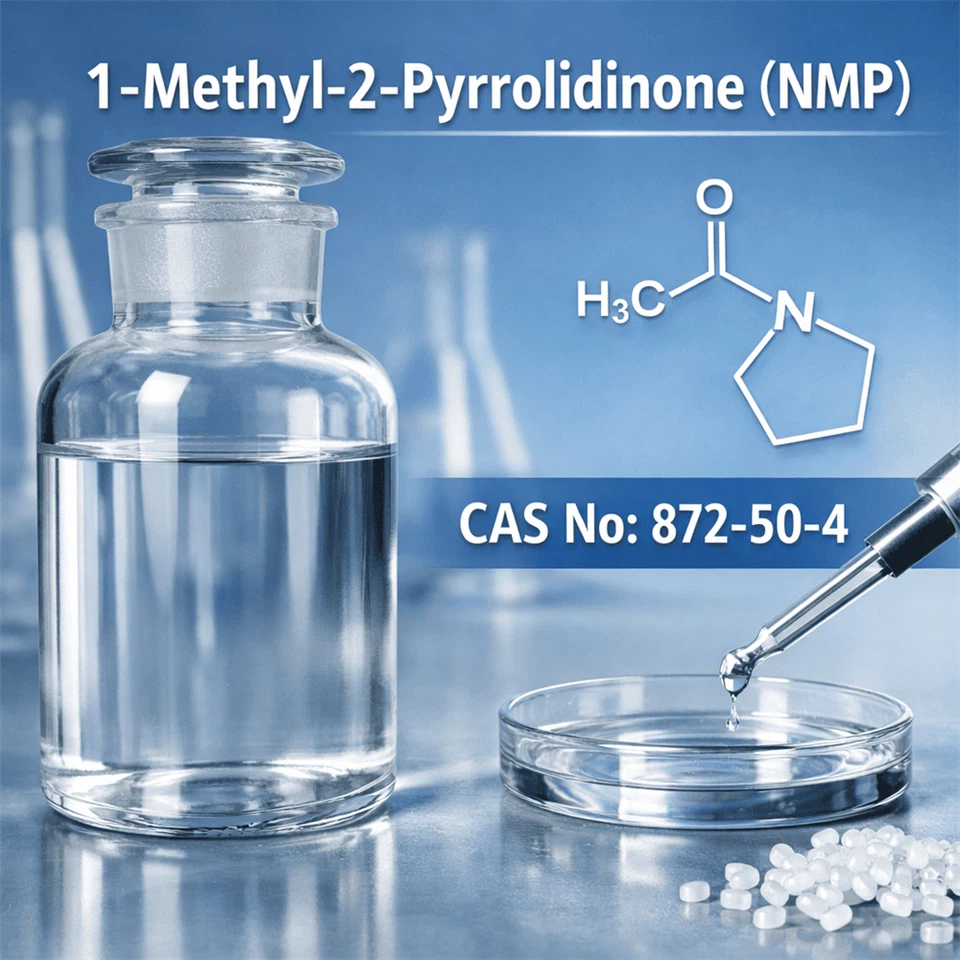
NMP - the full form is N-Methyl-2-pyrrolidinone (also written as N-methyl-2-pyrrolidone or 1-methyl-2-pyrrolidinone; CAS 872-50-4) - is a colorless, high-boiling polar aprotic solvent with the molecular formula C₅H₉NO. Its structure is a five-membered lactam ring: a pyrrolidinone ring with a methyl substituent on nitrogen. This cyclic amide structure gives NMP its exceptional stability, high polarity (dielectric constant ε ≈ 32.2), and broad solvency - it dissolves most organic polymers, resins, and inorganic salts that resist conventional solvents.
NMP is the dominant solvent in lithium-ion battery cathode slurry manufacturing, dissolving PVDF binder at industrial scale, and is the global standard for aramid fiber spinning, polyimide film synthesis, and semiconductor photoresist stripping. Its combination of high solvating power, low vapor pressure (enabling 100% solvent recovery), complete water miscibility, and biodegradability makes it technically irreplaceable in many high-value applications - though regulatory pressure (REACH, EPA) is driving active development of NMP replacement solvents for applications where substitution is feasible.
We partner with leading Chinese NMP manufacturers operating continuous production lines from maleic anhydride and methylamine feedstocks, with dedicated ultra-purification lines for electronic/battery-grade product achieving single metal ion levels ≤1 ppb.
Physical & Chemical Properties of NMP (1-Methyl-2-pyrrolidinone)
| Solvent | BP | ε | MW | PVDF Solubility | REACH Status |
|---|---|---|---|---|---|
| NMP (this product) | 202°C | 32.2 | 99 | Excellent ✓ | SVHC (Repr. 1B) |
| DMF (dimethylformamide) | 153°C | 36.7 | 73 | Good | SVHC (Repr. 1B) |
| DMAc (dimethylacetamide) | 166°C | 37.8 | 87 | Good | SVHC (Repr. 1B) |
| DMSO | 189°C | 46.7 | 78 | Poor | No restriction |
| γ-Butyrolactone (GBL) | 204°C | 39.1 | 86 | Moderate | Controlled substance |
NMP Specifications - Industrial / Electronic / Battery Grade
| Specification Item | Industrial Grade Petrochemical / Coatings / General |
Electronic Grade Semiconductor / Display |
Battery Grade Li-ion Cathode Slurry |
|---|---|---|---|
| Purity (GC) | ≥ 99.0% | ≥ 99.9% | ≥ 99.9% |
| Water Content | ≤ 0.1% (1000 ppm) | ≤ 0.05% (500 ppm) | ≤ 50 ppm |
| Color (APHA/Pt-Co) | ≤ 50 | ≤ 10 | ≤ 10 |
| Metal Impurities | Not specified | Single ion ≤ 1 ppb | Single ion ≤ 1 ppb |
| Specific Gravity (20°C) | 1.027–1.030 | 1.028 ± 0.002 | 1.028 ± 0.002 |
| Boiling Point | 202°C (industrial) / 202 ± 1°C (E/B grade) | ||
| Storage Stability | 12 months (sealed) | 18 months (N₂-sealed) | 18 months (N₂-sealed) |
| Packaging | 200 kg drum / 1000 kg IBC | 200 kg N₂-sealed HDPE drum | 200 kg N₂-sealed HDPE drum 10 t tank truck |
NMP Solvent Uses & Applications
1. Lithium-Ion Battery - Cathode Slurry Solvent (Largest Global Use)
NMP is the globally dominant solvent for lithium-ion battery cathode slurry formulation - accounting for approximately 40–45% of total global NMP demand and growing rapidly with EV adoption. Its critical role: dissolving PVDF (polyvinylidene fluoride) binder completely and uniformly dispersing cathode active materials (LFP, NMC, NCA, LCO) and conductive carbon (carbon black, carbon nanotubes) into a homogeneous coating slurry applied to aluminum current collector foil.
NMP's extremely low vapor pressure enables controlled evaporation during electrode drying and, crucially, 100% NMP recovery by condensation from the dryer exhaust - standard in all high-volume battery plants. Recovered NMP is purified and reused, making the solvent cost effectively a capital cost rather than a variable cost at scale. Battery-grade NMP with ≤50 ppm water and single metal ions ≤1 ppb is essential: trace water reacts with PVDF and active materials, reducing slurry stability and electrode performance; trace metals (Fe, Ni, Cr) contaminate the electrolyte and accelerate cell degradation.
2. Advanced Materials - Aramid Fibers, Polyimide & Engineering Polymers
Aramid fiber (Kevlar®, Nomex®) spinning: NMP is the spinning dope solvent for para- and meta-aramid fibers. Poly(p-phenylene terephthalamide) (PPTA) is dissolved in NMP/CaCl₂ system at 5–15% concentration to form anisotropic liquid crystal solutions that are dry-jet wet spun to produce high-tenacity aramid yarns for body armor, aerospace composite reinforcement, and tire cord.
Polyimide (PI) film synthesis: Poly(amic acid) precursors - intermediates for PI films (Kapton®-type) used in flexible PCBs, OLED display substrates, and aerospace thermal insulation - are synthesized and cast from NMP solutions. NMP's ability to dissolve both the dianhydride and diamine monomers and maintain the polymerization at controlled viscosity makes it the standard medium for PI synthesis.
NMP is also used for processing PEEK (polyetheretherketone) and PPS (polyphenylene sulfide) - ultra-high-performance engineering polymers for semiconductor equipment, medical implants, and aerospace structural parts - where NMP is one of the few solvents that can dissolve these intractable polymers.
3. Electronics & Semiconductor - Photoresist Stripper & Precision Cleaning
Electronic-grade NMP (single metal ions ≤1 ppb) is the industry standard for photoresist stripping in semiconductor wafer fabrication: it dissolves and lifts cross-linked photoresist films from silicon wafer surfaces without attacking underlying metal interconnects, dielectric layers, or silicon oxide - where alternatives like acetone or IPA cannot match its solvency or selectivity.
In LCD and OLED display manufacturing, NMP is used to clean glass substrates and strip alignment layers between production steps. Its GC solvent compatibility (NMP as GC solvent - used as the solvent for GC injection in residual solvent analysis per ICH Q3C, though with attention to column compatibility) also makes it useful in analytical method development for pharmaceutical residual solvent testing.
4. Petrochemical & Pharmaceutical - Extraction & Reaction Solvent
In petrochemical refining, NMP is used for aromatic extraction from lubricating oil base stocks (NMP extraction replacing older furfural/phenol processes), selective extraction of 1,3-butadiene from C4 cracking streams, and separation of acetylene from ethylene in steam cracker effluents. Its high selectivity, thermal stability, and recoverability make it economically superior to older solvent systems.
In pharmaceutical synthesis, NMP is used as a reaction medium and extraction solvent for APIs where its high boiling point enables reactions at temperatures impossible with lower-boiling solvents. ICH Q3C classifies NMP as a Class 2 solvent with a permitted daily exposure (PDE) of 5.3 mg/day - residual NMP in drug products must be controlled and tested.
5. NMP Paint Remover & Paint Stripper Applications
NMP is a highly effective paint remover and paint stripper component, used in NMP-based paint stripping pastes and gel formulations for removing epoxy coatings, polyurethane finishes, and powder coatings from metal substrates. NMP-based strippers penetrate deeply into cured coating films, swell and dissolve the polymer binder network, and release the coating intact as a peelable film - making it superior to methylene chloride-based strippers (which are being phased out under EPA restrictions) in terms of safety profile, though NMP itself is under regulatory scrutiny.
Regulatory note on NMP paint remover use: The EU Regulation (EU) 2017/1510 restricts NMP in paint strippers sold to the general public (concentration limit: 0.3%) but permits professional/industrial use. The U.S. EPA under TSCA has also issued risk management rules for NMP in paint and coating removal applications. Buyers should ensure end-use compliance with applicable local regulations.
REACH, EPA & Regulatory Status of NMP - What Buyers Need to Know
Storage, Stability & Safety Handling
Storage Requirements
Store in a cool (5–30°C), dry, well-ventilated area away from direct sunlight and heat. Industrial grade: sealed metal or HDPE drums. Electronic/Battery grade: nitrogen-sealed HDPE drums - NMP absorbs moisture and CO₂ from air, increasing water content and forming trace impurities that affect battery performance. Keep away from strong acids, oxidizers, and food/pharmaceutical materials. Max stack: 3 layers for 200 kg drums. Tank truck storage requires N₂ blanketing and temperature monitoring.
Stability
Stable under normal storage conditions. Shelf life: 12 months (industrial, sealed); 18 months (electronic/battery, N₂-sealed). Can be dried over molecular sieves (3Å or 4Å) to achieve <30 ppm water for ultra-critical battery applications. NMP is fully miscible with water - large spills can be diluted and routed to wastewater treatment (biological treatment degrades NMP effectively).
Safety Handling (SDS Summary)
GHS classification: Reproductive Toxin Category 1B (Repr. 1B), Skin Irritation Category 2, Eye Irritation Category 2. Combustible liquid (flash point 99°C). Harmful by skin absorption - this is the primary occupational exposure concern.
PPE required: Chemical-resistant gloves (nitrile ≥0.38mm or butyl rubber), safety goggles, protective clothing, organic vapor respirator. Pregnant women and women of childbearing potential must not work with NMP unless fully enclosed systems prevent all dermal/inhalation exposure.
Occupational exposure limits: EU IOELV 10 mg/m³ (1 ppm) TWA (skin). US ACGIH TLV 10 ppm. Engineering controls (local exhaust ventilation, closed-loop systems) are required to maintain below OEL.
Spill: Absorb with sand/activated carbon. Dilute with water and collect for waste treatment. Do not discharge to drains untreated. Full SDS/MSDS: sales@sinolookchem.com.
NMP Price - N-Methyl-2-pyrrolidinone Price 2025
The NMP price (n-methyl-2-pyrrolidone price / n-methylpyrrolidone price) is driven by maleic anhydride and methylamine feedstock costs, plus energy. Battery-grade NMP has seen rapid price evolution with Li-ion battery capacity expansion. Reference prices China-origin ex-works (2025):
200 kg drum / IBC
Metal ≤1 ppb
Water ≤50 ppm, Metal ≤1 ppb
Frequently Asked Questions about NMP Solvent
Q: What is NMP solvent? What is the full form of NMP?
The full form of NMP is N-Methyl-2-pyrrolidinone (also N-Methyl-2-pyrrolidone; CAS 872-50-4). NMP is a colorless, high-boiling (bp 202°C) polar aprotic solvent with excellent chemical and thermal stability. It is widely recognized by several synonyms: 1-methyl-2-pyrrolidinone, 1-methyl-2-pyrrolidone, N-methyl pyrrolidone, methylpyrrolidone, or simply NMP. The abbreviation "N-NMP" occasionally appears in literature where the N- prefix is added for disambiguation. It is one of the world's most important industrial solvents, with dominant use in lithium-ion battery manufacturing.
Q: What is the boiling point of 1-methyl-2-pyrrolidone (NMP)? What does a high bp mean for solvent use?
The boiling point of 1-methyl-2-pyrrolidone (NMP) is 202°C (1013 hPa) for industrial grade, or 202 ± 1°C for electronic/battery grades. The NMP solvent boiling point is one of its most commercially significant properties: combined with a vapor pressure of just 0.04 hPa at 20°C, it means NMP barely evaporates at ambient temperature (no VOC odor issues in normal handling), enables high-temperature reactions and coating processes that would flash-off lower-boiling solvents, and permits complete thermal recovery (condensation) from dryer exhaust in battery electrode manufacturing - recovering 99%+ of the solvent and dramatically reducing operating cost.
Q: Is NMP a polar aprotic solvent? How does its polarity compare to DMF and DMSO?
Yes - NMP is a polar aprotic solvent. It has a high dielectric constant (ε = 32.2) and a large dipole moment (~4.1 D), making it highly polar. As an aprotic solvent, it has no O–H or N–H groups that can donate hydrogen bonds to solutes - this combination of high polarity and lack of H-bond donation is what makes it such an excellent solvent for ionic compounds, polymers, and reactions involving charged intermediates. Compared to DMF (ε = 36.7) and DMSO (ε = 46.7), NMP has slightly lower dielectric constant but significantly higher boiling point (202°C vs 153°C for DMF and 189°C for DMSO), making it superior where thermal stability and recoverability matter.
Q: What is deuterated NMP and when is it used?
Deuterated NMP (d₉-NMP or NMP-d₉; CAS 67-68-9 for the fully deuterated form) is NMP where all nine hydrogens are replaced by deuterium. It is used as an NMR solvent for compounds that are insoluble in conventional deuterated solvents (CDCl₃, DMSO-d₆) but dissolve readily in NMP - particularly for high-performance polymers (aramid, polyimide, PEEK), inorganic materials, and specialty pharmaceuticals. Its NMR spectrum (with residual deuterated solvent peak at δ 2.94 ppm for the N-CD₃ group) must be accounted for in NMR assignments. Deuterated NMP is a specialty research chemical available from Sigma-Aldrich/Merck and other NMR solvent suppliers.
Q: What are the best NMP solvent replacements / NMP alternatives?
Driven by REACH and EPA regulatory pressure, there is significant industry interest in NMP solvent replacement. Viable alternatives depend heavily on the application. For polymer synthesis / coatings: Cyrene™ (dihydrolevoglucosenone, bio-based), dimethyl isosorbide (DMI), Rhodiasolv® PolarClean (methyl-5-(dimethylamino)-2-methyl-5-oxopentanoate). For pharmaceutical reactions: 2-MeTHF, cyclopentyl methyl ether (CPME), γ-valerolactone. For lithium-ion batteries: water-based binder systems (CMC/SBR) replacing PVDF+NMP are being adopted for LFP anodes and some cathodes, but NMP remains irreplaceable for high-energy-density NMC/NCA cathodes at commercial scale. We can supply both NMP and approved alternatives - contact us for a technical consultation.
Q: What is the NMP solvent CAS number? How does it differ from 1-methyl-2-pyrrolidinone vs 1-methyl-2-pyrrolidone?
The NMP solvent CAS number is 872-50-4. The names "1-methyl-2-pyrrolidinone" and "1-methyl-2-pyrrolidone" refer to the same compound - the suffix "-inone" is a more systematic IUPAC designation for the lactam (N-containing cyclic amide), while "-one" is the traditional and more commonly used industry form. Both map to the same CAS 872-50-4 and are identical in chemical structure and physical properties. When specifying NMP in purchase orders, COAs, or import/export documents, use CAS 872-50-4 to avoid any ambiguity between synonyms.
Industry References & Regulatory Standards
Physicochemical data, ¹H NMR spectra, toxicology, GHS classifications, and regulatory summaries for NMP.
EU REACH authorisation list (Annex XIV) entry, hazard assessment, SVHC classification details, and current EU restrictions for NMP.
EPA TSCA risk evaluation conclusions and risk management rules for NMP - required reading for US importers and industrial users.
Reference specifications for industrial, anhydrous, and deuterated NMP grades; NMR solvent data for d₉-NMP.
ICH Q3C classification of NMP as a Class 2 residual solvent in pharmaceuticals; PDE 5.3 mg/day; analytical testing requirements.
Get a Quote · Samples · REACH / EPA Compliance Support
Request NMP Price & Supply - Industrial / Electronic / Battery Grade
We supply N-Methyl-2-pyrrolidinone (NMP, CAS 872-50-4) in all grades - Industrial ≥99.0%, Electronic Grade ≥99.9%, and Battery Grade ≥99.9% with water ≤50 ppm and single metal ions ≤1 ppb. Full REACH/EPA compliance documentation, COA, SDS/MSDS provided. Contact us for a current NMP price quote or technical consultation.
Related products: DMF (Dimethylformamide) · DMAc (Dimethylacetamide) · DMSO · γ-Butyrolactone (GBL) · NMP Recovery Equipment · Maleic Anhydride (NMP feedstock)
Hot Tags: 1-methyl-2-pyrrolidinone, China 1-methyl-2-pyrrolidinone manufacturers, suppliers, 1 ethyl 2 pyrrolidinone, 1 methyl 2 pyrrolidinone anhydrous, buy dimethyl sulfoxide, dmso dimethyl sulfoxide, maleic, poly styrene maleic anhydride