

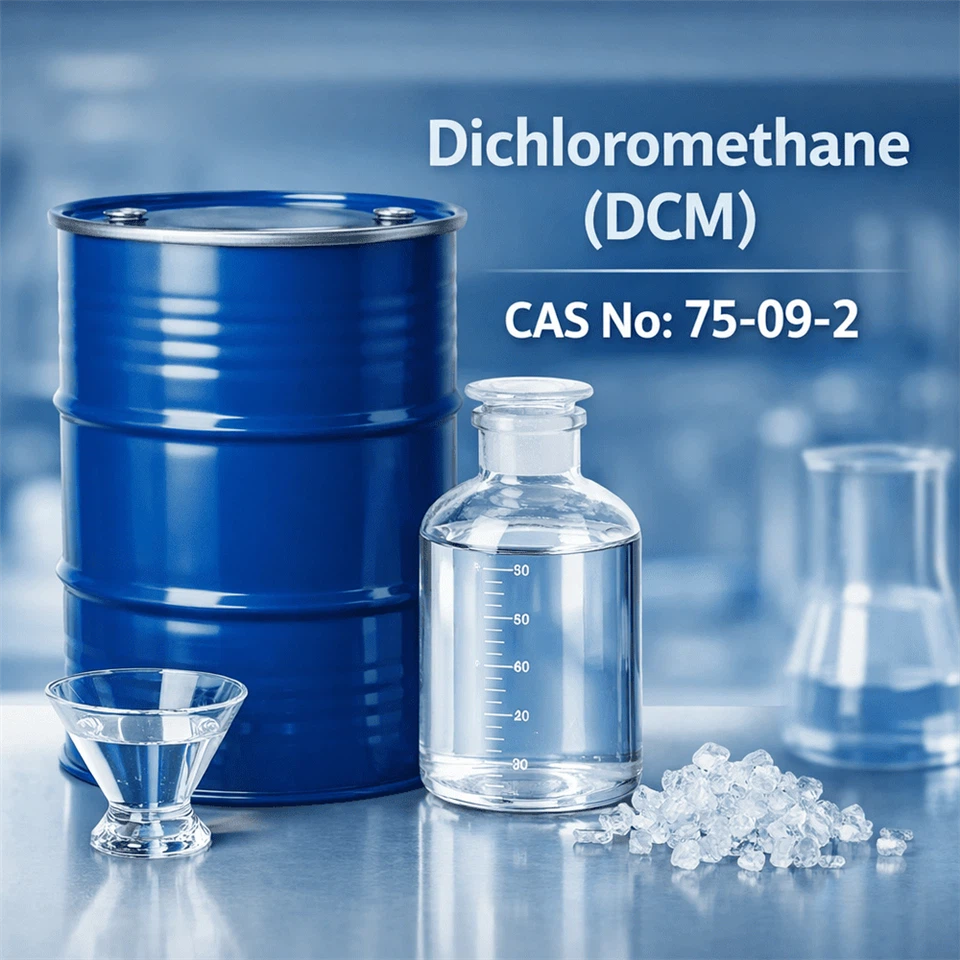
Dichloromethane (DCM / Methylene Chloride / CH₂Cl₂)
Non-Flammable Halogenated Solvent · Purity ≥99.9% · DCM Supplier from China · Pharmaceutical & Industrial Grade · Global Shipping
⛔ Critical Regulatory Notice - US HAP-Listed · EU OEL Severely Restricted · Paint Stripper Ban · Carc. 2 (H351) · CO-Generating Metabolite
1. US EPA Hazardous Air Pollutant (HAP): DCM is listed as a HAP under Section 112(b) of the US Clean Air Act. US manufacturers are subject to MACT/NESHAP emission reporting and control requirements.
2. EU OEL - Severely Tightened: EU Directive 2019/983/EU set a TWA OEL of 100 ppm / 353 mg/m³ and STEL of 200 ppm / 706 mg/m³. Germany and other member states apply stricter national OELs (e.g., Germany: ~28 ppm TWA). Practical EU industrial use requires significant engineering controls.
3. EU & US Paint Stripper Restriction: EU REACH Annex XVII Entry 71 restricts DCM in paint strippers for general public and professional users. The US EPA TSCA Section 6 rule (2019) prohibits DCM in consumer paint removal products and requires strict controls for most industrial uses. See: EPA TSCA Section 6 DCM Rule →
4. Carc. 2 (H351) & CO Metabolite: DCM is classified as a suspected carcinogen under EU CLP. It metabolises in vivo to carbon monoxide (CO) via the hepatic CYP2E1 pathway - posing specific cardiac risk for individuals with coronary artery disease. Workers with cardiovascular conditions must be excluded from DCM exposure areas.
ℹ Non-Flammable - But High-Vapour-Pressure Hazards Require Engineering Controls
DCM has no flash point and is classified as non-flammable - a genuine safety advantage over flammable solvents. However, its extremely high vapour pressure (~47 kPa at 20°C; boiling point 39.8°C) means vapour concentrations in enclosed spaces can reach acutely dangerous levels within minutes of a spill. The CO metabolite pathway means confined-space exposure raises carboxyhaemoglobin (COHb) rapidly. Forced ventilation, continuous air monitoring, and supplied-air respiratory protection are required for any DCM use in confined or enclosed spaces.
What Is Dichloromethane (DCM / Methylene Chloride)?
Dichloromethane (DCM, CAS 75-09-2), commonly known as methylene chloride, is a low-boiling chlorinated solvent with molecular formula CH₂Cl₂ and molecular weight 84.93 g/mol - the simplest dichloroalkane and one of the most widely used halogenated solvents in industrial chemistry. Produced by chlorination of methane or methyl chloride followed by distillation, DCM has been indispensable in pharmaceutical extraction, polycarbonate processing, precision cleaning, and laboratory-scale synthesis for more than 60 years. Complete physicochemical data is available from NCBI PubChem (CID 6344) and the ECHA substance information page.
DCM's defining physical profile - boiling point 39.8°C (the lowest of any common industrial solvent), density 1.322–1.328 g/cm³ (denser than water, enabling bottom-layer separation in aqueous extraction), vapour pressure ~47 kPa at 20°C, and broad solvency for organic polymers and natural products - gives it a unique technical identity. In liquid-liquid extraction, the DCM-organic layer settles below the aqueous phase (opposite to most organic solvents), providing unambiguous phase separation in pharmaceutical and natural product isolation workflows.
DCM is classified as an ICH Q3C Class 2 residual solvent (Permitted Daily Exposure 6.0 mg/day; concentration limit 600 ppm in drug product) - confirming its accepted role in pharmaceutical API synthesis under validated solvent removal controls.
The most toxicologically distinctive property of DCM is its in vivo metabolism to carbon monoxide (CO) via the hepatic CYP2E1 pathway. At occupational exposure concentrations, metabolic CO generation raises blood carboxyhaemoglobin (COHb) levels sufficiently to cause measurable cardiac stress - substantially elevated for individuals with pre-existing coronary artery disease. This CO-generation mechanism is the basis for NIOSH's recommendation that workers with cardiovascular disease be excluded from DCM exposure, and underpins requirements for COHb biological monitoring. See: NIOSH Pocket Guide for DCM.
Product Specifications
Sinolook's DCM specification includes the ≤0.01% water content limit - stricter than the ≤0.05% applied to most solvents - reflecting DCM's azeotropic complication with water and the sensitivity of pharmaceutical and polycarbonate applications to moisture. Reference data from PubChem CID 6344 and EPA CompTox Dashboard.
| Parameter | Specification / Value |
|---|---|
| Product Name | Dichloromethane (DCM / Methylene Chloride / Methylene Dichloride / CH₂Cl₂) |
| CAS Number | 75-09-2 |
| EC Number | 200-838-9 |
| Molecular Formula | CH₂Cl₂ |
| Molecular Weight | 84.93 g/mol |
| Appearance | Colorless Transparent Liquid with characteristic mild sweet odour |
| Purity | ≥99.9% |
| Water Content | ≤0.01% (Karl Fischer - tighter than most solvents; DCM forms azeotrope with water) |
| Acidity (as HCl) | ≤0.0005% - monitors HCl from thermal/oxidative degradation |
| Color (Pt-Co) | ≤10 |
| Density (d20) | 1.322–1.328 g/cm³ (denser than water - organic layer settles below aqueous) |
| Boiling Point | 39.8°C (760 mmHg) - extremely volatile; lowest bp of common industrial solvents |
| Flash Point | None - Non-Flammable Liquid (GHS not classified as flammable) |
| Vapour Pressure | ~47 kPa at 20°C - extremely high; rapid evaporation; hazard in enclosed spaces |
| Refractive Index | 1.421–1.425 (n20/D) |
| Viscosity (20°C) | ~0.413 mPa·s (very low viscosity) |
| Water Solubility | ~13 g/L at 20°C (partially soluble; forms azeotrope at ~1.5% water / 38.1°C) |
| EU CLP Classification | ⚠ Carc. 2 (H351); Skin Irrit. 2; STOT SE 3 |
| EU OEL (TWA / STEL) | 353 mg/m³ (100 ppm) TWA / 706 mg/m³ (200 ppm) STEL - Dir. 2019/983/EU; stricter national OELs apply |
| US HAP Status | ⚠ HAP-listed - Section 112(b) Clean Air Act |
| US TSCA Section 6 | ⚠ Paint stripper use prohibited (consumer); industrial use requires Worker Protection Program |
| ICH Q3C Status | Class 2 - PDE 6.0 mg/day; concentration limit 600 ppm in drug product |
| REACH Annex XIV | ✓ Not listed (Annex XVII Entry 71 paint stripper restriction applies) |
| Packing | 250 KG / Iron Drum; IBC Tank (1,000 KG) |
| Storage | 0–25°C; sealed metal or HDPE drums; dark, force-ventilated at floor level; 12-month shelf life |
Applications of Dichloromethane (DCM / Methylene Chloride)
DCM's application profile is driven by properties unique among common industrial solvents: non-flammability, extremely low boiling point (complete solvent removal at gentle temperatures), high density (bottom-layer aqueous separation), and very broad solvency. These properties are used in applications where no technically equivalent substitute exists at competitive cost.
API Extraction & Purification
Primary extraction solvent for pharmaceutical APIs, herbal extracts, and natural product isolation. Bottom-layer density ensures unambiguous aqueous-organic phase separation. ICH Q3C Class 2 (600 ppm limit). Very low bp enables solvent removal at 25–35°C protecting thermally sensitive intermediates.
PC Dissolution & Optical Film Casting
Standard solvent for polycarbonate (PC) solution casting of optical films for LCD display polariser components, security laminates, and specialty optical elements. PC dissolves at up to ~20–25% w/v; complete solvent removal at <40°C without thermal degradation of the PC film.
Vapour Degreasing & Metal Cleaning
Non-flammable precision cleaning of aircraft parts, medical devices, electronics, and hydraulic components where fire/explosion risk of flammable solvents is unacceptable. Dense vapour (~2.9× air) aids containment in properly engineered degreaser systems. Note: EU OEL and US TSCA WPP requirements apply.
Industrial Coating Removal (Controlled Use)
Highly effective paint stripping solvent for industrial equipment and aerospace component strip/recoat operations under engineering-controlled conditions. Regulatory restrictions apply - EU REACH Annex XVII Entry 71 and US TSCA Section 6 restrict use. Verify current permitted uses before procurement.
PU Foam Physical Blowing Agent
Physical blowing agent in flexible and rigid PU foam production. Low bp (39.8°C) vaporises during the exothermic PU reaction, producing fine-cell foam. Used for furniture/automotive seating (flexible, 18–45 kg/m³) and rigid insulation for refrigerators, cold storage panels, and building insulation.
Reaction Solvent
Low-boiling inert reaction solvent in Friedel-Crafts acylation (with AlCl₃), NaBH₄ reductions, low-temperature Grignard reactions, and organocatalytic reactions requiring a polar, non-nucleophilic, easily removed aprotic solvent. Also used as aerosol propellant solvent in specialty coatings.
Multi-Jurisdiction Regulatory Status
DCM operates under one of the most complex multi-jurisdictional regulatory frameworks of any common industrial solvent. Buyers must verify current status in their specific jurisdiction and application before use.
| Jurisdiction | Regulatory Status | Key Restriction / Requirement |
|---|---|---|
| EU - CLP | Carc. 2 (H351); Skin Irrit. 2; STOT SE 3 | Hazard labelling; workplace risk assessment mandatory |
| EU - REACH Annex XVII | ⚠ Entry 71 - paint stripper restriction | DCM paint strippers banned for general/professional use above thresholds |
| EU - OEL Directive | Dir. 2019/983/EU: 100 ppm TWA / 200 ppm STEL | Engineering controls + health surveillance; stricter national OELs (Germany: ~28 ppm) |
| US - HAP | ⚠ HAP-listed (Clean Air Act §112(b)) | MACT/NESHAP emission controls for facilities above threshold use |
| US - TSCA §6 | ⚠ Consumer use: PROHIBITED (2019) | Industrial use: strict Worker Protection Program (WPP) with air monitoring & COHb surveillance |
| US - OSHA PEL / NIOSH REL | OSHA: 500 ppm TWA / 2300 ppm STEL | NIOSH REL: 25 ppm TWA / 125 ppm STEL (much stricter); COHb biological monitoring recommended |
| US - IARC | Group 2A - probably carcinogenic to humans | Informs risk assessment; no formal occupational carcinogen designation |
| China | GB 30981 / Occupational exposure standard | 30 mg/m³ TWA (~8.6 ppm) - stricter than EU/US OEL |
| Global - Montreal Protocol | ✓ Not listed (not an ODS) | No phase-out obligations; distinct from CFCs/HCFCs |
Pharmaceutical API Extraction - Primary Global Use
The single largest industrial application of DCM globally is in pharmaceutical manufacturing as an extraction, washing, and crystallisation solvent in multi-step API synthesis. DCM's combination of high solvency for lipophilic organic intermediates, complete immiscibility with aqueous phases, very low boiling point (enabling solvent removal at 25–35°C under mild vacuum - critical for thermally sensitive pharmaceutical intermediates), and non-reactivity with most functional groups in pharmaceutical chemistry makes it effectively irreplaceable in several key step types.
DCM's density ensures the organic layer settles below the aqueous phase in separating funnels - providing unambiguous phase identification and preventing layer confusion errors. DCM is classified as an ICH Q3C Class 2 residual solvent (PDE 6.0 mg/day; 600 ppm concentration limit in drug product), confirming its accepted role in pharmaceutical synthesis under validated solvent removal controls. Sinolook's purity ≥99.9% DCM with HCl ≤0.0005% supports GMP process control requirements.
Polycarbonate Dissolution & Optical Film Casting
Polycarbonate dissolves readily in DCM at concentrations up to ~20–25% w/v at room temperature, producing optically clear casting solutions with excellent film-forming characteristics. DCM is the standard solvent for PC solution casting of optical films for LCD display polariser components, security laminate substrates, and specialty optical elements. Complete solvent removal is achievable at <40°C in casting ovens without thermally degrading the PC film. In PC solvent bonding, DCM temporarily dissolves the PC surface at the bond line, creating an interpenetrating polymer network upon evaporation - used in medical device manufacturing, electronics assembly, and optical instrument construction.
Storage, Handling & Safety
DCM demands more rigorous engineering controls than most common solvents - primarily because of its extreme volatility, CNS depressant potency, and CO-generating metabolic pathway. The absence of flammability removes one hazard but does not diminish inhalation and CO toxicity risks, which are the dominant occupational safety concerns. Full OEL guidance: NIOSH Pocket Guide for DCM and EU Directive 2019/983/EU.
📦 Storage Guidelines
• Store at 0–25°C in tightly sealed metal drums or HDPE - boiling point is only 39.8°C
• Dark storage essential: UV/visible light generates reactive radical species and HCl by photodecomposition
• Forced exhaust ventilation at floor level - DCM vapour is 2.9× heavier than air and accumulates at floor level
• Segregate from strong alkalis (NaOH, KOH - hydrolyse DCM to formaldehyde), strong oxidisers, and reactive metals (aluminium powder)
• Shelf life: 12 months sealed; retest HCl acidity and water if stored >6 months
🧤 Engineering Controls & PPE
• Continuous LEV mandatory at all dispensing points - target <25 ppm airborne (NIOSH REL 25 ppm TWA)
• Continuous fixed air monitors or personal dosimetry; COHb biological monitoring for high-exposure workers
• Supplied-air respirator for confined space entry or concentrations >50 ppm
• Gloves: nitrile ≥0.15 mm for brief contact; butyl rubber for prolonged contact - DCM penetrates most glove materials
• Exclude workers with cardiovascular disease, anaemia, or pregnancy from DCM exposure areas - CO metabolite cardiac risk
Frequently Asked Questions (FAQ)
Why is DCM described as non-flammable but still listed as hazardous?
DCM has no measurable flash point under standard closed-cup test conditions - meaning it does not produce ignitable vapour-air mixtures at its liquid surface temperature. This is a genuine and important safety advantage over flammable solvents like acetone or MEK. However, non-flammability does not mean non-hazardous: DCM's primary hazards are its CNS depressant potency (causing anaesthesia at high vapour concentrations), its Carc. 2 classification, and its unique CO-generating metabolism (cardiac risk at occupational exposure concentrations). Its extremely high vapour pressure means a 5-litre DCM spill in a 20 m³ enclosed room can reach anaesthetic concentrations within minutes - a hazard qualitatively different from, not lesser than, flammable solvents.
Does DCM metabolise to carbon monoxide - and what does this mean practically?
Yes. DCM is metabolised by two parallel pathways: a glutathione S-transferase pathway (producing CO₂ and formaldehyde) and a cytochrome P450 2E1 pathway (producing CO directly). At occupational exposure concentrations of 100–500 ppm, the CYP2E1 pathway generates sufficient CO to raise blood carboxyhaemoglobin (COHb) from the normal ~1–2% to 5–15% COHb - levels that reduce blood oxygen-carrying capacity and impair cardiac function in susceptible individuals. For workers with coronary artery disease, cardiomyopathy, or significant anaemia, even moderate DCM exposure can precipitate angina, arrhythmia, or myocardial infarction. This is the scientific basis for the NIOSH recommendation that workers with cardiovascular conditions be excluded from DCM exposure, and why pre-employment and periodic medical surveillance should include cardiovascular assessment and COHb measurement.
Can DCM still be used for pharmaceutical extraction in the EU?
Yes. DCM remains permitted for pharmaceutical extraction and purification in the EU - neither REACH Annex XVII Entry 71 (specific to paint/coating removal products) nor any current REACH Annex XIV listing restricts DCM in pharmaceutical manufacturing. EU pharmaceutical manufacturers using DCM are subject to the EU OEL under Directive 2019/983/EU (100 ppm TWA / 200 ppm STEL, with stricter national OELs in some member states), requiring engineering controls for large-scale extraction operations. In GMP-regulated manufacturing, DCM residuals in drug substances must meet ICH Q3C Class 2 limits (600 ppm / PDE 6.0 mg/day) - achievable with validated solvent removal steps. DCM continues to be the solvent of choice for many extraction and workup steps that have no direct technically equivalent alternative.
What is the DCM-water azeotrope and why does it affect specifications?
DCM and water form a heterogeneous minimum-boiling azeotrope at approximately 1.5% water content, boiling at 38.1°C - slightly below pure DCM's 39.8°C. This means fractional distillation of water-contaminated DCM cannot produce water-free product beyond the azeotropic composition without additional drying steps (molecular sieves, anhydrous CaCl₂, or P₂O₅ treatment). This explains Sinolook's tighter water specification of ≤0.01% (vs ≤0.05% for most solvents). In pharmaceutical extraction, even 0.1% water in DCM reduces the partition coefficient of hydrophilic APIs into the organic phase; in polycarbonate dissolution, water above ~50 ppm causes visible turbidity in PC casting solutions.
Authoritative Technical & Regulatory References
The following references are essential for buyers verifying DCM's multi-jurisdictional regulatory status, occupational safety requirements, and application-specific compliance frameworks.
| Reference Source | Description | Link |
|---|---|---|
| ECHA - DCM Substance Information | CLP Carc. 2 classification, REACH Annex XVII Entry 71 (paint stripper restriction), and current hazard assessment for CAS 75-09-2. | View → |
| PubChem - CID 6344 | NCBI PubChem record for DCM with complete physicochemical data, GHS classification, and CO metabolite biological activity data. | View → |
| EPA CompTox - Methylene Chloride | US EPA CompTox for CAS 75-09-2: HAP listing confirmation, TSCA inventory, TSCA Section 6 rule status, and physicochemical data. | View → |
| US EPA TSCA Section 6 - DCM Rule | TSCA Section 6 final rule on methylene chloride - prohibition for consumer use and Worker Protection Program requirements for permitted industrial uses (2019). | View → |
| NIOSH Pocket Guide - DCM | NIOSH REL (25 ppm TWA / 125 ppm STEL), IDLH 2300 ppm, carcinogen designation, CO metabolite hazard, and engineering control guidance. | View → |
| EU Directive 2019/983/EU - OEL | EU binding occupational exposure limits for DCM (100 ppm TWA / 200 ppm STEL) and transition timelines for member state implementation. | View → |
Note: External links are for reference only. DCM's regulatory status is subject to continuing change - always verify current restrictions via ECHA, EPA, and applicable national authorities before use. Sinolook provides current regulatory documentation with every shipment and notifies customers proactively of material regulatory changes affecting DCM supply.
Buy Dichloromethane from China - B2B Procurement Guide
As a direct DCM manufacturer in China with integrated chloromethane production, Sinolook provides volume-tiered competitive dichloromethane price with reliable supply continuity. Full DG documentation: UN1593, Class 6.1 (toxic), PG III; non-flammable classification confirmed. Regular export sailings from Shanghai, Tianjin, Qingdao, Guangzhou, and Ningbo.
MOQ
1 MT · Volume tiers: 1 MT → 5 MT → 20 MT → 100 MT → ISO/flexi-tank bulk
Samples
0.5–5 KG qualification samples at nominal charge, credited against first commercial order
Lead Time
7–14 business days standard; expedited available
Packaging
250 KG iron drums / IBC tanks (1,000 KG)
Contact Sinolook - Your Trusted DCM / Dichloromethane Supplier
Whether you are a pharmaceutical manufacturer requiring ICH Q3C-compliant dichloromethane for API extraction and purification, a polycarbonate optical film producer requiring high-purity DCM for defect-free PC solution casting, a precision engineering company using non-flammable methylene chloride for metal degreasing under controlled conditions, a polyurethane foam producer using DCM as a physical blowing agent, or a chemical synthesis laboratory requiring a low-boiling, easily removed aprotic reaction solvent - Sinolook Chemical provides purity ≥99.9% with comprehensive multi-jurisdiction regulatory documentation (US HAP declaration, TSCA confirmation, EU CLP SDS, OEL summary, ICH Q3C letter). Our team responds within 24 hours.
📱 Phone / WeChat
0086 134-0071-5622🌐 Website
www.sinolookchem.comSinolook Chemical Co., Ltd. - Global Supplier of Halogenated Solvents, Specialty Solvents & Industrial Chemicals
Hot Tags: dichloromethane (dcm), China dichloromethane (dcm) manufacturers, suppliers


