

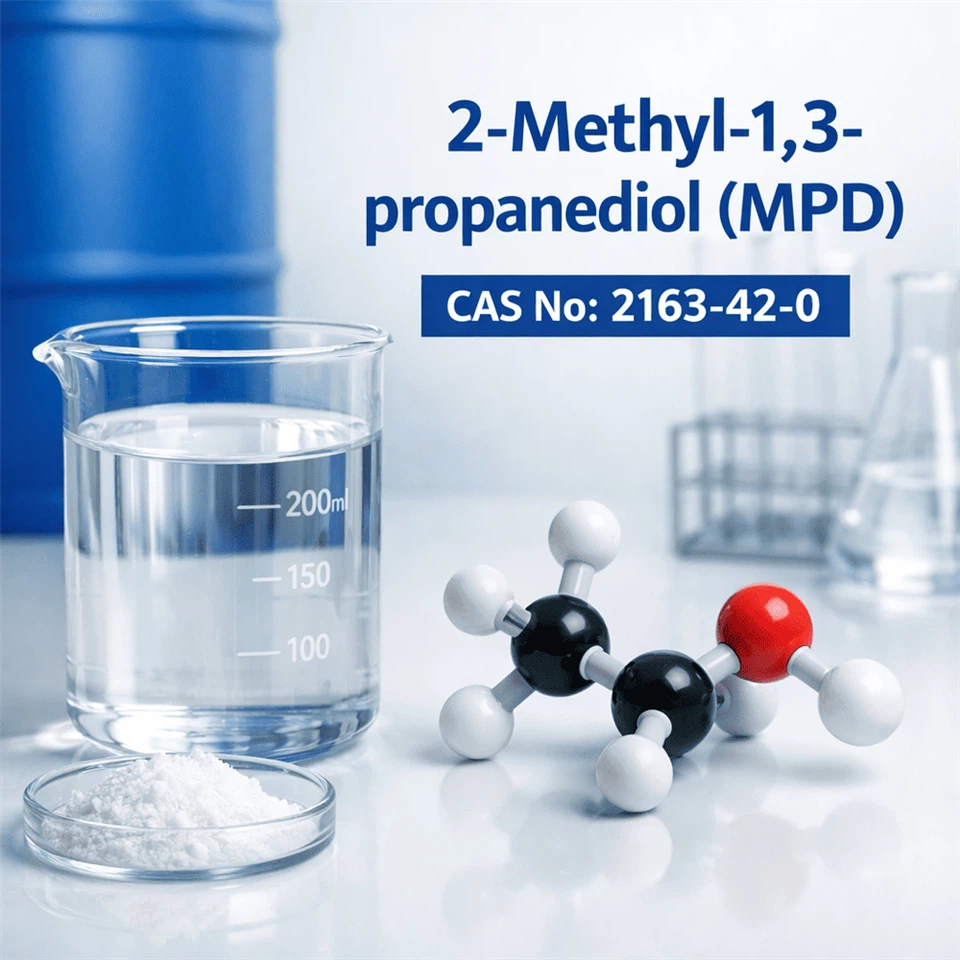
2-Methyl-1,3-propanediol (MPD / MPO)
Branched Asymmetric Diol Polyol Monomer · Purity ≥99.5% · No CMR Classification · MPD Supplier from China · Global Shipping
✓ Regulatory Advantage - No CMR · Not HAP-Listed · No REACH Annex XIV/XVII Restriction · Combustible Liquid (Flash Point ~113°C)
MPD (CAS 2163-42-0) has a clean regulatory profile: not classified as a reproductive toxicant (Repr. 1B), carcinogen, mutagen, or other CMR substance under EU CLP Regulation 1272/2008. Not listed on REACH Annex XIV, not subject to REACH Annex XVII restrictions, and not a US EPA Hazardous Air Pollutant (HAP). Flash point ~113°C - Combustible Liquid (Class III-B), requiring standard combustible liquid storage without the explosion-proof infrastructure mandated for flammable liquids. MPD is EU REACH registered and TSCA-listed. This straightforward regulatory profile allows use across EU, US, and global markets without the complex authorization, restriction, or HAP reporting obligations that affect DMF, DCM, and other regulated solvents. Sinolook provides EU CLP-compliant SDS and TSCA/REACH confirmation with every shipment.
ℹ MPD Structural Advantage - Branched Asymmetric Diol
MPD's key structural feature is its methyl-branched, asymmetric 1,3-diol: HOCH₂–CH(CH₃)–CH₂OH. This gives three polymer-design advantages over linear diols (1,3-PDO, 1,4-BDO): (1) No crystallinity - the methyl branch prevents chain-packing crystallisation, producing permanently flexible, amorphous polymer segments with lower Tg; (2) Asymmetric OH reactivity - one faster primary OH and one slightly hindered primary OH, enabling controlled branching density in polyester and PU synthesis; (3) Superior solubility & compatibility - branched structure reduces inter-chain hydrogen bonding, improving compatibility with aromatic acids and diverse isocyanates. Compared to NPG (symmetric gem-dimethyl diol), MPD's asymmetric structure produces softer, more flexible polymers better suited to coating and elastomer applications.
ℹ Hydroxyl Value Specification - Important Note for Buyers
The theoretical hydroxyl value of pure MPD (MW 90.12 g/mol, 2 OH groups) is ~1,245 mg KOH/g (calculated as: 2 × 56,100 / 90.12). The value of 530–550 mg KOH/g sometimes cited in the market corresponds to polyols of approximately MW 210 g/mol (such as neopentyl glycol-based short-chain polyesters) and is not the correct value for pure MPD monomer. For polyester or polyurethane formulation calculations using MPD, always use OHV ~1,245 mg KOH/g or request the analytically determined OHV from the batch COA.
What Is 2-Methyl-1,3-propanediol (MPD)?
2-Methyl-1,3-propanediol (MPD, CAS 2163-42-0), also known by the commercial abbreviation MPO, is a low-molecular-weight branched aliphatic diol of molecular formula C₄H₁₀O₂ and molecular weight 90.12 g/mol. Its structure - HOCH₂–CH(CH₃)–CH₂OH - makes it an asymmetric 1,3-diol with two hydroxyl groups occupying different steric environments, creating a reactivity gradient that enables controlled polyester and polyurethane synthesis. Produced industrially by hydroformylation of allyl alcohol followed by hydrogenation, MPD is an established polyol monomer for polyurethane producers, polyester resin manufacturers, powder coating formulators, and personal care ingredient suppliers. Complete physicochemical data from NCBI PubChem (CID 68748) and the ECHA substance information page.
A critical practical advantage of MPD is its permanent liquid state at room temperature (melting point approximately −30°C) - it remains pumpable and processable down to at least −20°C, with no need for heated storage, drum heating, or melt-handling infrastructure. This contrasts sharply with neopentyl glycol (NPG, mp 126°C) and 1,4-butanediol (1,4-BDO, mp ~20°C), both of which are solids or semi-solids at ambient temperature requiring heated handling systems. With density 1.016–1.020 g/cm³, viscosity ~90–130 mPa·s at 20°C, and complete water miscibility, MPD is fully processable at ambient temperature with standard liquid-handling equipment.
MPD's methyl branch disrupts interchain packing, producing amorphous, softer polymer segments with lower Tg, superior low-temperature flexibility (maintaining elastomeric behaviour at temperatures 15–25°C below BDO equivalents), and reduced tendency to humidity-induced whitening or delamination - properties specifically required in automotive skins, footwear, and outdoor coating applications. The EPA CompTox Dashboard confirms TSCA inventory listing and non-HAP status.
Product Specifications
Reference data from PubChem CID 68748 and EPA CompTox Dashboard.
| Parameter | Specification / Value |
|---|---|
| Product Name | 2-Methyl-1,3-propanediol (MPD / MPO / 2-Methyltrimethylene Glycol / 2-Methyl-1,3-propylene glycol) |
| CAS Number | 2163-42-0 |
| EC Number | 218-551-0 |
| Molecular Formula | C₄H₁₀O₂ |
| Molecular Weight | 90.12 g/mol |
| Structure | HOCH₂–CH(CH₃)–CH₂OH (branched asymmetric 1,3-diol) |
| Appearance | Colorless Transparent Viscous Liquid |
| Purity | ≥99.5% |
| Water Content | ≤0.05% (Karl Fischer) |
| Color (Pt-Co) | ≤10 |
| Density (d20) | 1.016–1.020 g/cm³ |
| Boiling Point | 214°C (760 mmHg) |
| Flash Point | ~113°C (closed cup) - Combustible Liquid (Class III-B) |
| Refractive Index | ~1.445–1.448 (n20/D) |
| Viscosity (20°C) | ~90–130 mPa·s (viscous liquid; processable at ambient temp.) |
| OHV (theoretical) | ~1,245 mg KOH/g (2 OH groups; MW 90.12) - see OHV clarification box above |
| Melting Point | ~−30°C - Permanent liquid; does not crystallise at storage temperatures |
| Water Miscibility | Completely miscible with water |
| EU CLP Classification | ✓ Skin Irrit. 2 (H315); Eye Irrit. 2 (H319) - No CMR, No SVHC |
| REACH Annex XIV / XVII | ✓ Not listed / Not restricted |
| US HAP Status | ✓ Not listed (Non-HAP) |
| Cosmetics (INCI) | ✓ Methylpropanediol - permitted under EU Reg. (EC) 1223/2009 |
| Packing | 200 KG / HDPE or Metal Drum; IBC Tank (1,000 KG) |
| Storage | 5–30°C; sealed drums; dry, ventilated; 12-month shelf life |
Applications of 2-Methyl-1,3-propanediol (MPD / MPO)
MPD's application profile is built on three structural contributions to polymer performance: suppression of crystallinity (for flexibility and transparency), asymmetric OH reactivity (for controlled branching and MW distribution), and permanent liquid state with complete water miscibility (for ease of handling and waterborne system compatibility).
PU Elastomers & TPU Coatings
Chain extender and soft-segment diol in TPU and cast PU elastomers. MPD's asymmetric structure produces amorphous PU segments with lower Tg and superior low-temperature flexibility vs BDO-extended PU. Used in automotive instrument panel skins, footwear midsoles, and industrial rollers - maintaining elastomeric behaviour down to −35/−40°C.
Polyester Resin for Powder Coatings
Diol monomer in saturated polyester resins for TGIC-cured and HAA-cured powder coatings. MPD's methyl branch reduces crystallinity, improves resin melt-flow and film levelling, and contributes flexibility and impact resistance to cured coating films on architectural aluminium, appliance panels, and automotive trim.
Waterborne PU Dispersions (PUD)
Diol component in PUD synthesis for leather coatings, textile coatings, and water-based adhesives. MPD's complete water miscibility and permanent liquid state facilitate PUD synthesis and dispersion stability. Contributes soft-segment flexibility and hydrolysis resistance to the PUD film - ideal for clear topcoat applications on leather goods.
Alkyd & Oil-Modified Polyester Resins
Partial replacement for ethylene glycol or NPG in alkyd resin synthesis. Branched MPD provides a lower-viscosity, better-solubility alkyd compared to straight-chain diol equivalents. Used in air-drying and baking alkyd systems for architectural and industrial protective coatings.
Polymeric Plasticiser Synthesis
Diol in polymeric plasticisers for PVC, polyacrylate, and other polymer matrices. MPD-based polyester plasticisers have lower volatility and better permanence than monomeric phthalate plasticisers - used in flexible PVC profiles, cable insulation, medical tubing, and food-contact films requiring low migration.
Humectant & PG Substitute
Humectant, solvent, and skin-conditioning agent (INCI: Methylpropanediol) in skin serums, moisturisers, toners, and hair care (1–15%). Used as a propylene glycol substitute in formulations where a lighter skin feel and 'propylene glycol-free' positioning are desired. Permitted under EU Regulation (EC) 1223/2009.
UV-Curable Polyester Acrylate Oligomers
Diol building block in polyester acrylate oligomers for UV-curable coating systems. MPD's branching introduces flexibility and reduces shrinkage stress in the cured acrylate film. Used in UV wood coatings, UV paper lacquers, and UV-cure inkjet vehicle systems requiring flexibility-hardness balance.
Polyurethane Elastomers - Low-Temperature Flexibility Advantage
In polyurethane synthesis, MPD functions primarily as a chain extender - a short-chain diol that builds the hard segment of segmented PU elastomers by reacting with MDI or HDI isocyanate to form urethane hard blocks. The performance differentiation over 1,4-BDO lies in hard segment morphology: MPD's methyl branch prevents tight crystalline packing, producing an amorphous hard domain that remains below its glass transition temperature at lower temperatures - translating directly to elastomeric behaviour retained down to −35 to −40°C vs approximately −15 to −20°C for equivalent BDO-extended systems.
In automotive TPU (instrument panel coverings, door panel skins, airbag covers), MPD-extended TPU maintains soft, leather-like surface feel and impact performance required by OEM specifications in winter conditions. In footwear TPU (running shoe midsoles, boot outsoles), MPD's low-temperature flexibility contributes to cold-weather performance and reduces cracking that affects lower-flexibility PU components in cold climates. In industrial PU rollers and belts, MPD provides flexibility retention and resistance to hydrolytic degradation that outperforms BDO-extended equivalents.
MPD vs. Competing Diol Polyol Monomers
Comparison based on NCBI PubChem and ECHA data. MPD highlighted.
| Property | 1,4-BDO (110-63-4) | NPG (126-30-7) | MPD (2163-42-0) ✓ | 1,3-PDO (504-63-2) |
|---|---|---|---|---|
| OH Groups | 2× primary | 2× primary (hindered) | 1× primary + 1× secondary | 2× primary |
| OHV (mg KOH/g) | ~1,245 | ~1,077 | ~1,245 | ~1,475 |
| State at 20°C | Solid (mp ~20°C) ⚠ | Solid (mp 126°C) ⚠ | Liquid ✓ (mp −30°C) | Liquid ✓ |
| Flash Point (°C) | ~121 | ~115 | ~113 | ~79 |
| Polyester Tg | Moderate | Higher (rigid) | Lower - flexible ✓ | Low (flexible) |
| Crystallinity | Can crystallise | Reduces crystallinity | Amorphous ✓ | Can crystallise |
| Hydrolysis Resistance | Good | Excellent ✓ | Very Good ✓ | Moderate |
| Water Miscibility | Miscible | Slightly soluble | Miscible ✓ | Miscible |
| EU Repr. / CMR | ✓ None | ✓ None | ✓ None | ✓ None |
| Key Strength | Widest PU use, lowest cost | High Tg, hydrolysis resist. | Flexible + liquid + compatible ✓ | Bio-based, flexible |
MPD is the optimal choice when flexibility, liquid-state handling, and clear-film performance are the priority properties. NPG's hydrolysis resistance is unmatched for outdoor weathering; BDO remains lowest-cost for high-volume standard PU. MPD also references: ECHA - NPG · ECHA - 1,4-BDO
Storage, Handling & Safety
MPD's handling profile is straightforward for an industrial diol monomer with combustible liquid classification - significantly simpler than the flammable, toxic, or CMR-classified chemicals in Sinolook's portfolio. Its permanent liquid state eliminates heated melting and transfer equipment required for solid NPG and semi-solid BDO. Full occupational safety data from GESTIS (IFA).
📦 Storage Guidelines
• Store at 5–30°C in sealed HDPE or metal drums - does not solidify (mp ~−30°C)
• Standard combustible liquid storage area - no explosion-proof electrics or flammable storage cabinets required (flash point ~113°C)
• Keep drums tightly sealed - MPD is hygroscopic; water absorption affects polymer formulation stoichiometry
• Segregate from strong acids, bases, and isocyanates - react with OH groups
• Shelf life: 12 months in original sealed packaging at 5–30°C
🧤 PPE & Handling
• Chemical-resistant gloves (nitrile ≥0.1 mm) and safety goggles - mild irritant (H315, H319)
• Good general ventilation adequate for most operations - very low vapour pressure at ambient temperature (bp 214°C)
• No respiratory protection required for normal ambient-temperature handling
• For heated processes above 100°C: local exhaust ventilation and half-mask with organic vapour cartridge
• Spill: absorb with dry sand or vermiculite; dispose as mild organic chemical waste
Frequently Asked Questions (FAQ)
Why is the hydroxyl value of MPD ~1,245 mg KOH/g - much higher than most polyols?
The OHV measures total OH group content per gram: OHV = (number of OH groups × 56,100) / molecular weight. For MPD: 2 × 56,100 / 90.12 = 1,245 mg KOH/g. This is high compared to polymeric polyols (OHV 30–300 mg KOH/g) due to their much higher molecular weights (500–4,000 g/mol), but entirely consistent with other low-MW diol chain extenders - BDO (MW 90.12) also has OHV ~1,245 mg KOH/g. In PU formulation using MPD as a chain extender, the MDI:MPD weight ratio is calculated from the isocyanate index and OHV. Using the correct OHV (1,245, not the sometimes-cited 530–550) is essential for accurate formulation.
How does MPD compare to propylene glycol (PG) in personal care applications?
MPD (1,3-diol; INCI: Methylpropanediol) and propylene glycol (1,2-propanediol; INCI: Propylene Glycol) are evaluated on three dimensions: (1) Skin feel - MPD's 1,3-diol geometry is reported to provide a lighter, less greasy feel than PG at equivalent concentrations; (2) Antimicrobial activity - PG has documented activity against Gram-positive bacteria and fungi above ~15%; MPD has different and generally lower antimicrobial potency, so formulations relying on PG for preservation contribution need to adjust their preservation system when substituting; (3) Regulatory positioning - MPD enables 'propylene glycol-free' label claims for consumers seeking to avoid PG. Contact our technical team for MPD-for-PG substitution guidance in specific formulation types.
Can MPD be used in unsaturated polyester resin (UPR) for FRP composites?
MPD can be used as a co-diol in UPR synthesis - the hydroxyl groups react with maleic anhydride and phthalic anhydride in the standard condensation polymerisation to produce the polyester backbone. MPD's contributions vs standard diols (propylene glycol, ethylene glycol): (1) reduced crystallinity of the polyester; (2) improved flexibility and impact toughness of the cured composite. However, MPD's higher cost than propylene glycol limits its use to specialty applications where the flexibility contribution justifies the premium - for example, flexible vinyl ester FRP liners for chemical tanks, or gel coat formulations requiring improved chip and crack resistance.
What is the difference between MPD (2-methyl-1,3-propanediol) and MPG (monopropylene glycol / 1,2-propanediol)?
These are completely different compounds despite similar abbreviations. MPG (monopropylene glycol, 1,2-propanediol, CAS 57-55-6) is a 1,2-diol widely used as a solvent, humectant, and antifreeze. MPD (2-methyl-1,3-propanediol, CAS 2163-42-0) is a 1,3-diol with a methyl branch on the central carbon - a polyol monomer for polymer synthesis. They have different molecular weights (76.09 vs 90.12 g/mol), different reactivities in polymerisation (1,2-diol vs 1,3-diol spacing affects polyester ring-forming tendency), and different applications (MPG: solvent/humectant; MPD: polymer monomer). Always use the full name or CAS number to avoid confusion when ordering.
Authoritative Technical & Regulatory References
| Reference Source | Description | Link |
|---|---|---|
| ECHA - MPD Substance Information | Confirms non-CMR classification, REACH registration, and absence of SVHC/restriction for CAS 2163-42-0. | View → |
| PubChem - CID 68748 | NCBI PubChem record for MPD with IUPAC name, molecular structure, physicochemical data, and regulatory information. | View → |
| EPA CompTox - MPD | US EPA CompTox for CAS 2163-42-0: TSCA inventory status, non-HAP confirmation, and physicochemical data. | View → |
| GESTIS - MPD Occupational Safety | IFA GESTIS database entry for 2-Methyl-1,3-propanediol: occupational safety data, physicochemical properties, and toxicological summary. | View → |
| ECHA - NPG (for comparison) | ECHA substance information for neopentyl glycol (NPG, CAS 126-30-7) - the most commonly compared branched diol in polyester and powder coating resin synthesis. | View → |
| ECHA - 1,4-BDO (for comparison) | ECHA substance information for 1,4-butanediol (CAS 110-63-4) - primary competing diol in PU chain extension - for regulatory and property comparison. | View → |
Note: Links are provided for reference only. Sinolook Chemical does not control third-party content. Buyers are responsible for verifying current classification and regulatory status in their specific jurisdiction and application context.
Buy 2-Methyl-1,3-propanediol from China - B2B Procurement Guide
As a direct MPD / MPO manufacturer in China, Sinolook provides transparent, volume-tiered competitive MPD price with reliable supply continuity for polyurethane, polyester, and personal care customers. Export classification: Combustible Liquid (Class III-B) - standard export procedures, no hazardous goods surcharges applicable to most routes.
MOQ
500 KG · Volume tiers: 500 KG → 2 MT → 10 MT → 50 MT → IBC (1,000 KG)
Samples
0.5–5 KG qualification samples at nominal charge, credited against first order
Lead Time
10–14 business days standard; expedited available
Packaging
200 KG HDPE or metal drums / IBC tanks (1,000 KG)
Contact Sinolook - Your Trusted MPD / MPO Supplier
Whether you are a polyurethane elastomer producer incorporating MPD as a chain extender for superior low-temperature flexibility in automotive TPU skins, footwear components, or industrial rollers; a powder coating polyester manufacturer using MPD to reduce crystallinity and improve flow in TGIC-cured systems; a waterborne PU dispersion formulator leveraging MPD's liquid state for PUD synthesis; a polymeric plasticiser producer synthesising low-migration MPD-based polyester plasticisers; or a personal care formulator seeking a skin-feel-differentiated propylene glycol alternative - Sinolook Chemical delivers purity ≥99.5%, permanent liquid-state handling convenience, correct analytical hydroxyl value, and clean regulatory documentation. Our team responds within 24 hours.
📱 Phone / WeChat
0086 134-0071-5622🌐 Website
www.sinolookchem.comSinolook Chemical Co., Ltd. - Global Supplier of Polyol Monomers, Specialty Solvents & Industrial Chemicals
Hot Tags: 2-methyl-1,3-propanediol (mp0), China 2-methyl-1,3-propanediol (mp0) manufacturers, suppliers


