


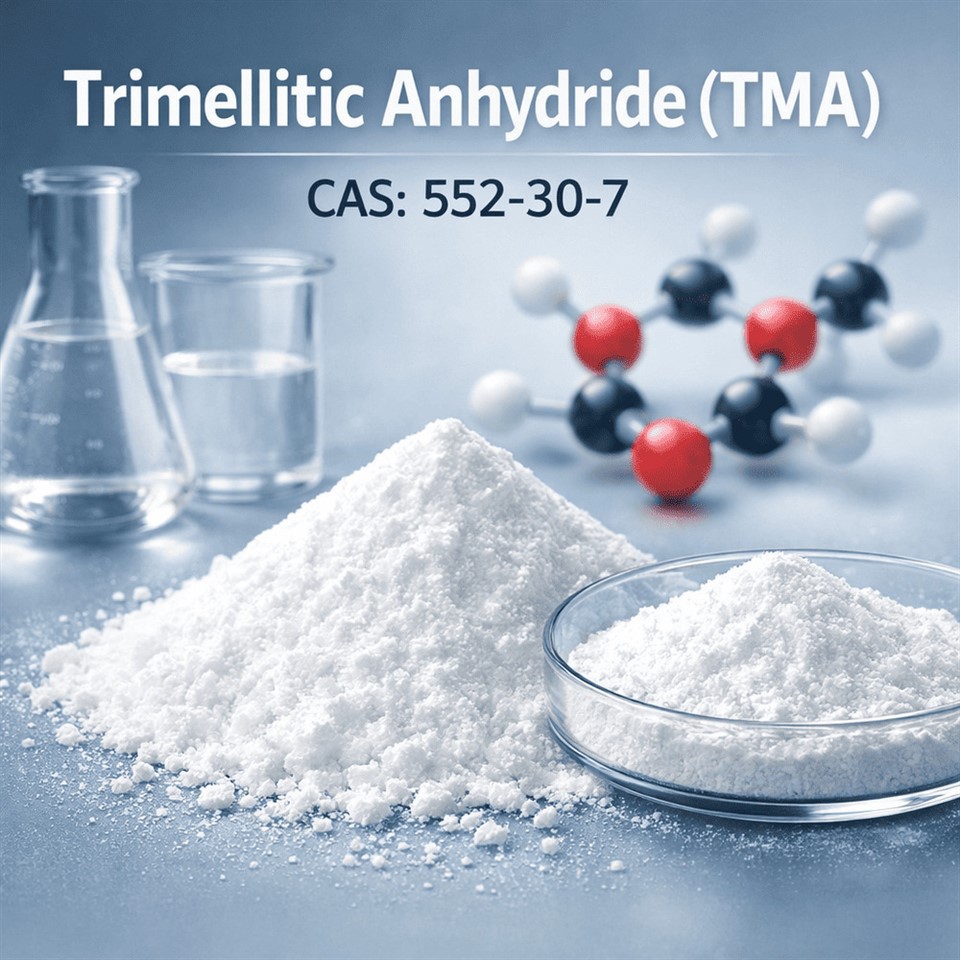
Upstream Intermediate for Trimellitate Ester Plasticisers & High-Performance Resins - Sinolook Supplies the Full Chain: Trimellitic anhydride (TMA, CAS 552-30-7) is the core aromatic acid anhydride feedstock for synthesising TM810 (Tri(octyl,decyl) trimellitate), TOTM (Tris(2-ethylhexyl) trimellitate), and all commercial trimellitate ester plasticisers and lubricants. Also the key trifunctional monomer for high-performance polyester resins, waterborne coatings, epoxy curing agents, and polyimide films. Sinolook supplies TMA at ≥99.5% purity (HPLC) with multi-parameter COA, alongside downstream TM810 and TOTM ester products - enabling single-source procurement for the full TMA → trimellitate ester chain. REACH and TSCA compliant. SDS and COA provided with every shipment.
Aromatic Trifunctional Anhydride · Trimellitate Ester Upstream · Polyester Resin · Polyimide · Epoxy Curing Agent
TMA - Trimellitic Anhydride
(Trimeric Triglyceride / Benzene-1,2,4-tricarboxylic anhydride / 1,2,4-Benzenetricarboxylic anhydride / 4-Carboxyphthalic anhydride)
| CAS No. | 552-30-7 |
| EC Number | 209-008-0 |
| IUPAC Name | 1,3-dioxo-1,3-dihydro-2-benzofuran-5-carboxylic acid (anhydride ring formed at 1,2-positions; free –COOH at 4-position) |
| Molecular Formula / MW | C₉H₄O₅ / 192.13 g/mol |
| Functional Groups | Anhydride (–CO–O–CO–) at C1,C2 positions + free carboxyl (–COOH) at C4 position - bifunctional aromatic: reacts with alcohols (esterification) via anhydride ring-opening AND retains free acid for further cross-linking |
| Physical State (25°C) | White crystalline powder; slight characteristic odour; hygroscopic - hydrolyses to trimellitic acid on prolonged moisture exposure |
| Key Downstream Products | TM810 (C8/C10 trimellitate) TOTM (C8 trimellitate) TOPM (C8 pyromellitate) Polyester / Polyimide resins |
| Regulatory Status | REACH registered TSCA listed RoHS compliant |
| GHS Hazards | Skin Irrit. 2 (H315) Eye Irrit. 2 (H319) STOT SE 3 (H335) - dust inhalation ✓ No CMR / No Repr. 1B |
What Is Trimellitic Anhydride? The Trifunctional Aromatic Intermediate Behind Trimellitate Plasticisers
Trimellitic anhydride (TMA, CAS 552-30-7) is a white crystalline solid aromatic anhydride of molecular formula C₉H₄O₅ and molecular weight 192.13 g/mol. Structurally, TMA contains an intramolecular anhydride ring formed between the carboxyl groups at the 1,2-positions of the benzene ring, plus a free carboxyl group at the 4-position - making it a bifunctional aromatic compound with both anhydride reactivity and free-acid reactivity in a single molecule. This trifunctional architecture is why TMA is the preferred aromatic acid anhydride for high-performance applications that require branched, cross-linked, or polyfunctional ester/polymer structures.
TMA is produced industrially by the liquid-phase catalytic oxidation of pseudocumene (1,2,4-trimethylbenzene) - a C9 aromatic from petroleum reformate or coal tar fractions - followed by thermal dehydration of the intermediate trimellitic acid to close the anhydride ring. The liquid-phase oxidation route, using cobalt/manganese/bromine catalyst systems in acetic acid solvent, is the dominant commercial process and produces a consistently high-purity product. China has become the world's dominant TMA producer, with production capacity concentrated in Jiangsu, Shandong, and Zhejiang provinces, providing the supply-side foundation for China-origin TMA competitive pricing and reliable export logistics.
TMA is the essential upstream raw material for the entire trimellitate ester plasticiser and lubricant family: reacting TMA with n-octanol/n-decanol yields TM810; with 2-ethylhexanol yields TOTM; with various other C6–C13 alcohols yields the full trimellitate ester series. Each mole of trimellitate ester (three ester bonds) requires one mole of TMA - making TMA content, purity, and acid value the primary quality determinants of downstream ester product yield and colour. Sinolook's position as a supplier of both TMA (upstream) and TM810/TOTM (downstream finished esters) enables single-source procurement for the complete production chain.
TMA Specifications & Physical Properties
| Parameter | Specification | Typical / Actual | Test Method / Note |
|---|---|---|---|
| Appearance | White crystalline powder | White, free-flowing | Visual inspection; slight characteristic odour; hygroscopic - keep sealed |
| Purity | ≥99.5 wt% | 99.8 wt% | HPLC; high purity minimises trimellitic acid, phthalic anhydride, and other isomeric impurities |
| Acid Value | 630–645 mg KOH/g | 638 mg KOH/g | GB/T 7304-2014; reflects combined anhydride + free –COOH acidity; use COA AV for ester charge calculation |
| Melting Point | 164–168°C | 166°C | GB/T 617-2006; sharp melting range (≤4°C spread) confirms high crystalline purity; broad range indicates hydrolysis or impurity |
| Moisture | ≤0.1 wt% | 0.05 wt% | Karl Fischer; TMA + H₂O → trimellitic acid (hydrolysis); excess moisture impedes anhydride ring-opening kinetics in esterification |
| Ash Content | ≤0.05 wt% | 0.02 wt% | GB/T 6378.2-2001; low ash confirms catalyst (Co/Mn/Br) removal completeness; critical for cable-grade TM810 volume resistivity compliance |
| Color (Pt-Co, 50% in acetone) | ≤20 Pt-Co | 10 Pt-Co | GB/T 3143-1982; measured in 50% acetone solution; pale colour propagates to downstream ester and resin products |
| Packaging | 25 kg paper-plastic composite bag / 1000 kg FIBC ton bag | Inner PE film liner | Bags sealed with PE inner liner; moisture-proof outer; max 8-layer stacking for 25 kg bags; FIBC single-layer only; shelf life 12 months |
TMA Production - Pseudocumene Liquid-Phase Oxidation Route
Commercial TMA is produced by the liquid-phase catalytic oxidation of pseudocumene (1,2,4-trimethylbenzene, C₉H₁₂) - a C9 aromatic hydrocarbon present in petroleum heavy reformate and coal tar fractions. The process involves two stages:
Step 1 - Liquid-Phase Oxidation
Pseudocumene reacts with air (oxygen) in acetic acid solvent using a cobalt-manganese-bromine (Co/Mn/Br) catalyst system at 150–200°C and 15–30 bar. All three methyl groups are progressively oxidised to carboxylic acid groups, yielding trimellitic acid (benzene-1,2,4-tricarboxylic acid). Reaction selectivity, temperature control, and catalyst concentration determine the ratio of trimellitic acid to isomeric by-products (isophthalic acid, phthalic acid fragments).
Step 2 - Dehydration to Anhydride
Trimellitic acid is thermally dehydrated at 160–200°C (below the melting point of TMA) to close the intramolecular anhydride ring between the adjacent C1 and C2 carboxyl groups, releasing water and forming TMA. The free carboxyl at C4 is unaffected by dehydration. After dehydration, the crude TMA undergoes recrystallisation and vacuum drying to achieve the ≥99.5% purity specification. Low ash content (≤0.05%) confirms complete catalyst removal during purification.
TMA Applications - From Plasticisers to Polyimide Films
1. Trimellitate Ester Plasticiser Synthesis - TM810, TOTM & the Full Trimellitate Series
TMA is the essential upstream feedstock for all commercial trimellitate ester plasticisers and lubricants. Each mole of trimellitate triester requires one mole of TMA esterified with three moles of alcohol. The esterification reaction proceeds via anhydride ring-opening (fast, low-temperature first step producing half-ester) followed by esterification of the free C4 carboxyl and the remaining acid hydroxyl at elevated temperature (typically 180–220°C with acid or titanium alkoxide catalyst) to yield the fully esterified triester product.
TM810 synthesis: TMA + mixed n-octanol / n-decanol (C8/C10) → Tri(octyl,decyl) trimellitate (TM810, CAS 68515-42-4). TMA's purity directly determines TM810's acid value, colour, and electrical properties - high-ash TMA produces TM810 with low volume resistivity, failing IEC 60811 cable insulation specifications. TOTM synthesis: TMA + 2-ethylhexanol → Tris(2-ethylhexyl) trimellitate (TOTM, CAS 3319-31-1). Both TM810 and TOTM are supplied by Sinolook, and TMA is available from the same supply chain as a single-source procurement option.
The trimellitate ester products (TM810, TOTM) are used as high-performance non-phthalate plasticisers for 105°C-rated PVC cable insulation, automotive interior PVC, and medical device PVC - all applications where TMA's three ester groups per molecule deliver the low volatility and high-temperature stability that two-ester phthalate plasticisers cannot match. For detailed downstream application data, see the TM810 and TOTM product pages.
2. Polyester Resins & Alkyd Resins - Branching / Cross-linking Monomer
In saturated polyester and alkyd resin synthesis, TMA functions as a trifunctional branching monomer: its two adjacent carboxyl groups (anhydride ring) react with diol or polyol monomers in the polycondensation, while the free C4 carboxyl group either introduces additional branching points or remains as a pendant acid group for water-dispersibility (in waterborne resins) or cross-linking sites (in baking resins). This trifunctionality at controlled loading (typically 2–10 mol% TMA replacement of phthalic or isophthalic acid) allows formulators to tune resin molecular weight, branching density, hydroxyl and acid values, and hardness.
TMA-modified polyester resins exhibit superior adhesion, chemical resistance, and weather resistance compared to linear (bifunctional acid only) equivalents, making them suitable for high-gloss industrial coatings, marine anti-corrosion coatings, and high-temperature baking coatings for automotive OEM applications. TMA also introduces acid groups that improve metallic substrate adhesion without requiring additional adhesion promoter additives.
3. Waterborne & High-Solid Coatings - VOC Reduction via Water-Dispersible Resin Synthesis
TMA's free carboxyl group at C4 is the key functional group for producing water-dispersible and water-soluble polyester and acrylic resins for waterborne coating systems. By controlling TMA content in the resin backbone, formulators introduce the specific acid value required for amine neutralisation and water dispersibility - typically targeting resin acid values of 30–60 mg KOH/g for waterborne polyester dispersions. The resulting waterborne coatings reduce VOC content to ≤150 g/L (compliant with EU Directive 2004/42/EC and EPA OTC Model Rule), while maintaining the gloss, hardness, and chemical resistance of solventborne equivalents.
TMA also functions directly as an epoxy resin curing agent (hardener): the anhydride ring opens with the epoxy group in a ring-opening addition reaction at 120–180°C, forming an ester linkage and a hydroxyl group that subsequently reacts further. TMA-cured epoxy systems exhibit high heat distortion temperature (HDT >150°C), excellent chemical resistance, and low shrinkage - used in electrical potting compounds, high-temperature adhesives, and composite laminates.
4. Polyimide Films, Rubber Crosslinking & Specialty Applications
Polyimide synthesis: TMA reacts with aromatic diamines in a two-step poly(amic acid) → imidisation route to produce TMA-based polyimide and polyamide-imide (PAI) resins. PAI (produced from TMA + 4,4'-methylenedianiline or MDI) exhibits exceptional thermal stability (continuous service to 220–260°C), high strength, and excellent electrical insulation - used in aerospace structural components, motor magnet wire insulation (Class H/220), printed circuit board substrates, and flexible electronics. The commercial PAI resin Torlon (Solvay) is TMA-based, establishing TMA as the core anhydride monomer for this high-performance polymer class.
Rubber crosslinking: TMA (as trimellitic acid trianhydride) and its partial metal salts are used as vulcanisation co-agents and crosslinking systems in fluoroelastomers (FKM) and acrylic rubbers (ACM), improving tensile strength, heat resistance, and chemical resistance of cured rubber compounds used in automotive seals, gaskets, and O-rings.
Other specialty uses: TMA-derived imide intermediates are used in pharmaceutical synthesis as biocompatible intermediates. TMA is also used as a reactive modifier in polyurethane resin synthesis to introduce carboxyl functionality and improve adhesion to polar substrates. Growing demand from new energy vehicle (NEV) motor insulation, 5G flexible circuit substrates, and aerospace TMA-based PAI composites is driving increasing global TMA consumption growth.
Sinolook Supply Chain Advantage - TMA + Finished Trimellitate Esters from One Source
Sinolook's product portfolio spans both TMA (upstream anhydride feedstock) and the full range of finished trimellitate ester plasticisers and lubricants (downstream) - enabling buyers to source the complete TMA → trimellitate ester production chain from a single supplier with aligned quality systems and consistent COA documentation.
Storage, Handling & Safety - TMA Is Hygroscopic: Keep Sealed
Storage
Store at 10–25°C in sealed packaging in a cool, dry, well-ventilated warehouse. Maintain relative humidity below 60%. Keep away from direct sunlight, heat sources, and open flames. Segregate from strong oxidants, strong bases, alcohols, and water-containing substances.
25 kg bags: PE inner liner sealed; max 8-layer stacking; reseal partially used bags immediately with moisture-proof tape. 1000 kg FIBC ton bags: sealed PE liner; single-layer stacking only; do not use torn or compromised bags.
Shelf life: 12 months in original sealed packaging at 10–25°C. Retest acid value and melting point if stored more than 9 months or if moisture absorption is suspected. Fire-fighting: dry powder extinguishers (CO₂ acceptable); do not use water or aqueous foam (reacts with TMA).
PPE & Handling
GHS hazards: Skin Irrit. 2 (H315) - avoid skin contact with moistened TMA; Eye Irrit. 2 (H319) - avoid dust contact with eyes; STOT SE 3 (H335) - dust inhalation irritates respiratory tract.
PPE: Chemical-resistant gloves (nitrile or neoprene) · safety goggles · dust mask (FFP2 or equivalent) · protective clothing. General ventilation adequate at ambient; local exhaust ventilation and dust collection for dusty handling operations (bag discharge, sieving).
First aid: Skin - flush with water ≥15 min; Eye - flush with water ≥15 min (remove contacts), seek medical attention; Inhalation - move to fresh air; Ingestion - do not induce vomiting, seek medical attention immediately.
Spill: Isolate area; use inert dry absorbent (sand, activated carbon); collect into sealed containers; dispose per local industrial chemical waste regulations. Do not discharge to sewers - TMA hydrolyses to create acidic waste.
Frequently Asked Questions about Trimellitic Anhydride
Q: What is the stoichiometric TMA:alcohol ratio for TM810 and TOTM ester synthesis?
The theoretical ratio is 1 mol TMA : 3 mol alcohol for the fully esterified trimellitate triester (all three carboxyl groups esterified). Using the molecular weights: for TM810, TMA (MW 192.13) + mixed C8/C10 alcohol blend (~MW 136 average); for TOTM, TMA + 2-ethylhexanol (MW 130.23). The practical alcohol charge typically uses a 5–15% molar excess of alcohol to drive complete esterification (Le Chatelier), with excess alcohol removed by vacuum distillation at the end of reaction. Always use the COA acid value of the TMA batch for batch-specific charge calculations rather than the nominal theoretical value, as the actual acid value directly reflects the anhydride + free –COOH content of that specific batch.
Q: Why is low ash content in TMA critical for cable-grade TM810 plasticiser?
Ash content in TMA reflects inorganic residues - primarily cobalt, manganese, and bromine catalyst remnants from the pseudocumene oxidation step. These ionic impurities carry through into the esterified TM810 product: metal ions and halide ions in the final TM810 plasticiser act as ionic charge carriers, dramatically reducing the volume resistivity of the PVC compound below the IEC 60811 requirement of ≥5×10¹¹ Ω·cm for 105°C cable insulation. Sinolook's TMA ash content of ≤0.05% (actual 0.02%) ensures that catalyst-derived ionic contaminants do not compromise the electrical insulation performance of downstream TM810 in cable compound applications. When comparing TMA suppliers, always request the ash content test result - low-purity TMA with high ash is the primary cause of TM810 volume resistivity failures in cable compound qualification testing.
Q: What is the difference between trimellitic anhydride (TMA) and pyromellitic dianhydride (PMDA) - which do I need?
TMA (CAS 552-30-7) and PMDA (pyromellitic dianhydride, CAS 89-32-7) are both aromatic acid anhydrides but with different structures and applications. TMA (benzene-1,2,4-tricarboxylic anhydride) has one anhydride ring + one free –COOH, making it trifunctional and the feedstock for trimellitate esters (TM810, TOTM) and polyamide-imide resins. PMDA (benzene-1,2,4,5-tetracarboxylic dianhydride) has two anhydride rings and is the feedstock for pyromellitate esters (TOPM) and polyimide (PI) films (Kapton-type). If you are synthesising TM810 or TOTM trimellitate esters or TMA-based polyester/alkyd resins, you need TMA. If you are synthesising TOPM tetraester lubricant/plasticiser or PI films, you need PMDA. Sinolook supplies both - contact us to confirm which intermediate matches your downstream synthesis.
Q: Can TMA be substituted with trimellitic acid (TM acid) - are they interchangeable in esterification?
TMA (the anhydride) and trimellitic acid (the corresponding triacid, CAS 528-44-9) are functionally related but not directly interchangeable in esterification. TMA's anhydride ring opens rapidly with alcohols at 100–150°C without strong acid catalyst (anhydride is significantly more reactive than a free –COOH), enabling faster initial esterification and lower-temperature process start. Trimellitic acid produces water at each esterification step, typically requiring higher temperatures (>180°C) or azeotropic water removal. For large-scale industrial TM810 and TOTM production, TMA is the standard feedstock. Trimellitic acid is occasionally used in waterborne resin synthesis where the free acid dissolution in alkaline water is desired. If your process currently uses trimellitic acid and you wish to switch to TMA, note that TMA has a higher effective acidity per gram (AV 630–645 vs triacid AV ~440 mg KOH/g) - charge calculations must be adjusted accordingly. Contact Sinolook's technical team for process conversion guidance.
Authoritative Technical & Regulatory References
ECHA substance page for TMA: EU CLP classification (irritant), REACH registration status, and absence of SVHC or Annex XIV/XVII restrictions.
NCBI PubChem compound record for CAS 552-30-7: IUPAC name, molecular formula C₉H₄O₅, MW 192.13 g/mol, structural diagram, GHS classification, and physicochemical data.
EPA CompTox Dashboard for CAS 552-30-7: TSCA inventory listing, available environmental and physicochemical data.
TMA esterified with n-octanol / n-decanol blend. Sinolook product page: 105°C cable PVC plasticiser, automotive interior PVC, medical PVC, high-temperature lubricant. Pour point −46°C; volatile loss ≤0.10% @ 130°C/3h; volume resistivity ≥5×10¹¹ Ω·cm.
TMA esterified with 2-ethylhexanol. Established high-temperature cable plasticiser and synthetic lubricant ester base oil - complementary to TM810.
Buy TMA from China · ≥99.5% Purity · HPLC Verified · REACH / TSCA / RoHS · TM810 & TOTM Also Available
Request TMA Price, Qualification Sample & COA
Sinolook supplies trimellitic anhydride (TMA, CAS 552-30-7) at ≥99.5% purity (HPLC), acid value 630–645 mg KOH/g, melting point 164–168°C, moisture ≤0.1%, ash ≤0.05% (actual 0.02%), colour Pt-Co ≤20 (actual 10). Packaging: 25 kg paper-plastic composite bags and 1000 kg FIBC ton bags. Also available: downstream TM810 and TOTM finished ester plasticisers for single-source TMA → trimellitate ester procurement. Full COA and REACH/TSCA/RoHS documentation with every shipment. Qualification samples 0.5–5 kg at nominal charge. Response within 24 hours.
Related products: TM810 (Tri(octyl,decyl) Trimellitate, CAS 68515-42-4) - finished trimellitate ester plasticiser · TOPM (Tetraoctyl Pyromellitate, CAS 3126-80-5) - four-ester pyromellitate ester · INA (Isononanoic Acid) · NMP (N-Methyl-2-pyrrolidinone) · Maleic Anhydride (MAH)
Hot Tags: trimellitic anhydride, China trimellitic anhydride manufacturers, suppliers, trimellitic acid anhydride, isononanoic, trimellitic anhydride cas, trimellitic anhydride, trimellitic, isononanoic acid


