
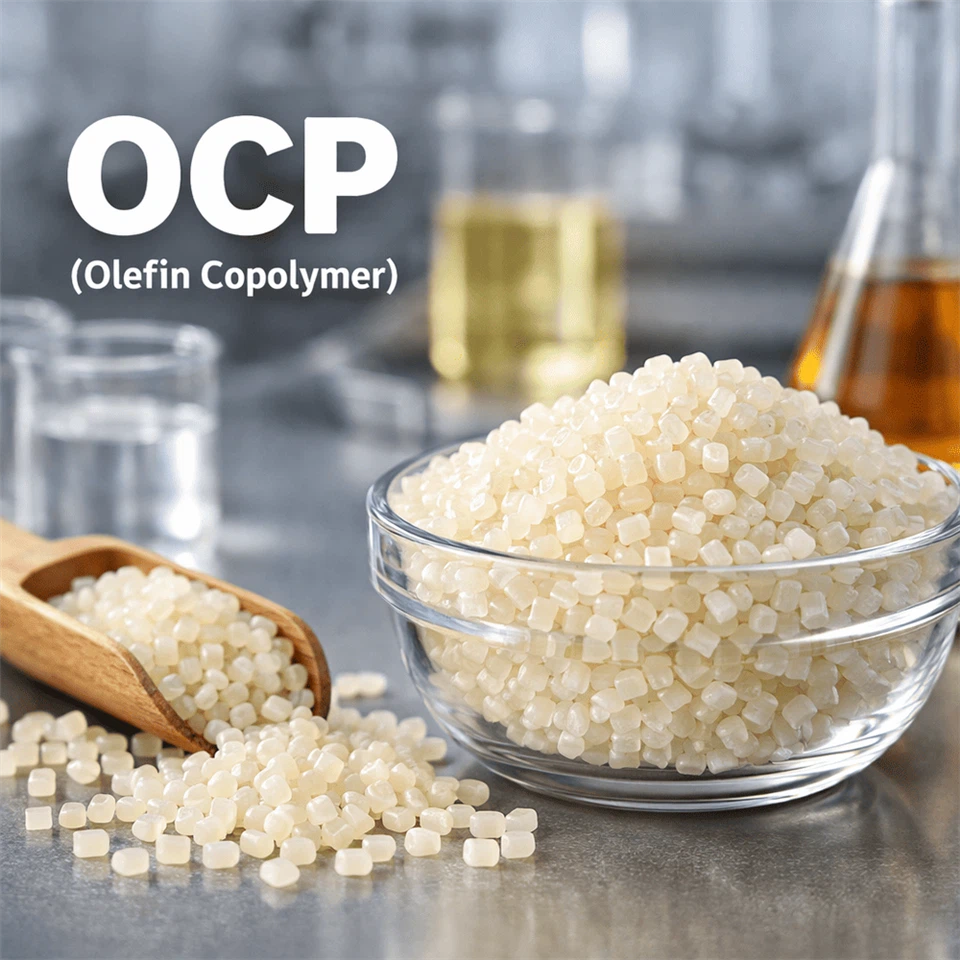
⚗️ Overview: What Is OCP (Olefin Copolymer) Viscosity Index Improver?
OCP Olefin Copolymer (CAS No. 9010-79-1) is a high-performance, polymer-based viscosity index improver (VII) additive synthesized from ethylene and propylene monomers. It is one of the most widely used and trusted VII additives in modern lubricant formulations, prized for its outstanding shear stability, thermal stability, and broad base-oil compatibility.
OCP's unique linear polymer structure enables it to respond dynamically to temperature: at low temperatures the chains coil tightly, minimizing cold-cranking viscosity and reducing fuel consumption during cold starts; at high temperatures they expand, thickening the oil to maintain a robust lubricating film on pistons, crankshafts, and bearings. This dual behavior makes OCP indispensable for formulating fuel-efficient multi-grade engine oils (0W-20, 5W-40, 10W-50) and heavy-duty industrial lubricants.
💡 Sinolook is a professional China chemical export company with long-term partnerships with leading OCP manufacturers. We supply both solid-grade and liquid-grade OCP, as well as dispersant-type (D-OCP) variants, to global buyers across Europe, North America, the Middle East, and Asia-Pacific - with competitive pricing, flexible MOQ, and full technical documentation.

OCP (Olefin Copolymer) CAS 9010-79-1 - Molecular Structure & Lubricant Applications
💡 OCP vs. Other Viscosity Index Improvers
OCP is the dominant VII in engine oil volumes worldwide. Here is how it compares to other common polymer types:
| Property | OCP | PMA | HSD / SBR |
|---|---|---|---|
| Shear Stability | ⭐⭐⭐⭐⭐ | ⭐⭐⭐⭐ | ⭐⭐⭐ |
| Thickening Efficiency | ⭐⭐⭐⭐⭐ | ⭐⭐⭐⭐ | ⭐⭐⭐ |
| Low-Temperature Performance | ⭐⭐⭐ | ⭐⭐⭐⭐⭐ | ⭐⭐⭐ |
| Pour Point Depression | ❌ Needs separate PPD | ✅ Inherent | ❌ |
| Dispersant Functionality | ✅ (D-OCP type) | ✅ (D-PMA type) | ❌ |
| Cost Efficiency | Excellent | Moderate | Moderate |
| Heavy-Duty / Industrial Use | Excellent | Good | Limited |
✅ OCP delivers the highest thickening efficiency per unit mass among all VII types - ideal for high-treat-rate engine oil formulations and cost-sensitive industrial lubricants.
🔬 Technical Specifications
Standard parameters provided by Sinolook's verified China manufacturing partners. Custom molecular weights, SSI grades, and solid/liquid formats are available on request.
| Parameter | Standard Value | Significance |
|---|---|---|
| Appearance | White to off-white granular solid or viscous liquid | Free of visible impurities or agglomerates |
| Molecular Weight | 100,000 – 800,000 g/mol | Adjustable to match thickening & shear requirements |
| Shear Stability Index (SSI) | ≤ 20% (high-shear grade) | Key indicator of viscosity retention under mechanical shear |
| Viscosity Thickening Efficiency (VTE) | 5 – 25 mm²/s @ 100°C (5% in 150N base oil) | Reflects thickening power in the finished lubricant |
| Softening Point (solid grade) | 80 – 120°C | Ensures easy dissolution in base oil during blending |
| Flash Point (COC) | ≥ 200°C | Critical safety parameter for storage & transport |
| Volatility (Noack, 250°C/1h) | ≤ 10% | Minimizes oil consumption at high temperatures |
| Shelf Life | 24 months (sealed, cool & dry storage) | Stable long-term quality assurance |
✅ All specifications comply with international lubricant additive standards. CoA, SDS/MSDS, and third-party test reports (SGS / Intertek) available upon request.
🏭 Key Application Fields
🚗 1. Multi-Grade Engine Oils - Fuel Efficiency & Cold-Start Protection
OCP Olefin Copolymer is the dominant VII in global engine oil production, used extensively in 0W-20, 5W-30, 5W-40, and 10W-50 multi-grade formulations. Its exceptional thickening efficiency means formulators can achieve target viscosity grades with lower treat rates than competing polymers, delivering direct cost savings per finished oil batch. At cold temperatures the tightly coiled polymer chains allow fast oil flow to critical engine surfaces during start-up, reducing cold-start wear. At operating temperature the expanded chains maintain an adequate lubricating film thickness, preventing metal contact on pistons, crankshaft bearings, and camshafts.
Dispersant-type OCP (D-OCP) incorporates polar functional groups that suspend soot and oxidation by-products, helping maintain engine cleanliness and supporting API SP / ACEA C5 compliant extended drain interval formulations. China suppliers offer a full range of SSI grades (SSI 10–55) to match diverse engine oil specifications.
⚙️ 2. Industrial Gear Oils & Hydraulic Fluids - Heavy-Duty Performance
Industrial gearboxes, hydraulic systems, and turbines demand lubricants that hold their viscosity under extreme mechanical and thermal stress. OCP's superior shear stability - the best among all VII polymer types - makes it the preferred choice for high-pressure hydraulic fluids (ISO VG 32–68) and heavy-duty industrial gear oils (ISO VG 220–680). It ensures consistent viscosity across wide temperature ranges, maintaining precise actuator response in hydraulic circuits and reliable gear film thickness under boundary lubrication conditions. China manufacturers produce high-SSI-stability OCP grades specifically engineered for these demanding industrial environments.
🔄 3. Transmission Fluids & Specialty Lubricants - ATF, CVTF & Marine Oils
OCP is widely used in automatic transmission fluids (ATF), continuously variable transmission fluids (CVTF), and marine engine oils where high shear stability is non-negotiable. Marine diesel engine oils in particular demand VII polymers that survive the aggressive shear conditions of large two- and four-stroke engines while maintaining adequate viscosity throughout long drain intervals at sea. OCP's resistance to permanent viscosity loss under high-shear conditions makes it significantly more reliable in these applications than lower-SSI polymer alternatives. Customized OCP grades with tailored molecular weight distributions are available from China suppliers for specific OEM ATF and marine oil specifications.
📦 Storage & Handling Guidelines
🏪 Storage Conditions
- Cool, dry, well-ventilated warehouse; away from direct sunlight, heat sources & open flames
- Recommended storage temperature: 5°C – 30°C; avoid prolonged exposure above 45°C (may cause polymer degradation)
- Solid grade: sealed woven bags. Liquid grade: sealed metal drums. Keep all packaging airtight
- Keep separate from strong oxidants, acids, alkalis & incompatible chemicals
- Max stacking: 5 layers (solid) / 3 layers (liquid) to prevent deformation & leakage
⚠️ Handling Precautions
- Wear dust mask (solid grade), chemical-resistant gloves, safety goggles & protective clothing
- For solid OCP: dissolve in base oil at 80–100°C using dedicated mixing equipment; avoid high-speed stirring that may cause chain scission
- Avoid impact, dropping, or compression of packages to prevent material leakage
- Spills: collect with inert absorbents (sand or activated carbon); dispose per local environmental regulations - do not discharge into drains or soil
- Skin/eye contact: rinse immediately with plenty of water for at least 15 minutes; seek medical attention if irritation persists
🌐 How to Choose a Reliable China OCP Supplier
The right OCP supplier delivers consistent polymer structure batch-to-batch, transparent quality documentation, and responsive technical support. Evaluate candidates across these five dimensions:
Advanced Ziegler-Natta or metallocene polymerization reactors with tight ethylene/propylene ratio control are essential for consistent SSI and VTE performance.
ISO 9001, ISO 14001, and IATF 16949 certifications confirm compliance with global quality management and automotive supply chain standards.
A full range of SSI grades (low-SSI to high-SSI), solid and liquid formats, and ND-OCP / D-OCP options ensures you can source all your OCP needs from a single partner.
Suppliers with dedicated application engineers can assist with treat rate optimization, dissolution protocol, compatibility testing, and API/ACEA/OEM specification compliance.
OCP's raw material costs (ethylene, propylene) fluctuate with petrochemical markets. A reliable Chinese supplier with adequate safety stock and stable procurement channels protects your supply chain from volatility.
OCP is typically traded in 25 kg bags (solid) or 200 L drums / IBC totes (liquid). Volume pricing tiers activate at 1MT, 5MT, and 20MT+. Benchmark treat-rate efficiency - not just unit price - since a higher-SSI-stability grade may allow lower dosage, reducing total formulation cost per liter of finished lubricant. Long-term supply agreements with fixed-volume commitments unlock priority allocation during ethylene/propylene feedstock tightness periods.
❓ Frequently Asked Questions (FAQ)
Q1: What is the CAS number for OCP Olefin Copolymer?
The CAS number is 9010-79-1 for ethylene-propylene copolymer (OCP / EPM). It is also referred to as Ethylene Propylene Copolymer (EPC), Olefin Copolymer VII, or OCP viscosity modifier in industry literature. Please specify your target SSI grade and physical form (solid granules vs. liquid concentrate) when requesting a quotation.
Q2: What is the difference between solid OCP and liquid OCP concentrate?
Solid OCP (granular pellets or crumbs, typically 40–60% polymer content) requires dissolution in base oil at 80–100°C before blending. It offers lower shipping costs per unit of active polymer and longer shelf life. Liquid OCP concentrate (typically 10–15% polymer in base oil) is pre-dissolved and ready to blend at ambient temperature, reducing blending complexity and energy consumption, ideal for smaller blending operations or where heating equipment is unavailable.
Q3: What SSI grade should I choose for a 5W-30 engine oil formulation?
For passenger car 5W-30 (PCMO), SSI grades of 25–45 are typical, balancing thickening efficiency with long-term viscosity retention. For heavy-duty diesel engine oils (HDEO) where shear stability is paramount, SSI ≤ 20 grades are preferred. Our technical team can recommend the optimal SSI / treat-rate combination for your specific base oil and target viscosity grade.
Q4: Does OCP also depress pour point like PMA?
No. OCP does not inherently depress pour point - a separate Pour Point Depressant (PPD) additive is required in multi-grade engine oil and low-temperature hydraulic fluid formulations. This is one key advantage of PMA over OCP. However, for high-volume cost-sensitive applications where pour point is managed by the PPD package, OCP's superior thickening efficiency and shear stability make it the economically preferred VII choice.
Q5: What documentation is available for import and quality verification?
Sinolook provides a complete documentation package with every shipment: Certificate of Analysis (CoA), Safety Data Sheet (SDS/MSDS), commercial invoice, packing list, Bill of Lading, and Certificate of Origin. Third-party inspection reports (SGS, Intertek, BV) and REACH compliance documentation are available upon request.
📩 Contact Sinolook – Your Trusted Partner for OCP Olefin Copolymer
Sinolook is a professional chemical export company connecting global lubricant formulators with China's leading OCP manufacturers. Our OCP Olefin Copolymer (CAS 9010-79-1) - available in solid and liquid grades, ND and dispersant types - meets rigorous international quality standards and is trusted by customers across Europe, North America, the Middle East, and Asia-Pacific. We provide complete one-stop procurement support: grade matching, technical consultation, quality inspection, customs documentation, and international logistics.
| 📧 | sales@sinolookchem.com | |
| 📱 | +86 181 5036 2095 | |
| 💬 | WeChat / Tel | +86 134 0071 5622 |
| 🌐 | Website | www.sinolookchem.com |
| 🏢 | Address | 38th Floor, Zhongmin Building, No. 72 North Hubin Road, Siming District, Xiamen, Fujian, China |
Hot Tags: OCP Olefin Copolymer (CAS 9010-79-1) – Viscosity Index Improver Additive | China Manufacturer & Bulk Supplier, China OCP Olefin Copolymer (CAS 9010-79-1) – Viscosity Index Improver Additive | China Manufacturer & Bulk Supplier manufacturers, suppliers