Hexylene Glycol as an Industrial Solvent
Coatings, Inks & Hydraulic Fluids
How 2-methyl-2,4-pentanediol (CAS 107-41-5) delivers coalescent, retarder, coupling, and viscosity-modifying functions across demanding industrial applications.
📋 Table of Contents
- Why MPD Excels as an Industrial Solvent
- Application 1: Waterborne Coatings - Coalescent & Flow Agent
- Application 2: Printing Inks - Retarder & Coupling Solvent
- Application 3: Fire-Resistant Hydraulic Fluids
- Application 4: Industrial Cleaners & Degreasers
- Application 5: Construction Chemicals & Adhesives
- Application 6: Chemical Synthesis & Polymerisation
- Industrial Grades, Purity & Packaging
- Industrial Safety & Handling Summary
- Frequently Asked Questions
1 ⚗️ Why MPD Excels as an Industrial Solvent
Not all solvents can straddle the boundary between aqueous and organic systems while maintaining low volatility, acceptable toxicology, and regulatory compliance across global markets. 2-Methyl-2,4-pentanediol (MPD) does all three, which explains its sustained industrial relevance over more than six decades of commercial production.
The compound's industrial utility stems from four core physical attributes working in concert:
💧 Full Water Miscibility
Compatible with 100% aqueous systems - essential for waterborne industrial formulations.
🌡️ High Boiling Point (197–198 °C)
Low volatility means slower evaporation - critical for open-time control in coatings and inks.
⚖️ Balanced LogP (0.58)
Amphiphilic character enables coupling between polar and non-polar components in complex formulations.
✅ Mild Toxicity & Regulatory Status
Listed on REACH, TSCA, and IECSC. Not classified as VOC under most regulatory definitions - a key advantage over ketone and ester solvents.
For a comprehensive overview of MPD's physical and chemical properties, see: What Is 2-Methyl-2,4-Pentanediol? Uses, Properties & Industry Overview →
2 🎨 Application 1: Waterborne Coatings - Coalescent & Flow Agent
The transition from solvent-borne to waterborne coatings technology - driven by increasingly stringent VOC regulations in the EU, North America, and China - has created strong demand for high-performance coalescent solvents. Hexylene glycol is one of a select group of diol solvents that fulfils this role effectively in both architectural and industrial maintenance coatings.
🔧 How MPD Functions as a Coalescent
In waterborne latex systems (acrylic, vinyl-acrylic, styrene-acrylic), polymer particles are dispersed in water but must fuse into a continuous film upon drying. This fusion requires the polymer to reach its glass transition temperature (Tg) under ambient conditions - often impossible without a coalescent solvent that temporarily plasticises the polymer particles.
MPD acts as an efficient temporary plasticiser: it partitions into the polymer-particle surface layer during film formation, lowering the effective Tg and allowing complete particle coalescence at lower temperatures. Once the film is fully formed and MPD evaporates (slowly, due to its high boiling point), the polymer network returns to its design Tg, giving the film its full hardness and performance.
| Coating Parameter | Without Coalescent | With MPD (3–8%) | Benefit |
|---|---|---|---|
| MFFT (Minimum Film Formation Temp.) | 15–25 °C (typical) | Reduced by 5–15 °C | Application in cold conditions |
| Surface Levelling | Brush marks visible | Smooth, uniform film | Improved aesthetics |
| Open Time (workability) | Short | Extended significantly | Easier brush/roller application |
| Film Cracking / Mud-cracking | Risk at low temperatures | Eliminated | Film integrity maintained |
| Final Film Hardness | Baseline | Equivalent (after full cure) | No long-term plasticisation |
📐 Recommended Use Levels in Coatings
🔹 Architectural / decorative paints: 3–6% on total formulation weight
🔹 Industrial maintenance coatings: 5–10% depending on polymer Tg
🔹 Wood coatings and lacquers: 3–8% for film build and flow
🔹 Floor coatings: 5–8% for hard-wearing film formation at ambient temperature
MPD's VOC classification is an important consideration for formulators targeting low-VOC architectural paint specifications. In the EU, under the Decopaint Directive (2004/42/EC), the VOC classification depends on the boiling point threshold - MPD's boiling point of 197–198 °C places it at the borderline of VOC/non-VOC classification, and its use should be verified against the specific national regulation applicable to the target market. For the coatings deep-dive including VOC compliance guidance, see our article: Hexylene Glycol in Coatings & Inks: How MPD Improves Film Formation and Flow →
3 🖨️ Application 2: Printing Inks - Retarder & Coupling Solvent
The global transition to water-based printing inks in flexographic and gravure printing - driven by food packaging regulations (EU Regulation 10/2011, FDA 21 CFR) and workplace safety concerns - has made high-boiling water-miscible solvents like MPD indispensable in ink formulation.
🖨️ Key Functions in Water-Based Inks
🔸 Retarder / Open-Time Extender: MPD's high boiling point and relatively low evaporation rate slow down the drying of the ink film on the anilox roll and printing plate, preventing premature drying and plate blinding - one of the most common causes of print defects in flexographic presses operating at high ambient temperatures.
🔸 Coupling Solvent: Water-based inks contain both polar components (binders, pigment dispersions) and non-polar components (waxes, slip agents, defoamers). MPD bridges these phases, maintaining a homogeneous, stable ink system throughout the press run without phase separation or viscosity drift.
🔸 Pigment Wetting Aid: Its surface-active character improves the wetting of pigment particles by the aqueous ink vehicle, contributing to better colour development and gloss in the dried print.
🔸 Substrate Adhesion Promoter: MPD's interaction with polymer substrate surfaces (OPP, PET, PE films) can improve ink adhesion by temporarily plasticising the substrate surface layer during printing, improving intermolecular contact between ink and film.
Typical addition levels in water-based flexographic and gravure inks: 2–8% on total formulation weight, with higher levels (5–8%) used in summer formulations or high-speed presses prone to plate drying.
4 ⚙️ Application 3: Fire-Resistant Hydraulic Fluids
In high-temperature industrial environments - steel mills, die-casting operations, foundries, and underground mining - the use of conventional petroleum-based hydraulic fluids poses unacceptable fire risks. Water-glycol hydraulic fluids (also designated HFC under ISO 6743-4) are the industry-standard fire-resistant alternative, and hexylene glycol is a key functional component in their formulation.
🔧 MPD's Role in HFC Hydraulic Fluids
| Function | How MPD Contributes | Performance Impact |
|---|---|---|
| Viscosity Modification | Controls fluid viscosity within ISO VG 46/68 target range across operating temperature | Consistent hydraulic system response across temperature |
| Freeze Point Depression | Lowers the freeze point of the water base to below −20 °C at typical use concentrations | Year-round operability in cold climates |
| Lubricity Enhancement | MPD's polar groups adsorb onto metal surfaces, forming a boundary lubrication layer | Reduced wear on pumps, seals, and valves |
| Corrosion Inhibitor Solubilisation | Acts as co-solvent for organic corrosion inhibitor packages in the aqueous base | Stable, clear fluid formulation without phase separation |
| Evaporation Control | Low vapour pressure minimises glycol evaporation losses from reservoir | Reduced top-up frequency and fluid concentration drift |
Typical glycol content in HFC fluids is 35–50% by weight, combining MPD with other glycols (polyalkylene glycols, ethylene glycol) to achieve the desired viscosity and freeze-point specification. The water content (50–65%) provides the fire-resistant character by absorbing latent heat and suppressing ignition.
5 🧹 Application 4: Industrial Cleaners & Degreasers
Hard-surface cleaners, industrial degreasers, and metal cleaning formulations frequently employ glycol-based coupling solvents to solubilise surfactant concentrates and hydrocarbon soils into stable, water-dilutable products. MPD serves this coupling function particularly well in alkaline aqueous cleaner concentrates used in automotive, aerospace, and metal fabrication industries.
✅ Performance Advantages in Cleaner Formulations
🔹 Coupling efficiency: At 2–5%, MPD creates clear, single-phase concentrates from otherwise incompatible surfactant + oil mixtures - eliminating the need for ethylene glycol monobutyl ether (banned or restricted in several markets)
🔹 Soil emulsification: Assists in emulsifying mineral oils, cutting fluids, and stamping oils into the aqueous cleaning phase during the wash cycle
🔹 Flash-point compliance: Unlike glycol ethers with lower flash points, MPD (flash point 88 °C) provides a safer handling profile that meets workplace safety regulations in most jurisdictions
🔹 Rinse-aid action: Reduces surface tension of the rinse water, improving drainage and drying on metal and glass surfaces
6 🏗️ Application 5: Construction Chemicals & Adhesives
In the construction chemicals sector, MPD finds use as a plasticiser co-solvent and open-time extender in several product categories where water-based polymer systems need to remain workable during application before achieving full cure.
🔸 Cementitious renders and mortars: At 0.5–2% on polymer content, MPD extends the open time of polymer-modified cementitious systems (acrylic or EVA-based), allowing masons additional working time before the binder sets - critical in hot, dry climates.
🔸 Water-based contact adhesives: Reduces the minimum film formation temperature of polychloroprene and acrylic dispersions, improving bond formation at ambient temperatures below the polymer Tg.
🔸 Tile adhesives and grouts: Improves the flexibility and crack resistance of dried adhesive films by acting as a temporary internal plasticiser that gradually migrates out over weeks, leaving a dimensionally stable bond line.
7 🧪 Application 6: Chemical Synthesis & Polymerisation
As a bifunctional diol, MPD participates directly in polymer-forming reactions and serves as a ligand precursor in several important catalytic systems.
🔸 Polyester synthesis: MPD's branched structure introduces steric bulk into polyester backbones, producing polymers with lower crystallinity, improved flexibility, and better low-temperature performance compared to linear diol-based polyesters. Used in specialty polyester polyols for polyurethane coatings and adhesives.
🔸 Polyurethane intermediates: As a chain extender at low concentrations, MPD modifies the hard/soft segment ratio of polyurethane elastomers, tuning mechanical properties for applications in synthetic leather, films, and coatings.
🔸 Ziegler-Natta catalyst ligands: In the production of isotactic polypropylene, MPD-based internal electron donors (diether donors) are used in MgCl₂-supported Ziegler-Natta catalyst systems. This high-purity, catalytic-grade use demands the highest specification MPD available.
8 📦 Industrial Grades, Purity & Packaging
| Grade | Purity | Typical Applications | Available Packaging |
|---|---|---|---|
| Industrial Grade | ≥ 98.0% | Coatings, inks, hydraulic fluids, cleaners, adhesives | 200 kg drum, 1,000 kg IBC, ISO tank |
| High-Purity Industrial | ≥ 99.0% | Chemical synthesis, polyurethane polyols, catalyst support | 200 kg drum, 1,000 kg IBC |
| Cosmetic / Pharma Grade | ≥ 99.5% | Personal care, pharmaceutical excipients | 25 kg drum, 200 kg drum, 1,000 kg IBC |
All grades are available with full documentation: Certificate of Analysis (COA), Safety Data Sheet (SDS/MSDS), REACH registration confirmation, and where required, Halal/Kosher certification. Sinolook Chemical exports to 50+ countries with standard lead times of 7–15 working days for container loads. View full product specifications and request a quote →
9 🛡️ Industrial Safety & Handling Summary
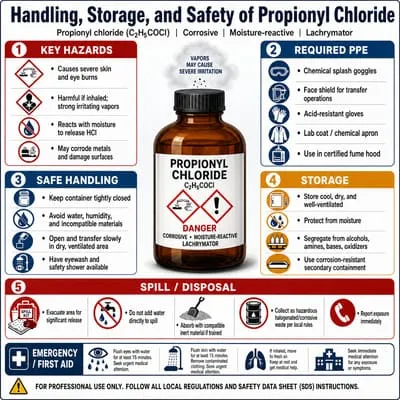
For industrial users, hexylene glycol presents a manageable safety profile compared to many conventional solvent alternatives. Its relatively high flash point of 88 °C (closed cup) means it is classified as a combustible liquid rather than a flammable liquid under GHS, significantly simplifying storage classification requirements in many jurisdictions.
⚠️ Industrial Handling Key Points
🔸 Storage classification: Combustible liquid - Class IIIB (USA NFPA 30) or Category 4 (GHS). Not flammable at room temperature.
🔸 Storage conditions: Sealed containers, 5–35 °C, away from oxidising agents and open ignition sources. Compatible with stainless steel, HDPE, and lined steel tanks.
🔸 Vapour exposure: Negligible at ambient temperature (vapour pressure <0.1 hPa at 20 °C). General ventilation sufficient under normal conditions.
🔸 PPE requirements: Chemical splash goggles and nitrile gloves for routine handling; face shield and chemical-resistant apron for bulk transfer operations.
🔸 Spill response: Absorb with dry inert material. Flush residual with large amounts of water. Dispose per local industrial waste regulations.
For the complete SDS and GHS classification data, including transport classification (UN number, packing group, ERG guide) for international shipments, visit our product page to download the official SDS →
10 ❓ Frequently Asked Questions
Q: Is hexylene glycol classified as a VOC?
A: This depends on the jurisdiction and regulatory definition. Under the EU Decopaint Directive, VOC is defined as any organic compound with an initial boiling point ≤250 °C at 101.3 kPa. MPD's boiling point of 197–198 °C places it within this definition technically, though its slow evaporation rate means its actual contribution to coating VOC is very low. In the US EPA architectural coatings rule, MPD is often listed as an exempt compound from VOC limits. Always confirm with the applicable national or regional regulation for your specific product category.
Q: Can MPD replace glycol ethers (e.g. EGBE) as a coatings coalescent?
A: In many formulations, yes. MPD can partially or fully replace ethylene glycol monobutyl ether (EGBE / butyl cellosolve) as a coalescent and coupling solvent, with the benefit of a significantly better toxicological profile. EGBE is restricted or phased out in several markets due to reproductive toxicity concerns, making MPD an attractive regulatory-compliant alternative. Performance parity will depend on the specific polymer system and may require formulation adjustment.
Q: What is the typical dosage of MPD in waterborne latex paints?
A: Typically 3–8% on total formulation weight, equivalent to approximately 8–20% on polymer solids weight. The optimal level depends on the polymer's Tg and the MFFT reduction required for the target application temperature range. Always conduct MFFT measurement and scrub resistance testing to optimise the specific dose for your system.
Q: Is hexylene glycol compatible with water-glycol hydraulic fluid standards?
A: Yes. Hexylene glycol-containing HFC fluids are classified under ISO 6743-4 (type HFC) and meet the fire-resistance requirements defined by Factory Mutual (FM), Cincinnati Milacron, and various OEM hydraulic system approvals. Specific OEM approval should always be confirmed before service use.
Q: What is the minimum order quantity for industrial-grade MPD from China?
A: Sinolook Chemical can supply from 1 × 200 kg drum for trial orders up to full 20-foot container loads (~16 mt). For bulk requirements of multiple containers, ISO tank delivery is also available on request. Contact us for a freight-inclusive quotation →
📚 Related Articles in This Series
🏭 Source Industrial-Grade Hexylene Glycol
Sinolook Chemical supplies ≥98% industrial-grade 2-methyl-2,4-pentanediol with full SDS, COA, and REACH documentation. Drums, IBCs, and ISO tank available for export worldwide.
Request Industrial Quote →