🏭 Production & Chemistry
How Butyric Acid Is Produced: Oxo Synthesis vs Fermentation
Two routes, one molecule. Here is how butyric acid (CAS 107-92-6) is made - from propylene in a reactor and from sugar in a fermenter.
Butyric acid (butanoic acid, CAS 107-92-6) reaches the market by two fundamentally different manufacturing paths: a petrochemical route built on propylene, and a bio-based route built on fermentation. ⚗️ Both yield the same C₄ carboxylic acid, but they differ in feedstock, footprint, economics and the story a buyer can tell about origin.
Understanding how butyric acid is produced also helps explain why grade and purity vary between suppliers. This article breaks down each route and compares them. It is part of our butyric acid series - for the buyer's angle, see How to Choose a Butyric Acid Grade, and for the wider picture, the pillar guide Butyric Acid Uses and Applications.
🛢️ Route 1: The Petrochemical (Oxo) Route
This is the dominant industrial route for large-volume butyric acid. It proceeds in two main stages, both well-established in the chemical industry.
Step 1 - Hydroformylation (Oxo Synthesis) 🔧
Propylene reacts with synthesis gas (carbon monoxide + hydrogen) over a catalyst to add an aldehyde group - this is hydroformylation, also called the oxo process:
propylene + CO + H₂ → butyraldehyde (n-butanal)
The reaction is tuned to favor the linear (normal) butyraldehyde needed for n-butyric acid. 💡
Step 2 - Oxidation 🔥
The butyraldehyde is then oxidized - typically with air or oxygen - to the carboxylic acid:
butyraldehyde + O₂ → butyric acid
After purification (usually by distillation), the result is high-purity butyric acid suitable for technical and higher grades.
✅ Strengths - high volume, consistent quality, cost-effective, mature technology.
⚠️ Considerations - petroleum-derived feedstock; origin is fossil-based rather than renewable.
🌱 Route 2: The Bio-Based (Fermentation) Route
Butyric acid is also a natural fermentation product - in fact, it is one of the short-chain fatty acids that gut microbes make from fiber. Industrially, this same biology is harnessed to make renewable butyric acid.
Anaerobic Fermentation 🦠
Sugars from renewable feedstocks (such as glucose from starch or biomass) are fermented by anaerobic bacteria - most notably Clostridium species - which convert them into butyric acid:
sugars → butyric acid (+ by-products)
The broth is then processed to separate and concentrate the acid - the recovery and purification step is where much of the cost and engineering challenge lies. 🌾
✅ Strengths - renewable, non-petroleum origin; attractive for buyers with sustainability goals or "natural" positioning where regulations permit.
⚠️ Considerations - historically higher cost; by-product formation and downstream separation add complexity; scale is smaller than the petrochemical route.
📊 The Two Routes Compared
| Factor | Oxo / Petrochemical | Fermentation / Bio-based |
|---|---|---|
| Feedstock | Propylene (fossil) | Sugars (renewable) |
| Scale | High volume | Smaller, growing |
| Cost | Lower | Typically higher |
| Origin story | Petroleum-derived | Renewable / bio |
| Main challenge | Fossil feedstock | Recovery/purification |
💡 Thermodynamic and physical property data for butyric acid can be checked at the NIST Chemistry WebBook, and identity data at PubChem (CID 264).
🎯 From Route to Grade
Whichever route is used, the crude acid is purified - most often by distillation - to reach the assay and impurity profile a given grade requires. The production route and the depth of purification together determine whether the material qualifies as technical, feed, food or pharmaceutical grade. For exact specifications, purity and SDS, see the N-Butyric Acid product page, and to match a grade to your use, How to Choose a Butyric Acid Grade.
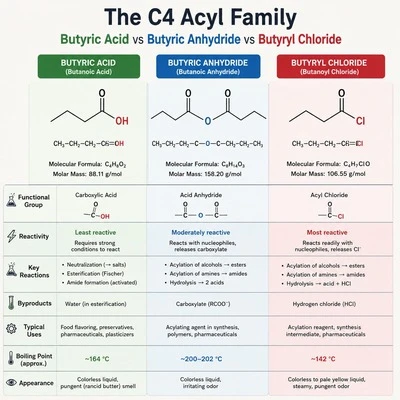
🔗 The same butyraldehyde and butyric acid chemistry also feeds the wider C4 acyl family - butyric anhydride and butyryl chloride. See how they compare in Butyric Acid vs Butyric Anhydride vs Butyryl Chloride.
💬 Frequently Asked Questions
🔹 How is butyric acid made industrially?
Most industrial butyric acid is made petrochemically: propylene is hydroformylated (the oxo process) to butyraldehyde, which is then oxidized to butyric acid and purified by distillation. A bio-based route using bacterial fermentation of sugars is also used.
🔹 What is the oxo process?
Hydroformylation - the "oxo" process - reacts an alkene (here propylene) with carbon monoxide and hydrogen over a catalyst to form an aldehyde (butyraldehyde). That aldehyde is the direct precursor oxidized to butyric acid.
🔹 Can butyric acid be made from renewable sources?
Yes. Anaerobic bacteria such as Clostridium ferment sugars from renewable feedstocks into butyric acid - the same natural process behind butyrate in the gut. It offers a bio-based origin, though recovery and purification make it typically more costly than the petrochemical route.
🔹 Is bio-based butyric acid the same as petrochemical butyric acid?
Chemically, yes - it is the identical molecule (CAS 107-92-6). The difference is the feedstock and origin story, plus potential variations in impurity profile that purification addresses to meet the target grade.
🔹 Does the production route affect purity?
The route influences the crude impurity profile, but final purity is set by the purification step (typically distillation). Both routes can reach high purity; the grade you buy reflects how far the material is refined and what documentation accompanies it.
📚 Related Reading
🧬 Derivatives
Butyric Acid vs Butyric Anhydride vs Butyryl Chloride →Where the C4 acyl family goes next - reactivity, handling and uses compared.
🛒 Buyer's Guide
How to Choose a Butyric Acid Grade →How the production route and purification set the grade you can buy.
🗺️ Pillar Guide
Butyric Acid Uses and Applications →The complete map of where butyric acid goes once it leaves the reactor.
Need Consistent, Well-Documented Butyric Acid? 📩
We supply butyric acid (CAS 107-92-6) with the specification, Certificate of Analysis and SDS your process requires. Tell us your grade and volume and our team will match documentation and packaging. Sinolook Chemical, backed by the Sinolook group, serves customers in 50+ countries.