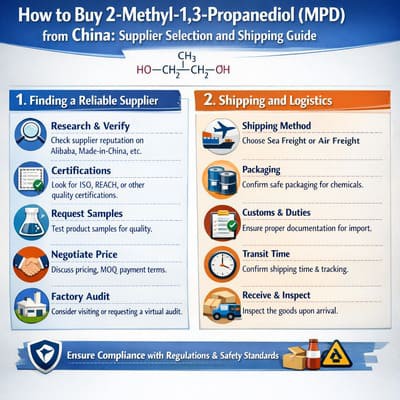
How to Buy 2-Methyl-1,3-Propanediol (MPD) from China:
Supplier Selection & Shipping Guide
Supplier qualification · Documentation · Packaging · Incoterms · Customs clearance · First-order checklist
🔗 View MPD Product Page & Request a Quote📋 Table of Contents
- Why Source MPD from China?
- Types of Chinese MPD Suppliers
- Supplier Qualification: What to Check
- Essential Documentation for Every Shipment
- Packaging Options & Selection Guide
- Incoterms & Price Basis
- Shipping & Customs Clearance
- Incoming Quality Control on Arrival
- First-Order Checklist
- Frequently Asked Questions
🌏 1. Why Source MPD from China?
China has become the dominant global source for competitively priced MPD, with multiple manufacturers having established commercial-scale production capability. For buyers in Europe, Southeast Asia, the Middle East, Africa, and the Americas, Chinese-origin MPD offers a compelling combination of cost, availability, and logistics simplicity.
Chinese MPD is typically 40–60% lower cost than equivalent Western-produced MPD; competitive manufacturing and scale benefits passed through to export price
Non-DG sea freight classification means simple B/L booking, no DG surcharge, no vessel acceptance complications, and standard container logistics
China's major chemical export ports (Shanghai, Ningbo, Tianjin, Qingdao, Guangzhou) serve all major global trade lanes with frequent sailings
Established exporters provide REACH OR letters, GHS SDS in destination language, COA per batch, and TSCA certification for US buyers
Top-tier Chinese MPD producers now supply at ≥99.5% GC purity with APHA ≤10 cosmetic grade, fully competitive with Western specifications
🏭 2. Types of Chinese MPD Suppliers
Not all Chinese chemical companies that offer MPD are equivalent. Understanding the supplier landscape helps buyers identify who they are actually buying from, and what that means for quality, pricing, and reliability.
| Supplier Type | Description | Advantages | Cautions |
|---|---|---|---|
| Direct manufacturer | Factory that actually produces MPD; has production facility, R&D, and quality system | Best pricing; direct quality control; production insight; can customise grades | May have high MOQ; export experience varies; language barrier possible |
| Trading company (专业贸易商) | Buys from manufacturers and resells; specialises in chemical export; has export licence | Professional export documentation; English-speaking; flexible MOQ; multi-product one-stop | Margin added vs manufacturer; limited production visibility; quality depends on source factory |
| Manufacturer + trader (生产贸易一体) | Manufacturer with in-house export/trading arm; best of both categories | Manufacturer pricing + professional export service; direct quality accountability | Verify the manufacturer claim - confirm production facility exists |
| Alibaba / platform reseller | Online listing; actual identity unclear until due diligence; may be manufacturer, trader, or broker | Easy to contact; price indication available online | High risk of unknown sourcing chain; quality inconsistency; avoid for recurring commercial supply without thorough qualification |
| Regional distributor (outside China) | Regional warehouse holds Chinese MPD for faster local delivery (Europe, SE Asia, Middle East) | Short lead time (days not weeks); local language support; can supply small quantities | Premium vs direct import; limited volume availability; depends on their stock cycles |
💡 About Sinolook Chemical: Sinolook Chemical Co., Ltd. (sinolookchem.com) is a manufacturer-backed specialty chemical exporter based in China, supplying MPD and other specialty chemicals to customers in 50+ countries. We hold an EU REACH Only Representative appointment for MPD, provide GHS SDS in all major languages, supply COA per batch, and offer drum, IBC, and ISO tank packaging. Contact us at WhatsApp 0086 18150362095 or sales@sinolookchem.com.
🔍 3. Supplier Qualification: What to Check
A robust supplier qualification process is essential before placing commercial orders. For MPD from China, the following checks are minimum best practice for industrial buyers; more extensive audits are recommended for cosmetic-grade applications.
- Business licence - verify company registration, registered capital, and business scope includes chemical manufacture or trade
- Export licence - confirm the company is registered for chemical export (customs registration code visible)
- Sample COA - request a representative COA from a recent production batch; check purity, water content, colour, refractive index vs your spec
- SDS - request GHS-compliant SDS in English (and your destination language if applicable); check all 16 sections are complete and consistent
- REACH OR letter (EU buyers) - confirm they hold an EU OR appointment or can provide one
- ISO 9001 or equivalent - quality management system certification; indicates process control
- Request 500 mL–1 L sample with COA; pay sample freight
- Receive sample, verify COA against your incoming QC results - key tests: GC purity, refractive index, water content (Karl Fischer), APHA colour
- Run formulation trial with sample MPD in your specific application (polyester synthesis, PU trial, cosmetic formulation)
- Compare trial results against your reference standard (incumbent supplier or internal spec)
- Document trial results in qualification report; confirm "pass" before commercial order
- For cosmetic grade: additionally test heavy metals (ICP), microbial limits (if required by your cosmetic safety assessment)
For high-volume or mission-critical supply, a factory visit or third-party audit (SGS, Intertek, Bureau Veritas) provides the highest level of assurance. Key areas to assess:
- Production capacity and actual vs nominal utilisation
- QC laboratory capabilities (GC, Karl Fischer, refractometer)
- Storage and handling conditions (contamination prevention)
- EHS compliance (relevant for cosmetic and food-adjacent buyers)
- Export documentation process and track record
🚩 Red Flags to Watch For
- Refuses to provide COA or SDS before order
- Cannot provide sample for qualification
- COA lacks GC purity, water content, or refractive index
- Price significantly below market (possible substandard product)
- Cannot confirm CAS 2163-42-0 identity
- SDS is generic / not product-specific
- Requests large upfront payment before any documentation
- No traceable business address or registration number
📄 4. Essential Documentation for Every Shipment
Correct documentation is not optional - missing or incorrect documents can result in customs delays, goods being held, regulatory non-compliance, or rejected invoices. The table below specifies what to request for each major destination market.
| Document | EU | USA | SE Asia / ME | Purpose / Notes |
|---|---|---|---|---|
| Commercial Invoice | ✅ | ✅ | ✅ | Product name, CAS 2163-42-0, HS 2905.39, quantity, unit price, total value, Incoterms, origin |
| Packing List | ✅ | ✅ | ✅ | Number of packages, net/gross weight, dimensions; must match B/L exactly |
| Bill of Lading (B/L) | ✅ | ✅ | ✅ | Non-DG B/L - no DGD required; "General Cargo" or "Chemical" description; verify "Non Dangerous Goods" noted if required by your customs broker |
| Certificate of Analysis (COA) | ✅ | ✅ | ✅ | Per batch; signed by QC manager; must include GC purity, water, APHA, RI, and date of manufacture |
| Safety Data Sheet (SDS) | ✅ (language) | ✅ (OSHA HazCom) | ✅ | EU: REACH Annex II 2020/878 format in destination language; USA: OSHA 29 CFR 1910.1200 HazCom 2012 format |
| Certificate of Origin (COO) | ✅ | ✅ | ✅ | For duty preference (e.g., ASEAN FTA, GSP schemes); "Made in China" standard COO from local Chamber of Commerce; Form A for preference if applicable |
| REACH OR Letter | ✅ Required | N/A | N/A | EU only; confirms REACH registration and OR appointment; ECHA registration number; required for EU compliance |
| TSCA Certification | N/A | ✅ Required | N/A | US only; Positive TSCA certification on invoice or separate letter; filed with CBP at entry |
| Dangerous Goods Declaration (DGD) | Not required ✅ | Not required ✅ | Not required ✅ | MPD is not IMDG dangerous goods at ambient temperature - no DGD required for any market; confirm "Not DG" statement is included in shipping instructions to forwarder |
| Cosmetic-grade quality statement | If cosmetic grade | If cosmetic grade | If cosmetic grade | Letter confirming INCI name, intended cosmetic use, heavy metals ≤5 ppm, and compliance with EU Cosmetics Regulation / FDA cosmetics requirements |
📦 5. Packaging Options & Selection Guide
MPD's non-DG status, liquid state, and density near 1.0 g/cm³ make it compatible with all standard liquid chemical packaging formats. The right packaging choice balances per-unit cost, handling practicality, and unloading infrastructure at your facility.
| Net weight | ~190 kg |
| Per 20ft FCL | ~80 drums (~15.2 MT) |
| MOQ | 1 pallet (~4–5 drums) |
| Unloading | Drum pump or bung |
| Best for | 1–10 MT/order; no bulk storage |
✅ Widely available; easy to handle manually in lab/small production. ⚠️ Highest cost per MT; steel drums require proper disposal or reconditioning.
| Net weight | ~1,000 kg |
| Per 20ft FCL | ~20 MT (20 IBCs) |
| MOQ | 1 IBC (1 MT) |
| Unloading | Bottom valve + pump |
| Best for | 2–20 MT/order; forklift access |
✅ Good cost/handling balance; forklift stackable; pallet-based delivery. ⚠️ IBC return/disposal logistics; verify IBC suitability (UN HDPE or metal cage).
| Net weight | ~18–22 MT |
| Per shipment | 1 ISO tank = 1 delivery unit |
| MOQ | 1 ISO tank (~18 MT) |
| Unloading | Bottom discharge valve + hose |
| Best for | >15 MT/order; tank storage available |
✅ Lowest per-MT cost; no packaging waste; reusable tank. ⚠️ Requires bulk liquid storage tank and unloading pump at destination; ISO tank hire fee applies.
📦 Packaging Selection Decision Guide
| Annual MPD Volume | Recommended Packaging | Typical Order Frequency | Storage Infrastructure Needed |
|---|---|---|---|
| < 2 MT/year | Drums (200 L) | As needed / 1–2×/year | Standard drum storage area; drum pump |
| 2–10 MT/year | IBC or drums | Quarterly | Forklift; IBC pallet area; pump |
| 10–40 MT/year | IBC (primary) ⭐ | Monthly to quarterly | Forklift; sealed storage; transfer pump to day tank |
| > 40 MT/year | ISO tank ⭐⭐ | Monthly or bi-monthly ISO tanks | Fixed bulk storage tank (>20 MT); centrifugal pump; nitrogen blanket capability |
📜 6. Incoterms & Price Basis
Incoterms 2020 define the allocation of costs, risks, and responsibilities between buyer and seller. For international MPD purchases from China, the most commonly used Incoterms are FOB, CIF, and DAP/DDP. Understanding which to use directly affects your total landed cost calculation and risk exposure.
| Incoterm | What the Seller Covers | What the Buyer Covers | Best For |
|---|---|---|---|
| EXW | Product at factory gate only | All costs: local truck, export customs, ocean freight, import customs, delivery | Buyers with own China forwarder; maximum control over logistics |
| FOB ⭐ | Product + China trucking + export customs clearance; loaded on vessel | Ocean freight, marine insurance, import customs, destination delivery | Most common for MPD; buyer controls ocean freight booking; allows freight rate optimisation |
| CIF | Product + China trucking + export customs + ocean freight + basic insurance | Import customs, destination port handling, inland delivery | Buyers without freight forwarder relationships; simpler logistics for smaller orders |
| DAP | Product + all freight to named destination + unloading | Import customs and duties only | Buyers who want simple logistics; supplier manages freight risk to destination |
| DDP | Everything: product + all freight + import customs + duties + delivery | Nothing - receive goods at door | Buyers wanting complete simplicity; note: DDP may create VAT complexity; less common for large volumes |
💡 Recommendation: For most buyers, FOB China main port is the preferred Incoterm for MPD. It gives you full visibility and control over ocean freight costs (which can vary significantly between carriers), lets you consolidate MPD with other chemicals from China in the same shipment for freight efficiency, and clearly defines the risk transfer point (vessel rail at loading port). Use CIF if you are placing your first order and lack a China-route freight forwarder relationship - it is simpler to manage for initial orders.
🚢 7. Shipping & Customs Clearance
- Origin ports: Shanghai, Ningbo (most common for East China chemical exporters); Tianjin (North China); Guangzhou/Shenzhen (South China)
- Container type: 20ft FCL standard dry container for drums/IBCs; ISO tank for bulk
- Transit times (indicative): Europe ~25–35 days; US East Coast ~28–35 days; SE Asia ~7–14 days; Middle East ~18–28 days; Australia ~18–25 days
- No DG surcharge - MPD ships as general cargo; quote ocean freight without DG surcharge from all carriers
- Book sailing 2–3 weeks in advance for FCL; 3–4 weeks for ISO tank (tank sourcing + cleaning lead time)
- Export HS code: 2905.3990
- No export licence required for MPD
- Chinese export VAT refund: check current MPD refund rate (HS 2905.39 may be eligible for 9–13% VAT rebate - this benefit is typically built into the FOB price)
- Provide: commercial invoice, packing list, contract, export customs declaration
- Customs clearance time: 1–3 working days for standard chemical export at major Chinese ports
- HS import code: 2905.39 (verify 10-digit national code with customs broker)
- EU: standard customs declaration; MFN duty rate ~0% for 2905.39; VAT on import value; REACH-compliant SDS required
- US: CBP entry (Form 7501); MFN + Section 301 tariff (verify current rate); TSCA positive certification on entry; ISF filing 24h before loading
- Typical customs clearance time: 1–3 days with complete documentation; delays often caused by missing or incorrect SDS or COO
| Destination Region | Sea Transit (days) | Total Lead Time (FOB to delivery) | Recommended Buffer Stock |
|---|---|---|---|
| 🇬🇧🇪🇺 Europe (NW) | 28–35 | 35–50 days | 8–10 weeks |
| 🇺🇸 USA (East Coast) | 28–35 | 40–55 days | 10–12 weeks |
| 🇺🇸 USA (West Coast) | 14–18 | 22–35 days | 6–8 weeks |
| 🌏 SE Asia (Singapore, Vietnam, Indonesia) | 7–14 | 14–25 days | 4–6 weeks |
| 🇮🇳 India | 12–18 | 20–30 days | 5–7 weeks |
| 🌍 Middle East (UAE, Saudi Arabia) | 18–25 | 25–38 days | 7–9 weeks |
| 🌍 East/West Africa | 25–35 | 35–55 days | 10–12 weeks |
🧪 8. Incoming Quality Control on Arrival
Even with a qualified supplier, incoming QC on every batch is good practice and may be required by your quality management system. For MPD, a practical incoming QC protocol can confirm identity and key quality parameters quickly with standard lab equipment.
| Test | Method | Pass Specification | Equipment | Time to Result |
|---|---|---|---|---|
| Refractive index (identity) | ASTM E1967 / direct RI measurement | nD²⁰ = 1.445–1.447 | Abbe refractometer | 5 minutes ✅ |
| Colour (APHA) | ASTM D1209 | Industrial: ≤20; Cosmetic: ≤10 | Colorimeter or visual comparison | 10 minutes ✅ |
| Water content | Karl Fischer (KF) | ≤ 0.1% (industrial); ≤ 0.05% (cosmetic) | KF titrator | 20–30 minutes ✅ |
| GC purity (confirmation) | GC-FID (DB-FFAP or similar polar column) | ≥ 99.0% (industrial); ≥ 99.5% (cosmetic) | GC-FID instrument | 30–60 minutes |
| Acidity | Potentiometric titration | ≤ 0.01% (as acetic acid) | pH meter + NaOH titration | 15–20 minutes |
| Heavy metals (cosmetic grade) | ICP-OES | ≤ 5 ppm total; Pb ≤ 1 ppm | ICP-OES (outsource if needed) | 1–3 days (if outsourced) |
💡 Rapid incoming QC protocol (10 minutes): For most industrial applications, a rapid two-test incoming QC - refractive index (nD²⁰ within 1.445–1.447) + APHA colour (≤20) - is sufficient to confirm identity and basic quality on receipt. These two measurements take under 10 minutes with standard lab equipment, require no reagents, and will catch the most common issues (wrong product, severe contamination, or significant colour degradation). Run GC purity and Karl Fischer as full confirmation tests on the first batch from a new supplier, and subsequently quarterly for established suppliers.
✅ 9. First-Order Checklist
Use this checklist to ensure all steps are completed before, during, and after your first MPD order from a Chinese supplier.
- ☐ Confirm CAS 2163-42-0 and grade (industrial / cosmetic)
- ☐ Receive and review supplier's COA (sample batch)
- ☐ Receive GHS SDS in your language; confirm 16 sections complete
- ☐ EU buyers: receive REACH OR letter; verify ECHA registration number
- ☐ US buyers: confirm supplier can provide TSCA positive certification
- ☐ Request and test qualification sample; run incoming QC + formulation trial
- ☐ Agree Incoterms, packaging format, and price per MT
- ☐ Confirm packaging (drums / IBC / ISO tank) and verify your storage can receive it
- ☐ Place purchase order with product name, CAS, grade, quantity, packaging, Incoterms, and destination
- ☐ Confirm payment terms (L/C, T/T 30% deposit + 70% on B/L copy, or open account for established buyers)
- ☐ Nominate your freight forwarder (if FOB); or confirm supplier's forwarder (if CIF)
- ☐ Request pre-shipment COA from the specific production batch
- ☐ Instruct supplier to confirm "Non Dangerous Goods" on B/L
- ☐ US buyers: confirm TSCA certification wording on invoice
- ☐ Cross-check shipping documents against original order: quantity, grade, COA batch number, B/L
- ☐ Inspect packaging on receipt (no visible damage, leakage, or container deformation)
- ☐ Run incoming QC: refractive index + APHA (immediate); KF + GC purity (within 48h)
- ☐ Compare incoming QC results against supplier COA - raise NCR immediately if out-of-spec
- ☐ Store in designated area with correct labelling; update inventory management system
- ☐ Provide feedback to supplier on quality and documentation; build supplier score card
- ☐ File documents for regulatory records (SDS, COA, REACH OR letter) per your document control system
📚 Complete MPD Article Series
❓ 10. Frequently Asked Questions
Q1: How do I know if a Chinese MPD supplier is a manufacturer or just a trading company?
The most reliable verification steps are: (1) request the company's Chinese business licence (营业执照) - the business scope (经营范围) will state whether they manufacture chemicals (生产) or trade chemicals (贸易); (2) ask for the production facility address and verify it on Google Maps / Baidu Maps - a manufacturer will have a factory in a chemical industrial park, not just an office in a city centre; (3) ask for a factory audit or at minimum a video call walking through their facility; (4) use Alibaba's "Verified Supplier" or "Manufacturer" badge as a first filter, but verify independently - these badges are supplier-reported and not always independently audited; (5) check the company in the Chinese National Enterprise Credit Information System (gsxt.gov.cn) using the company's unified social credit code - this shows their registration status, legal representative, and whether they have any administrative penalties. Trading companies are not inherently inferior to manufacturers for MPD, but you should know what you are buying and price accordingly.
Q2: What are the typical payment terms for MPD from Chinese exporters?
Payment terms vary by buyer-seller relationship maturity and order size. Common structures are: (1) T/T 30% advance + 70% against copy of B/L - most common for new relationships; protects seller against non-payment; buyer gets B/L copy (sufficient for customs) before releasing final payment; (2) T/T 100% in advance - sometimes demanded by sellers from unknown buyers; not recommended unless you have thoroughly qualified the supplier; (3) Irrevocable L/C at sight - protects both parties; adds bank charges (~0.5–1% of invoice value); preferred for large orders with new suppliers; (4) Open account (Net 30–60 days) - available with established suppliers after track record of payments; lowest admin burden; (5) T/T 100% against full set of original B/L documents - used for CIF transactions; seller surrenders control at payment. For your first order with a new supplier, T/T 30/70 with B/L copy or L/C at sight is the recommended balanced approach.
Q3: Can I consolidate MPD with other chemicals from China in one shipment?
Yes - MPD's non-DG classification makes it straightforward to consolidate with other chemicals in a single container shipment. In an LCL (Less than Container Load) consolidation, MPD can share space with other non-DG chemicals without special segregation requirements. In an FCL shipment, MPD can be combined with other non-DG chemicals from the same Chinese supplier or from different suppliers via a consolidation freight forwarder (co-loading). The main practical consideration is chemical compatibility in the unlikely event of container damage and leakage - MPD is fully water-miscible and reactive with isocyanates, so avoid packing adjacent to isocyanate products in the same container without separation. Otherwise, MPD's benign hazard profile makes it one of the easiest specialty chemicals to handle in mixed-product consolidations.
Q4: What should I do if my incoming MPD fails the refractive index test?
An out-of-specification refractive index on arrival is a significant finding and should trigger an immediate non-conformance report (NCR). The RI specification for MPD is nD²⁰ = 1.445–1.447; a reading outside this range indicates either wrong product (possibly 1,3-propanediol, propylene glycol, or another glycol of similar appearance), significant contamination, or degradation. Immediate steps: (1) quarantine the batch - do not use in production; (2) notify the supplier in writing with your measured RI value and the COA RI value; (3) send a counter-sample back to the supplier for their re-test (retain your own sealed portion for reference); (4) if RI is substantially off (e.g., below 1.440 or above 1.450), also run GC to confirm identity - PG has RI ~1.432; 1,3-PDO has RI ~1.439; diethylene glycol has RI ~1.447 (close to MPD - run GC to distinguish); (5) if confirmed non-conforming, invoke the purchase contract quality clause for replacement or credit. Most reputable Chinese suppliers will replace or refund non-conforming batches - document the dispute process in writing from the start.
Q5: How long does sea freight from China to Europe take and how does this affect my ordering cycle?
Sea freight from Chinese ports (Shanghai, Ningbo) to Northwest Europe (Rotterdam, Hamburg, Felixstowe) typically takes 28–35 days transit, and total lead time from order confirmation to delivered goods at your warehouse is typically 35–50 days when accounting for production and packing lead time (3–7 days), export customs clearance (1–3 days), transit time (28–35 days), import customs clearance (1–3 days), and inland delivery (1–3 days). This means to maintain uninterrupted production, you should place a new order when your on-hand stock reaches approximately 6–8 weeks of consumption - equivalent to about 1.5× your transit time. For monthly MPD consumption of 2 MT, this implies ordering when stock drops to ~3 MT; for 5 MT/month, order when stock drops to ~7.5 MT. Establish a simple min/max inventory policy based on your actual monthly consumption rate and this lead time framework.
Q6: How do I get a quote for MPD from Sinolook Chemical?
Contact Sinolook Chemical directly with your requirements for a prompt quotation. To receive an accurate quote, please provide: (1) product: 2-methyl-1,3-propanediol, CAS 2163-42-0; (2) grade: industrial or cosmetic; (3) quantity: MT per order or per year; (4) packaging: drums / IBC / ISO tank; (5) destination port / country; (6) Incoterms preference (FOB or CIF); (7) any specific documentation requirements (REACH OR, TSCA cert, language-specific SDS). We will provide: firm price quotation; COA from recent production batch; GHS SDS in your language; REACH OR letter (EU buyers); TSCA certification text (US buyers); and sample availability for qualification. We typically respond to quote requests within 24 hours on business days. Contact us at: WhatsApp 0086 18150362095 · WeChat/Tel 0086 13400715622 · Email sales@sinolookchem.com.
Ready to Order MPD from China?
Contact Sinolook Chemical Today
Industrial & cosmetic grade MPD · REACH OR letter · GHS SDS in your language
COA per batch · Non-DG sea freight · Drums, IBC & ISO tank · 50+ countries · Prompt quotation