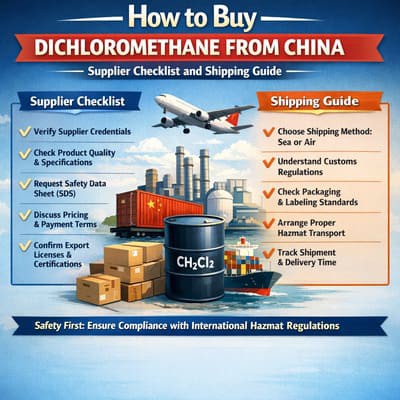
How to Buy Dichloromethane from China:
Supplier Checklist & Shipping Guide
Supplier evaluation · Specification · Documentation · DG shipping · Lead times · Common pitfalls
🔗 View DCM Product Page📋 Table of Contents
- Understanding Chinese DCM Supplier Types
- Specification: What to Request & How to Read a COA
- Supplier Evaluation Checklist
- Required Trade & Compliance Documents
- Packaging Options: Drums vs ISO Tanks
- Dangerous Goods Shipping: UN 1593 Requirements
- Lead Times, Port Loading & Transit
- Incoterms Selection & Price Basis
- Common Pitfalls & How to Avoid Them
- Frequently Asked Questions
🏭 1. Understanding Chinese DCM Supplier Types
Before placing an enquiry, it is important to understand that "Chinese DCM suppliers" are not a homogeneous group. The supply chain has three distinct layers, each with different capabilities, pricing structures, and risk profiles. Knowing which type of supplier you are dealing with directly affects quality consistency, documentation reliability, and your ability to resolve problems.
Large-scale chlorinated solvent manufacturers operating their own chlorination and distillation facilities. Examples include major Shandong and Jiangsu chemical groups. These suppliers own the production process end-to-end, can provide authentic batch-level COAs, and have the production consistency needed for pharmaceutical applications.
⚠️ Considerations: Higher MOQ (often 1 FCL minimum); may not offer small trial orders
Established chemical traders who purchase DCM from multiple producers, provide logistics and export services, and often add value through documentation management, label printing, and multi-product consolidation. Many have long-term supply agreements with specific producers. COA quality depends entirely on their relationship with the source manufacturer.
⚠️ Considerations: Must verify source factory; COA may be reissued (not original manufacturer's)
Online marketplace listings (Alibaba, Made-in-China, Global Sources) and commission-based brokers who connect buyers with Tier 1 or Tier 2 suppliers but may have limited chemistry knowledge and variable quality control. Appropriate for market intelligence and initial supplier discovery, but require additional verification before placing commercial orders.
⚠️ Considerations: Variable reliability; DG expertise may be limited; verify credentials carefully
💡 Recommendation for new buyers: For initial purchases, Tier 2 established chemical trading companies with documented export experience in DCM and other Class 6.1 dangerous goods often offer the best combination of accessibility, flexibility, and documentation capability. Once you have established volume requirements and a track record, engaging directly with Tier 1 producers typically delivers better pricing and more reliable quality documentation.
📋 2. Specification: What to Request & How to Read a COA
Specifying DCM correctly in your purchase order is the single most effective quality control step available to importers. A clear specification forces the supplier to confirm they can meet your requirements before shipment - and gives you the basis for rejection if a batch falls short.
| Parameter | Standard Technical Grade | High-Purity / Industrial | Pharma Grade (ICH Q3C) | Test Method |
|---|---|---|---|---|
| GC Purity | ≥99.0% | ≥99.5% | ≥99.9% | GC-FID |
| Chloroform (CHCl₃) | ≤200 ppm | ≤50 ppm | ≤10 ppm | GC-ECD or GC-FID |
| Water Content | ≤100 ppm | ≤50 ppm | ≤30 ppm | Karl Fischer |
| Acidity (as HCl) | ≤5 ppm | ≤3 ppm | ≤1 ppm | Potentiometric titration |
| APHA Colour | ≤10 | ≤5 | ≤5 | Colorimetric |
| Non-volatile Residue | ≤5 ppm | ≤3 ppm | ≤2 ppm | Gravimetric |
| Refractive Index (nD²⁰) | 1.4240 ± 0.0005 | 1.4242 ± 0.0004 | 1.4242 ± 0.0003 | Refractometer (Abbe) |
| Density (20 °C, g/cm³) | 1.322–1.328 | 1.323–1.327 | 1.323–1.327 | Hydrometer / pycnometer |
🔍 How to Read a DCM Certificate of Analysis (COA)
Confirm the COA shows: manufacturer name and address, batch/lot number, production date, and the CAS number 75-09-2. Reject COAs without a specific lot number - these cannot be traced to a specific production batch.
GC purity should be listed with the test method (GC-FID). Chloroform content is the most critical impurity - verify it is ≤10 ppm for pharma, ≤200 ppm for technical. Water content (Karl Fischer) should be listed separately from "moisture".
Refractive index (1.4242 ± 0.0005) and density (1.323–1.328 g/cm³) are easy to verify on arrival with basic instruments. Significant deviation from these values is a red flag for dilution or contamination.
The COA should be signed (or digitally authorised) by the QC department, dated, and issued within 6 months of shipment. COAs older than 12 months are not acceptable for pharmaceutical purchases - request a re-test if material has been in storage.
✅ 3. Supplier Evaluation Checklist
Use the checklist below when evaluating a new Chinese DCM supplier. Work through all items before placing the first commercial order. For high-volume or pharmaceutical purchases, an on-site audit of the Tier 1 producer facility adds significant assurance.
- Verify business registration on China's SAMR Enterprise Credit system (国家企业信用信息公示系统)
- Confirm chemical business licence (危险化学品经营许可证) - mandatory for DCM trading in China
- Check export licence status - confirm company is registered as an export entity
- Verify physical address independently (Google Maps, Baidu Maps)
- Request company profile with years in business, product range, key export markets
- Request sample batch COA for the grade you intend to purchase
- Confirm QC laboratory capabilities: GC-FID, Karl Fischer, APHA colour, refractometer
- Ask which manufacturer's DCM they supply (for Tier 2 traders)
- For pharma grade: confirm ICH Q3C Class 2 documentation experience
- Request a sample for incoming QC testing before first commercial order
- Confirm supplier has experience exporting Class 6.1 dangerous goods internationally
- Request a sample DGD (Dangerous Goods Declaration) from a previous shipment
- Confirm they use UN-certified packaging (UN 1H1 or UN 1A2 steel drums)
- Ask which shipping lines they work with for DG cargo
- Confirm ability to provide MSDS / SDS in your required language
- Request a sample commercial invoice and packing list format
- Confirm they can issue a Certificate of Origin (CO/FORM A) if FTA tariff preference applies
- For EU buyers: confirm REACH registration number availability
- Confirm all documentation can be provided in English (not Chinese only)
- Assess responsiveness: prompt, accurate replies to technical questions indicate good quality control culture
📄 4. Required Trade & Compliance Documents
A complete DCM shipment documentation package is non-negotiable for customs clearance, dangerous goods compliance, and quality assurance. The table below distinguishes between core commercial documents (required for all shipments) and supplementary compliance documents (required for specific grades or destinations).
| Document | Required For | Key Content to Verify |
|---|---|---|
| Commercial Invoice | All shipments | Product name (Dichloromethane), CAS 75-09-2, HS code 2903.12, quantity (MT), unit price, total value, Incoterm, buyer and seller details |
| Packing List | All shipments | Number of drums / containers, net weight per drum, gross weight, dimensions, UN packaging type (e.g. 1H1 steel drum) |
| Bill of Lading (B/L) | All sea shipments | Confirm "Dichloromethane" or "Methylene chloride" as cargo description; UN 1593 Class 6.1 PG III; DG declaration clause |
| Certificate of Analysis (COA) | All shipments | Batch number, production date, all specified parameters with test results and pass/fail, QC authorisation signature |
| Safety Data Sheet (SDS) | All shipments | GHS-compliant, 16 sections, in destination language (English for most markets; verify if local language required), UN transport info on Section 14 |
| Dangerous Goods Declaration (DGD) | All sea/air shipments | UN 1593, Class 6.1, PG III, "DICHLOROMETHANE" proper shipping name, total quantity, packaging type and quantity, signed by DG-certified shipper |
| Certificate of Origin (CO) | Many destinations | Country of origin: China; HS 2903.12; FORM A (for GSP preference where applicable); issued by CCPIT or local Chamber of Commerce |
| REACH Registration Number | EU / UK buyers | Must appear on SDS Section 1 for EU/UK market. Format: 01-XXXXXXXXXXXX-XX-XXXX. Confirm Only Representative (OR) arrangement if supplier is non-EU/UK. |
| ICH Q3C Documentation Package | Pharma buyers | Supplier declaration of ICH Q3C Class 2 compliance; analytical method validation data; batch-specific COA aligned with pharma grade specification |
| Container Load Plan / Stowage Certificate | FCL drum shipments | Required by some shipping lines for DG cargo; confirms drums are secured, upright, and stowed to IMDG requirements |
⚠️ Critical documentation rule: Never accept a DGD that has not been signed by a person holding a current IATA/IMDG Dangerous Goods Transport certification. An uncertified or improperly completed DGD is the most common cause of DCM shipments being rejected, detained at port, or returned at the buyer's cost. Always request a copy of the shipper's DG certification with the first shipment.
📦 5. Packaging Options: Drums vs ISO Tanks
DCM is commercially available in two primary packaging forms for international shipment. The choice between drums and ISO tanks depends primarily on your monthly consumption volume, storage infrastructure, and the flexibility you need to manage multiple grades.
| Net weight per drum | ≈ 265 kg |
| Drums per 20' FCL | 80 drums (~21 MT) |
| UN packaging code | 1A2/Y/265/... (steel drum) |
| Minimum order | 1 FCL (80 drums) |
| Cost vs ISO tank | +$30–60/MT higher |
| Storage infrastructure | Standard drum storage |
| Best for | Flexible volumes; multi-grade; trial orders |
⚠️ Limitations: Higher per-unit cost; more handling; drum disposal/return needed
| Net capacity | 18,000–22,000 L (≈ 24–29 MT) |
| Tank standard | ISO T4/T7 (Class 6.1) |
| Minimum order | 1 ISO tank (≈ 22–26 MT) |
| Cost vs drums | $30–60/MT lower |
| Tank return | Required (cost varies) |
| Storage infrastructure | Tank unloading pump + storage tank |
| Best for | High-volume; single-grade; bulk users |
⚠️ Limitations: Tank return logistics and cost; requires bulk storage infrastructure; single grade only
💡 Volume break-even: For buyers consuming ≥ 40 MT per month (approximately 2 FCL drum shipments or 1–2 ISO tanks), ISO tank procurement typically saves USD 30–60/MT - worth USD 1,200–2,400 per tank on a 22 MT load. Below 40 MT/month, drums generally offer better overall value when factoring in the complexity of ISO tank logistics and infrastructure costs.
🚢 6. Dangerous Goods Shipping: UN 1593 Requirements
DCM is classified as a dangerous good for all modes of international transport. For sea freight - by far the most common mode for bulk DCM - the International Maritime Dangerous Goods (IMDG) Code governs packaging, stowage, documentation, and emergency response requirements. Understanding these requirements helps buyers identify compliant suppliers and avoid costly shipping errors.
⚠️ UN Classification for Dichloromethane
| Transport Mode | Governing Regulation | Key Requirements for DCM |
|---|---|---|
| Sea freight (IMDG) | IMDG Code (current edition) | DGD required; UN-certified packaging; Class 6.1 label; Stowage Category A (no restriction); Segregation Group: None |
| Air freight (IATA) | IATA Dangerous Goods Regulations | Passenger aircraft: 60 L/package max; cargo aircraft: 220 L/package max. PI 602. Not practical for bulk - sea freight strongly preferred. |
| Road (ADR / RID) | ADR 2023 (Europe); 49 CFR (USA) | Standard PG III requirements; no tunnel restriction code; Class 6.1 diamond placard on vehicle; transport documentation (ADR certificate or Bill of Lading with DG details) |
| Inland waterway | ADN (Europe) | Permitted under ADN tank regulations for bulk liquid transport on European waterways |
🚢 Sea Freight DG Compliance Checklist for Buyers
- DGD signed by IMDG-certified shipper
- Proper shipping name: "DICHLOROMETHANE"
- UN number 1593 on DGD and packages
- Class 6.1 labels on all packages
- Packing Group III stated
- UN-certified drum markings visible (1A2/Y or 1H1/Y)
- SDS included in at least one package in the consignment
- Container packed to IMDG stowage requirements
- B/L cargo description includes UN number and class
- Emergency response number on DGD (24/7 contact)
⏱️ 7. Lead Times, Port Loading & Transit
Understanding the full lead time from order placement to product available for use is essential for managing DCM inventory and avoiding production disruptions. The table below provides typical timeframes for different destinations.
📅 Order-to-Delivery Timeline (Typical)
| Destination | Loading Port (China) | Sea Transit | Typical Total Lead Time (Order to Cleared) |
|---|---|---|---|
| India (Nhava Sheva / Chennai) | Qingdao, Shanghai, Tianjin | 10–18 days | 30–45 days |
| Southeast Asia (Singapore, Bangkok, Jakarta) | Shanghai, Ningbo, Guangzhou | 5–12 days | 25–38 days |
| Middle East (Dubai, Jeddah) | Shanghai, Qingdao, Tianjin | 12–22 days | 32–50 days |
| Africa (Lagos, Mombasa, Durban) | Shanghai, Ningbo | 20–35 days | 40–60 days |
| Europe (Rotterdam, Hamburg) | Shanghai, Ningbo, Tianjin | 25–35 days | 45–60 days |
| South America (Santos, Callao) | Shanghai, Ningbo | 25–38 days | 45–65 days |
📝 8. Incoterms Selection & Price Basis
The choice of Incoterm determines where the risk and cost transfer from seller to buyer, and affects your total landed cost calculation significantly. For dangerous goods like DCM, some Incoterms are more practical than others.
| Incoterm | Risk Transfer Point | Who Handles What | Recommended? |
|---|---|---|---|
| FOB | When goods pass ship's rail at loading port | Seller: export clearance, DGD, loading. Buyer: freight, insurance, import clearance, all costs from loading port. | ✅ Common |
| CIF | When goods pass ship's rail at loading port (risk); destination port (cost) | Seller: export clearance, DGD, freight, insurance to destination. Buyer: import clearance, duties, inland delivery. | ✅ Most common for DCM |
| CFR | Same as CIF but buyer arranges own insurance | Seller: export clearance, DGD, freight. Buyer: insurance, import clearance, duties. | ✅ Acceptable |
| EXW | At seller's premises | Buyer handles everything including export clearance and DGD preparation in China - very difficult for foreign buyers without Chinese entity. | ❌ Not recommended |
| DDP | At buyer's named destination | Seller handles everything including import duties and inland delivery - maximum seller responsibility. Rare for chemical exports but occasionally offered by large traders. | ⚠️ If available, verify costs |
💡 Recommendation: For most international DCM purchases from China, CIF (named destination port) is the most practical Incoterm. It places freight booking and DG documentation responsibility on the Chinese seller - who is more familiar with Chinese port DG procedures - while keeping import clearance and duties with the buyer, who has the local customs knowledge. Always specify "CIF [your port]" in the purchase order and confirm that the CIF price includes DG surcharges, which can be substantial for Class 6.1 cargo.
⚠️ 9. Common Pitfalls & How to Avoid Them
Based on the most frequently encountered issues in DCM import transactions, the following pitfalls account for the majority of quality rejections, customs delays, and commercial disputes. Awareness is the first step to avoidance.
What happens: Generic or undated COAs may not correspond to the actual shipped material. If quality issues arise, there is no way to trace the batch back to a specific production run or hold the supplier accountable.
Solution: Require that every COA includes a unique lot/batch number and production date that matches the drum or tank labels on arrival.
What happens: An incomplete DGD - missing proper shipping name, UN number, packing details, or certifier signature - can cause the shipping line to reject the booking, the container to be offloaded mid-voyage, or customs to detain the shipment on arrival.
Solution: Request a sample DGD from a previous shipment before placing your first order. Confirm the person signing the DGD holds a current IMDG certification. Review the DGD against the UN 1593 requirements before vessel departure.
What happens: Technical grade DCM (chloroform up to 200 ppm) cannot be used directly in GMP pharmaceutical processes where ICH Q3C limits apply (chloroform ≤10 ppm in product). Using technical grade material in pharma processes can result in finished product OOS (out-of-specification) results and batch rejection.
Solution: Always specify grade explicitly in the purchase order. For pharma use, require "pharmaceutical grade, ≥99.9% purity, chloroform ≤10 ppm, with ICH Q3C Class 2 documentation."
What happens: In China, trading and exporting hazardous chemicals (including DCM) requires specific licences (危险化学品经营许可证 and export registration). Unlicensed suppliers may offer lower prices but can cause shipments to be held by Chinese customs on export.
Solution: Request the supplier's business licence and hazardous chemical operating licence. Cross-check on China's National Enterprise Credit Information Publicity System (gsxt.samr.gov.cn).
What happens: Buyers comparing Chinese FOB quotes with US domestic or non-China-origin quotes on an equivalent basis fail to add the 25% Section 301 tariff to the Chinese price, making the Chinese quote appear more competitive than it actually is in delivered-duty-paid terms.
Solution: Always add the applicable Section 301 tariff to Chinese FOB pricing for US-destination total cost calculations. Verify the current tariff rate with a licensed US customs broker before quoting or purchasing.
What happens: Chinese MEE environmental inspections can shut down multiple DCM production facilities simultaneously with 1–2 weeks notice. Buyers with only 2–3 weeks of safety stock find themselves scrambling to source from alternative suppliers at spot premiums of 20–40% above contracted prices.
Solution: Maintain 6–8 weeks of safety stock. Monitor Chinese MEE inspection announcements. Keep a second qualified supplier on standby even if they are not your primary source.
📚 Related Articles in This Series
❓ 10. Frequently Asked Questions
Q1: What is the minimum order quantity (MOQ) for DCM from China?
For sea freight shipments, the practical minimum is typically one 20-foot FCL container: approximately 80 × 200 L drums = 21 MT net. Many Chinese suppliers will not quote for less than one FCL due to the logistics overhead of DG documentation and shipping line booking. For buyers needing less than one FCL, consolidation services (LCL - Less than Container Load) are available but are significantly more expensive per MT for Class 6.1 dangerous goods and require careful cargo compatibility review with the consolidator. Some established trading companies offer trial shipments of 10–20 drums by LCL for new buyers, at a significant cost premium.
Q2: How do I verify whether a Chinese DCM supplier is legitimate?
Four practical verification steps: (1) Business registration check - search the company name or unified social credit code (统一社会信用代码) on China's National Enterprise Credit Information Publicity System at gsxt.samr.gov.cn. This shows registration status, legal representative, and any administrative penalties. (2) Chemical business licence - ask for a copy and verify it includes hazardous chemicals operating scope (危险化学品). (3) Sample COA and DGD - request samples from a previous shipment. Legitimate exporters can provide these readily; fraudulent operators often cannot. (4) Video call factory visit - request a video call where the contact person is physically at the warehouse or plant, not in an office. Most established Chinese chemical companies will accommodate this for serious buyers.
Q3: What is a Dangerous Goods Declaration and why is it critical?
A Dangerous Goods Declaration (DGD) is a mandatory shipping document that confirms hazardous cargo is classified, packaged, labelled, and described in compliance with the IMDG Code (for sea freight) or IATA DGR (for air freight). It is signed by the shipper (or their DG-certified agent) who certifies that all DG requirements have been met. For DCM, it must state: UN 1593, "DICHLOROMETHANE", Class 6.1, PG III, total net quantity, package type and count. Shipping lines will reject a booking or offload the container if the DGD is missing, incorrect, or unsigned. Customs authorities at many destinations require the DGD as part of import clearance. A compliant DGD is the single most important document in a DCM shipment after the Bill of Lading.
Q4: Can I ship DCM by air freight from China?
Technically yes - DCM is permitted on cargo aircraft under IATA Packing Instruction 602, with a maximum net quantity of 220 L per package. However, air freight of DCM is almost never commercially viable for bulk orders because: (1) Air freight rates for Class 6.1 DG cargo are 10–20× sea freight rates per kg; (2) package size limits mean multiple small packages for any significant volume; (3) many airlines refuse to carry chlorinated solvent Class 6.1 cargo due to their own cargo acceptance policies. Air freight of DCM is occasionally used for laboratory-scale research samples (1–4 L bottles) or for emergency pharmaceutical manufacturing situations where the cost of production delay exceeds the air freight premium.
Q5: What should I do when DCM arrives and drums are damaged or the COA doesn't match specification?
Follow this sequence: (1) Photograph all damage before offloading from the container - you need photographic evidence dated before you take custody for insurance and supplier claims. (2) Note any discrepancies on the delivery receipt - a clean signed delivery receipt is used by freight companies and suppliers to deny claims later. (3) Hold non-conforming material in quarantine - do not use material that does not meet specification while the claim is being resolved. (4) Notify the supplier in writing within 48 hours with photographic evidence and COA comparison data. (5) For insurance claims: contact your cargo insurer with the Bill of Lading, survey report, and damage photos. (6) Resample and retest if in doubt about quality - your own QC test result is the definitive basis for a quality dispute.
Q6: Why should I choose Sinolook Chemical as my DCM supplier?
Sinolook Chemical Co., Ltd. is an established Chinese specialty chemical exporter with experience shipping DCM and other chlorinated solvents to 50+ countries. We provide: complete trade documentation (commercial invoice, packing list, COA, SDS, DGD, certificate of origin); both technical grade and high-purity/pharmaceutical grade DCM with batch-specific COAs; support for ICH Q3C Class 2 documentation requirements for pharmaceutical customers; SDS in multiple languages; and reliable DG-compliant sea freight through established shipping line partnerships. Our team responds promptly to technical specification queries and can arrange sample shipments for quality qualification before commercial orders. Contact us via WhatsApp, WeChat, or email for a prompt quotation.
Ready to Place Your DCM Order?
Contact Sinolook Chemical
Technical & pharma grade DCM · Full documentation package · DG-compliant shipping
Export to 50+ countries · Drums & ISO tanks available · Responsive team