Isooctanoic Acid Regulatory Status:
REACH, TSCA & Global Compliance Guide
EU REACH SVHC · CLP H361 · Authorisation · US TSCA · China IECSC · Japan · Korea K-REACH · Transport
🔗 View Isooctanoic Acid Product Page⚖️ Disclaimer: Regulatory status changes frequently. This article reflects the regulatory position of isooctanoic acid / 2-ethylhexanoic acid (CAS 25637-84-7 / 149-57-5) as understood in early 2025. Always verify current status on official databases (ECHA, EPA, etc.) and consult your regulatory consultant. This article does not constitute legal advice.
📋 Table of Contents
- Global Regulatory Snapshot
- EU CLP Classification: H361 in Detail
- EU REACH: SVHC, Registration & Authorisation
- REACH Downstream User Obligations
- US TSCA Inventory & Compliance
- China: MEE/IECSC & Domestic Regulations
- Japan CSCL & Korea K-REACH
- Transport Regulations Summary
- Regulatory Comparison: IOA vs Isononanoic Acid
- Frequently Asked Questions
🌍 1. Global Regulatory Snapshot
| Jurisdiction | Regulation | Listed? | Special Status | Key Note |
|---|---|---|---|---|
| 🇪🇺 EU | REACH (1907/2006) | Registered ✅ | SVHC ⚠️ | 2-EHA (CAS 149-57-5) on SVHC Candidate List (H361); OR needed for EU importers; DNEL for reproductive endpoint applies |
| 🇪🇺 EU | CLP (1272/2008) | Classified ✅ | H361 ⚠️ | H227 + H315 + H319 + H361; GHS08 pictogram required on label; WARNING signal word |
| 🇺🇸 USA | TSCA | Active ✅ | No action ✅ | On Active TSCA Inventory; no Section 5/6 action; TSCA positive certification required at import |
| 🇨🇳 China | MEE/IECSC | Listed ✅ | Hazardous ⚠️ | Listed on IECSC; in China's Hazardous Chemicals Catalogue (危险化学品目录); requires hazardous chemical handling permits; Class 8 transport permit |
| 🇯🇵 Japan | CSCL / ISHL | Listed ✅ | General ✅ | General Chemical under CSCL; ISHL: Japanese GHS SDS required for supply; no priority designation |
| 🇰🇷 Korea | K-REACH | Listed ✅ | CMR ⚠️ | Existing Chemicals List; 2-EHA classified as CMR substance under K-REACH; additional obligations for CMR substances in Korea |
| 🇨🇦 Canada | CEPA/DSL | DSL ✅ | No action ✅ | On DSL; no CEPA Schedule 1 priority substance listing for IOA currently |
| 🌍 Transport | IMDG/ADR/IATA | DG Class 8 ⚠️ | UN 3265 | DGD required for all transport modes; DG surcharges apply; Class 8 PG III |
🏷️ 2. EU CLP Classification: H361 in Detail
The EU CLP Regulation (EC No 1272/2008) governs classification and labelling in the EU. The classification of 2-ethylhexanoic acid under CLP - particularly the H361 reproductive toxicity designation - is the central regulatory fact that drives all other compliance obligations.
| CLP Element | Detail for IOA / 2-EHA |
|---|---|
| Harmonised classification (Annex VI) | 2-EHA (CAS 149-57-5) has harmonised classification in CLP Annex VI, Table 3.1: Repr. 2 (H361); Skin Irrit. 2 (H315); Eye Irrit. 2 (H319); Flam. Liq. 4 (H227) |
| Harmonised H361 basis | H361: Suspected of damaging fertility or the unborn child. Basis: animal developmental and reproductive toxicity studies (OECD 414, 421, 422); effects on foetal development and fertility observed in rats and rabbits at doses above NOAEL ~100–200 mg/kg/day; insufficient human evidence for Cat. 1 but sufficient for Cat. 2 precautionary classification |
| Signal word | WARNING (H361 Cat.2 → WARNING not DANGER; H315 Cat.2 → WARNING; H319 Cat.2 → WARNING; H227 Cat.4 → WARNING) |
| GHS pictograms | GHS02 (flame - combustible liquid) · GHS07 (exclamation mark - skin/eye irritant) · GHS08 (health hazard - reproductive toxicant) |
| Key precautionary statements (H361) | P201: Obtain special instructions before use · P202: Do not handle until all safety precautions have been read · P280: Wear protective equipment · P308+P313: IF exposed or concerned: get medical advice/attention · P405: Store locked up |
| Harmonised vs self-classification | 2-EHA has a harmonised classification (CLH) in Annex VI for H361 - this means the classification is legally mandated and cannot be downgraded by a supplier through self-classification; all EU suppliers must use this classification |
| C&L Inventory (ECHA) | Notified by hundreds of registrants across EU; consistent H361 classification across notifications; available at clc.echa.europa.eu |
| Mixture classification | Formulations containing >0.3% 2-EHA must carry H361 classification and GHS08 on the SDS/label; some EU consumer restrictions apply to H361 substances in consumer products above threshold concentrations |
🇪🇺 3. EU REACH: SVHC, Registration & Authorisation
REACH (EC No. 1907/2006) is the central EU chemicals regulation. For isooctanoic acid, the most critical REACH elements are the SVHC listing of 2-EHA, the registration requirement, and the evolving authorisation pathway.
2-Ethylhexanoic acid (CAS 149-57-5) is on the SVHC Candidate List under REACH Article 57(c) - reproductive toxicant Category 1B or 2. The SVHC listing triggers several immediate obligations for downstream users and importers regardless of whether the substance appears on Annex XIV.
- Article 33: Suppliers of articles containing >0.1% w/w 2-EHA must provide SVHC information to customers and consumers on request
- Article 7(2): Producers/importers of articles containing >0.1% 2-EHA must notify ECHA if production/import exceeds 1 tonne/year
- SCIP database: EU companies placing articles on the market must submit SVHC information to the SCIP database (Waste Framework Directive requirement since January 2021)
| EC Number (2-EHA) | 205-743-6 |
| EC Number (mixture) | 247-180-8 |
| Registration status | Registered ✅ |
| Tonnage band | ≥1,000 tonnes/year (high tonnage) |
| Chemical Safety Report | Required (above 10 t/year); includes DNEL for reproductive endpoint |
| Only Representative (OR) | Required for non-EU manufacturers |
The REACH authorisation process (Annex XIV) requires companies to obtain authorisation from ECHA for continued use of SVHC substances in specified applications after a sunset date. As of early 2025, 2-EHA is on the SVHC Candidate List but has not yet been added to Annex XIV. However, the authorisation process is active for several reproductive toxicants, and the regulatory trajectory points toward potential Annex XIV listing for 2-EHA.
- Monitor ECHA's priority substance recommendations annually
- If added to Annex XIV, users would need to apply for authorisation or transition to INA / alternatives before the sunset date
- This regulatory uncertainty is one of the key drivers for proactive IOA → INA substitution in EU formulations
🔑 Only Representative (OR) for EU buyers: When a non-EU manufacturer (e.g., Chinese IOA producer) exports IOA to the EU, a REACH Only Representative must be appointed to carry the REACH registration obligations for EU importers. Without an OR, each EU importer independently carries the registration burden. For a SVHC substance like 2-EHA, the OR appointment is especially critical - EU procurement teams should demand written OR confirmation and the ECHA registration dossier number from their Chinese supplier before placing commercial orders. Sinolook Chemical has appointed an EU Only Representative for isooctanoic acid and provides OR letters and registration confirmation with each EU shipment.
📋 4. REACH Downstream User Obligations
Companies that purchase IOA / 2-EHA and use it in their manufacturing processes - drier manufacturers, PVC stabiliser producers, lubricant additive formulators - are "downstream users" under REACH and have specific obligations beyond those of the registrant.
| Obligation | Trigger Condition | Action Required |
|---|---|---|
| Article 37 - Use covered by registration | Your use of IOA must be included in the registrant's chemical safety report (as an "identified use") | Verify your use case is listed in the supplier's eSDS exposure scenarios; if not, notify the supplier to add your use or prepare a downstream user CSR |
| Article 38 - DU chemical safety report | Your use is not covered by the registrant's exposure scenarios; and you use >1 tonne IOA per year | Prepare your own downstream user chemical safety report (DU-CSR); notify ECHA via REACH-IT; applies especially for novel formulation uses not listed in the registration dossier |
| Exposure scenario compliance | eSDS attached to your IOA SDS contains exposure scenarios with operational conditions (OCs) and risk management measures (RMMs) | Check that your actual process conditions (temperature, quantity, frequency, ventilation) comply with the OCs/RMMs in the exposure scenario; document compliance in your process safety file |
| DNEL compliance (H361) | The eSDS specifies a DNEL for reproductive systemic effects (inhalation and dermal routes) | Conduct workplace exposure assessment; verify actual exposure is below the reproductive DNEL; document; implement LEV or enhanced PPE if measurements exceed DNEL |
| Article 33 (in articles) | Your product (article) contains >0.1% w/w 2-EHA (e.g., a coating that is sold as an article) | Inform customer and provide SVHC information on request; submit SCIP notification to ECHA; update substance in article declarations |
| SDS pass-through | You supply IOA or IOA-containing preparations to other EU companies | Provide updated SDS (REACH Annex II, 2020/878 format) in the language of the destination country; include H361 classification, SVHC statement, and DNEL values |
🇺🇸 5. US TSCA Inventory & Compliance
The Toxic Substances Control Act (TSCA), administered by the EPA, is the principal US federal chemicals management law. For isooctanoic acid, the TSCA compliance picture is considerably simpler than the EU REACH situation - no reproductive toxicity equivalent to H361 drives special obligations under TSCA.
| TSCA Inventory | Active ✅ |
| Section 5 PMN required? | No ✅ |
| Section 6 risk evaluation | Not initiated ✅ |
| SNUR in effect | None ✅ |
| CDR reporting threshold | >25,000 lbs/year manufacture or import; report every 4 years |
| SARA Title III / TRI | Not on SARA 313 TRI list; no TRI reporting |
| EPCRA Sections 302/304 | No EHS threshold; no emergency planning requirement |
Under 19 CFR 12.118–12.127, all importers of chemical substances subject to TSCA must certify at US Customs entry. For IOA, the Positive TSCA Certification applies:
- Include on commercial invoice or as a separate letter filed with CBP Form 7501
- IOA is on the Active TSCA Inventory - positive certification is straightforward
- No additional EPA approval or permit needed for commercial import
US importers of Chinese-origin IOA face potential Section 301 tariffs in addition to MFN duties. Carboxylic acids and derivatives under HS Chapter 29.15 have been subject to Section 301 actions in various tranches. The current tariff rate applicable to IOA from China (HS 2915.90) may include additional Section 301 duty of 7.5–25%. US buyers must:
- Confirm the exact 10-digit HTS classification for IOA with their customs broker
- Check current USTR Section 301 list and any applicable exclusions
- Factor Section 301 tariff into total landed cost comparison vs US domestic or non-China origin supply
🇨🇳 6. China: MEE/IECSC & Domestic Regulations
In China, isooctanoic acid has a more complex domestic regulatory position than in most other jurisdictions because it is listed in the National Hazardous Chemicals Catalogue (危险化学品目录), triggering a set of production, storage, and transport requirements that do not apply to non-listed chemicals.
| Chinese Regulation | IOA Status | Obligation / Notes |
|---|---|---|
| IECSC (Inventory of Existing Chemical Substances) | Listed ✅ | No new chemical notification required; standard domestic manufacture and import |
| ⚠️ Hazardous Chemicals Catalogue (危险化学品目录) | Listed ⚠️ | IOA is listed in China's Hazardous Chemicals Catalogue - triggers: production licence requirements; storage licence requirements; special transport documentation; Chinese-language GHS MSDS (GB/T 16483 format) mandatory |
| Regulations on Safe Management of Hazardous Chemicals (国务院令591号) | Applies ⚠️ | Chinese producers/users of IOA must hold dangerous chemicals business permit; storage facilities must meet Class 8 hazardous chemical standards; safety training mandatory for all staff handling IOA |
| Road Transport (危险货物道路运输安全管理办法) | DG Transport ⚠️ | Special hazardous goods transport vehicle and qualified driver required for road transport; transport approval may be required for cross-provincial movement; vehicle tracking system required |
| China Export Customs | Exportable ✅ | No export licence required; HS code 2915.9000 for export customs; standard export documentation + Chinese MSDS; DG declaration required at Chinese port for IMDG compliance |
| MEE New Chemical Substances Order | Exempt ✅ | IECSC-listed substance; new chemical notification not required for manufacture or import |
💡 China export note for international buyers: IOA exported from China requires a full DG export documentation package at the Chinese port, including the Dangerous Goods Declaration (船舶危险货物申报单), Chinese MSDS, and confirmed stowage category from the shipping line. Sinolook Chemical manages all DG export documentation as standard, including the Chinese Customs DG declaration, English DGD for IMDG compliance, and Class 8 container labelling. Our export team holds the necessary qualifications for DG cargo handling.
🇯🇵🇰🇷 7. Japan CSCL & Korea K-REACH
| CSCL Category | General Chemical (第三種監視) |
| Priority Assessment Chemical | Not designated ✅ |
| ISHL SDS requirement | Yes - Japanese GHS SDS (JIS Z 7253) required for supply to workplaces; must include reproductive toxicity data |
| GHS reproductive toxicity (Japan) | Category 2 (H361) applied in Japan JIS classification |
| Import notification | Not required for General Chemical ✅ |
The reproductive toxicity classification (H361 equivalent) that applies in the EU is also recognised under Japan's JIS GHS classification system - SDS for Japan must include this hazard.
| Existing Chemicals List | Listed ✅ |
| CMR Classification (Korea) | Reproductive toxicant Category 2 ⚠️ |
| K-REACH CMR obligations | Enhanced registration data requirements; workplace CMR management plan if handling >1 tonne/year; worker health monitoring |
| Substances of Concern (SoC) | Check current K-REACH SoC list; CMR Cat.2 substances may be designated |
| Korean SDS requirement | Korean-language SDS (MOE format) required; CMR classification must be prominently stated |
Korea applies K-REACH CMR obligations more strictly than TSCA - the reproductive toxicity classification triggers enhanced worker protection requirements for companies handling >1 tonne/year in Korea.
🚢 8. Transport Regulations Summary
| Mode / Code | Class | UN No. | PG | Key Shipping Requirement |
|---|---|---|---|---|
| Sea (IMDG) | 8 Corrosive | 3265 | III | DGD required; UN-certified Class 8 packaging (drums, IBCs); Class 8 container label; EmS: F-A, S-B; segregation from foodstuffs and oxidisers |
| Air (IATA) | 8 | 3265 | III | CAO only (no passenger aircraft); quantity limits; DG air waybill; packaging must pass UN drop and stack tests |
| Road EU (ADR) | 8 | 3265 | III | ADR transport document (CMR + DG); Class 8 ADR placard; driver ADR certificate; orange plates on vehicle; exemption quantities apply for small loads |
| US Road (DOT) | Corrosive | 3265 | III | 49 CFR hazmat shipping papers; Corrosive placard for quantities above threshold; emergency response info; carrier acceptance |
| China Road | Class 8 | 3265 | III | Listed in Chinese hazardous goods list (GB 12268); specialised hazmat vehicle; cross-provincial transport approval; vehicle GPS tracking |
⚖️ 9. Regulatory Comparison: IOA vs Isononanoic Acid
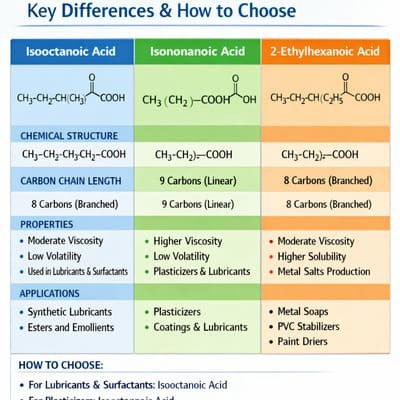
The most practically useful regulatory comparison for procurement teams and formulators is between IOA/2-EHA and isononanoic acid (INA), the primary technical alternative. The regulatory differences between the two are substantial and growing.
| Regulatory Criterion | IOA / 2-EHA (CAS 149-57-5) | Isononanoic Acid (CAS 26896-18-4) |
|---|---|---|
| EU CLP H361 | Yes - harmonised Annex VI classification ⚠️ | No ✅ |
| EU REACH SVHC | Yes - on Candidate List ⚠️ | Not on Candidate List ✅ |
| REACH Article 33 / SCIP obligation | Yes - if >0.1% in article ⚠️ | No ✅ |
| Potential REACH Annex XIV | Possible future restriction ⚠️ | No anticipated restriction ✅ |
| Workplace DNEL (reproductive) | Required - ~5–15 mg/m³ (long-term inhalation) ⚠️ | Not required (no H361) ✅ |
| Korea K-REACH CMR | CMR Category 2; enhanced obligations ⚠️ | Not CMR ✅ |
| China Hazardous Chemicals Catalogue | Listed - permits/licences required ⚠️ | Verify - INA may or may not be listed; check current 2022 Catalogue |
| Transport DG class (IMDG) | Class 8, UN 3265, PG III ⚠️ | Verify per batch - INA may also be Class 8 depending on exact isomer composition and flash point |
| GHS pictogram count | 3 pictograms (GHS02 + GHS07 + GHS08) | 2 pictograms (GHS02 + GHS07) - no GHS08 ✅ |
📚 Related Articles in This Series
❓ 10. Frequently Asked Questions
Q1: Is 2-ethylhexanoic acid on the EU REACH SVHC Candidate List?
Yes - 2-ethylhexanoic acid (CAS 149-57-5, EC 205-743-6) was added to the REACH SVHC Candidate List under Article 57(c) on the basis of its reproductive toxicity classification (Repr. Cat. 2, H361). The Candidate List is a dynamic list maintained by ECHA; substances can be added or removed as new scientific evidence and regulatory decisions are made. To verify the current status, always check the ECHA SVHC Candidate List at echa.europa.eu/candidate-list-table - do not rely on any article (including this one) as the definitive current status. As of early 2025, 2-EHA remains on the Candidate List, triggering Article 33 downstream notification obligations and SCIP database requirements for companies placing articles containing >0.1% 2-EHA on the EU market.
Q2: What documents should an EU buyer request from a Chinese IOA supplier for REACH compliance?
For REACH compliance when importing IOA from China, request these documents: (1) REACH Only Representative (OR) letter - naming the EU OR company, the ECHA registration number for 2-EHA (CAS 149-57-5) and/or CAS 25637-84-7, and confirming EU importers purchasing from this manufacturer are covered by the registration; (2) Extended Safety Data Sheet (eSDS) - 16 sections plus attached exposure scenarios (ES) in your language, compliant with REACH Annex II (Regulation 2020/878), including DNEL values for reproductive systemic effects (inhalation and dermal); (3) SVHC declaration - confirming that 2-EHA is on the Candidate List and that Article 33 notifications may be required for your downstream products if IOA content exceeds 0.1% w/w in articles; (4) Certificate of Analysis - per batch (acid value, colour, water, RI); (5) Certificate of Origin - for import duty purposes. Sinolook Chemical provides all five documents for every EU IOA shipment.
Q3: Does the H361 classification apply to formulated products containing IOA (driers, stabilisers) as well as to the pure acid?
Yes - the H361 classification applies to mixtures (formulated products) containing IOA above the applicable classification threshold. Under EU CLP (and GHS generally), the cut-off/concentration limit for H361 in mixtures is 0.3% w/w for reproductive toxicant Category 2 substances: any mixture containing ≥0.3% of a Repr. Cat. 2 ingredient must carry the H361 classification on its own SDS and label. Cobalt isooctanoate drier solutions in mineral spirits typically contain 50–60% of cobalt isooctanoate by weight, which in turn is ~80% isooctanoate ligand - so the final drier solution contains substantial 2-EHA content and must carry H361. Similarly, liquid Ca/Zn one-pack stabilisers containing Ca/Zn isooctanoates will exceed the 0.3% threshold for the isooctanoate component and must declare H361 in their SDS. This cascade of H361 through the supply chain - from pure IOA to the derived metal soap products - is one of the key regulatory drivers for the industry to consider INA-based alternative products.
Q4: How does the SCIP database requirement affect companies using IOA?
The SCIP (Substances of Concern In articles as such or in complex objects/Products) database was established under the EU Waste Framework Directive (2008/98/EC, amended by 2018/851). Since 5 January 2021, EU companies that place articles containing SVHC at >0.1% w/w on the market must submit information to ECHA's SCIP database. For IOA, this applies to: end products (e.g., coating products formulated as articles) if the 2-EHA content in the article is >0.1%; intermediate products (e.g., drier solutions in metal containers) if the container with contents is treated as a complex article and 2-EHA content is >0.1%. The SCIP database requirement does not apply to plain chemical substances or mixtures (SDS/supply chain communication covers these). In practice, most drier and stabiliser manufacturers who formulate with IOA and sell to industrial chemical users (not direct consumer articles) are primarily affected by the Article 33 customer notification obligation rather than SCIP directly - but this depends on how their products are characterised under EU waste law. Consult your legal counsel on the SCIP applicability for your specific product portfolio.
Q5: Is IOA restricted under China's Hazardous Chemicals Catalogue and what does this mean in practice?
Yes - isooctanoic acid is listed in China's Hazardous Chemicals Catalogue (危险化学品目录, 2022 edition), which triggers a specific set of operational requirements for Chinese companies producing, storing, or trading IOA. In practice, this means: Chinese IOA manufacturers must hold a Hazardous Chemical Production Licence (危险化学品生产许可证) from the relevant provincial safety authority; storage facilities must comply with the Regulations on Safe Management of Hazardous Chemicals and pass safety inspection; all personnel handling IOA must complete formal hazardous chemical safety training; chemical accident emergency response plans must be prepared and filed with local authorities; Chinese-language safety data sheets (Chinese SDS format per GB/T 16483) must be provided to domestic customers. For international buyers, the practical implication is that legitimate Chinese IOA suppliers should be able to produce their hazardous chemical production licence upon request - this is a basic qualification check that distinguishes a properly licensed manufacturer from informal traders. Sinolook Chemical holds all required Chinese hazardous chemical licences and can provide copies upon request.
Q6: If I switch from IOA to INA to avoid H361, do I need to re-register under REACH?
If you are a downstream user (DU) of IOA who switches to purchasing INA from your supplier (rather than IOA), you do not need to file a new REACH registration yourself - registration is the obligation of manufacturers and importers, not downstream users. What you need to do: (1) Update your SDS - the new SDS for INA will not include H361, GHS08, or SVHC notifications; distribute updated SDS to your customers; (2) Update Article 33 / SCIP notifications - once you have switched to INA, your products no longer contain an SVHC (if INA is the only isooctanoic acid-type component); Article 33 and SCIP obligations cease to apply; (3) Update chemical inventory - change the CAS number in your chemical management system from 149-57-5/25637-84-7 to 26896-18-4; (4) Verify INA's REACH registration - confirm with your INA supplier that they have an EU OR and that INA is registered under REACH (CAS 26896-18-4); (5) Inform your OR - if you have been listed as using IOA under a specific OR's registration dossier, notify the OR that you have changed raw material; the OR can update the identified use records. The substitution is administratively manageable for most downstream users; the main effort is updating SDS, informing customers, and verifying the INA registration chain.
Source REACH-Compliant IOA or INA from China
Contact Sinolook Chemical
Isooctanoic acid (CAS 25637-84-7) with full REACH eSDS + H361 data · EU OR appointment confirmed
Isononanoic acid (CAS 26896-18-4) available as H361-free alternative · DG Class 8 export documentation