Propionyl Chloride as an Acylating Agent: Esters, Amides, and Other Derivatives
CAS 79-03-8 · CH₃CH₂COCl · Turning a reactive acid chloride into esters, amides, salts, and reduction products.
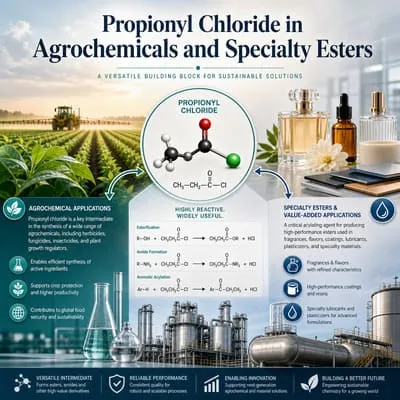
Propionyl chloride - IUPAC name propanoyl chloride - exists in the lab and the plant for one reason: to deliver a propionyl group (CH₃CH₂C=O–) onto another molecule. 🔬 Because it is so reactive, it does this faster and more completely than propionic acid ever could. This guide is a practical tour of the products you can make from it and the equations behind each one.
If you would like the underlying mechanism first, read propionyl chloride reactions explained. For the full overview, see the complete guide to propionyl chloride.
⚗️ What "Acylating Agent" Means
An acylating agent transfers an acyl group - here, the propionyl group - to a nucleophile. Propionyl chloride is one of the most powerful because chloride is such a good leaving group. The trade-off is that the reaction releases HCl, which usually has to be neutralized with a base such as pyridine or triethylamine to protect sensitive substrates and drive the reaction to completion. 💡
🧴 Making Esters: Ethyl Propanoate and More
React propionyl chloride with an alcohol and you get a propionate ester. With ethanol, the product is ethyl propanoate - a sweet, fruity ester used in flavors and fragrances:
CH₃CH₂COCl + C₂H₅OH → CH₃CH₂COOC₂H₅ + HCl
CH₃CH₂COCl + CH₃OH → CH₃CH₂COOCH₃ + HCl
Compared with the slow, equilibrium-limited esterification of propionic acid, the acid chloride route is fast and essentially irreversible - a major reason it is chosen for ester synthesis. ✅
🧬 Making Amides: Propanamide and N-Substituted Amides
With ammonia or amines, propionyl chloride forms amides. Ammonia gives propanamide; primary amines give N-substituted propanamides. Two equivalents of the nitrogen nucleophile (or an added base) are used to absorb the HCl:
CH₃CH₂COCl + 2 NH₃ → CH₃CH₂CONH₂ + NH₄Cl
CH₃CH₂COCl + 2 CH₃NH₂ → CH₃CH₂CONHCH₃ + CH₃NH₃Cl
The reaction with ammonia gives propanamide; with methylamine it gives N-methylpropanamide. These amide-forming steps are central to many pharmaceutical syntheses.
🧂 Salts: The Sodium Propanoate Connection
Propionyl chloride does not form sodium propanoate directly; instead, it first hydrolyzes to propionic acid, which is then neutralized with sodium hydroxide to give the salt:
CH₃CH₂COCl + H₂O → CH₃CH₂COOH + HCl
CH₃CH₂COOH + NaOH → CH₃CH₂COONa + H₂O
Sodium propanoate (sodium propionate) is a well-known preservative. This two-step path shows how the acid chloride links back to the wider propionate family.
🔬 Reduction: Toward Propanal and Propanol
Acid chlorides can be reduced selectively. A mild, hindered reducing agent such as lithium tri-tert-butoxyaluminum hydride stops at the aldehyde, converting propionyl chloride to propanal. Stronger reduction (e.g., LiAlH₄) takes it all the way to propanol:
To aldehyde: CH₃CH₂COCl → CH₃CH₂CHO (propanal)
Full reduction: CH₃CH₂COCl → CH₃CH₂CH₂OH (propan-1-ol)
↩️ Back to the Acid: Hydrolysis
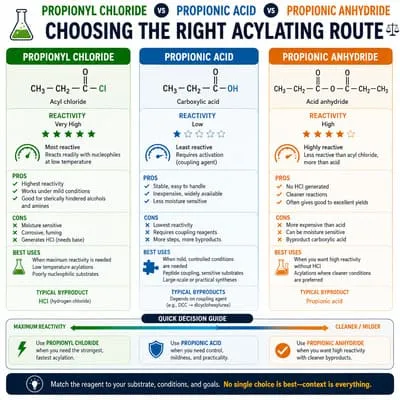
Finally, simple hydrolysis returns propionyl chloride to propionic acid plus HCl. While this is usually an unwanted side reaction (hence the need for dry conditions), it also explains why the acid chloride and the acid are so closely related. We compare them head-to-head in propionyl chloride vs propionic acid vs propionic anhydride.
🗂️ Derivative Map at a Glance
🔹 + alcohol → propionate ester (e.g., ethyl propanoate)
🔹 + ammonia / amine → propanamide / N-substituted amide
🔹 + water → propionic acid (→ sodium propanoate with NaOH)
🔹 + aromatic ring / AlCl₃ → aryl ketone (see Friedel–Crafts acylation)
🔹 + reducing agent → propanal or propanol
❓ Frequently Asked Questions
Q: How do you convert propanoyl chloride to ethyl propanoate?
React it with ethanol; the alcohol displaces chloride to form the ester, releasing HCl (often with pyridine to neutralize the acid).
Q: How do you make propanamide from propanoyl chloride?
React it with excess ammonia; one equivalent forms the amide and another absorbs the HCl as ammonium chloride.
Q: How is propanoyl chloride converted to propanal?
By controlled reduction with a hindered hydride reagent that stops at the aldehyde stage rather than reducing fully to the alcohol.
Q: Why use propanoyl chloride instead of propanoic acid for acylation?
The acid chloride is far more reactive, giving fast, high-yield, essentially irreversible acylation rather than a slow equilibrium.
🔗 Authoritative References
For derivative identities and properties, see PubChem (CID 62324); for peer-reviewed acylation procedures, see Organic Syntheses.
📚 Related Articles
Propionyl Chloride Reactions Explained
The nucleophilic acyl substitution behind every derivative.
Read more →Complete Guide to Propionyl Chloride
Properties, reactions, uses, safety and sourcing in one place.
Read more →🤝 Source High-Purity Propionyl Chloride
Sinolook Chemical Co., Ltd. is a China-based manufacturer and exporter supplying propionyl chloride and other specialty chemicals to 50+ countries. Contact our team for specifications, samples, pricing, and compliant export documentation.
📱 WhatsApp: 0086 18150362095
💬 WeChat / Tel: 0086 13400715622
✉️ Email: sales@sinolookchem.com
View Product & Request a Quote →