Propionyl Chloride (Propanoyl Chloride): The Complete Guide to Properties, Reactions, and Industrial Uses
CAS 79-03-8 · Formula CH₃CH₂COCl · A high-purity acyl chloride and acylating agent for pharma, agrochemical, flavor & fragrance, and specialty-ester manufacturing.
Propionyl chloride - its preferred IUPAC name is propanoyl chloride - is one of the workhorse acylating reagents of modern fine-chemical synthesis. Wherever a chemist needs to attach a propionyl group (CH₃CH₂C=O–) quickly and cleanly, this small, reactive molecule is usually the tool of choice. 🔬 This guide walks through everything a technical buyer or process chemist needs: identity, structure, properties, reactions, manufacturing routes, applications, safety, regulatory status, and how it compares with related reagents.
Whether you searched for "what is propionyl chloride", "propanoyl chloride", or simply "propionyl chloride uses", the sections below are designed to be both a quick reference and a deeper learning resource, with links to detailed companion articles on each topic.
🧪 What Is Propionyl Chloride?
Propionyl chloride is the acyl chloride (acid chloride) derived from propionic acid. Replacing the –OH of propionic acid (CH₃CH₂COOH) with a chlorine atom gives the far more reactive CH₃CH₂COCl. It is a colorless, mobile, strongly fuming liquid with a sharp, pungent odor, and it reacts vigorously with water and most protic compounds.
Because the C–Cl bond next to a carbonyl is an excellent leaving group, propionyl chloride is described as a highly electrophilic acylating agent. That single property is the reason it appears across so many synthesis routes. To understand exactly why, see our companion article on the structure and functional group of propionyl chloride.
🪪 Identity & Key Properties at a Glance
The core identifiers below are the quickest way to confirm you are evaluating the right material. For the full specification sheet, purity grades, and SDS, please refer to the Sinolook Propionyl Chloride product page.
🔹 Common name: Propionyl chloride
🔹 IUPAC name: Propanoyl chloride (also: propionic chloride, propionic acid chloride)
🔹 CAS No.: 79-03-8 · EC/EINECS: 201-170-0 · UN No.: 1815
🔹 Molecular formula: C₃H₅ClO (CH₃CH₂COCl)
🔹 Molecular weight: 92.52 g/mol
🔹 Boiling point: ~80 °C · Density: ~1.065 g/cm³ · Appearance: colorless liquid
🔹 Chemical class: Acyl chloride (acid chloride)
💡 We cite each headline value once here for orientation; detailed, certified specifications live on the product page to keep this guide focused on understanding rather than data tables.
📐 Structure and Functional Group
Structurally, propanoyl chloride is a three-carbon chain ending in a carbonyl carbon that bears a chlorine atom: CH₃–CH₂–C(=O)–Cl. The defining feature is the acyl chloride functional group (–COCl), where a strongly electron-withdrawing carbonyl is paired with chlorine. This combination makes the carbonyl carbon highly electrophilic and primes it for nucleophilic acyl substitution.
We cover the displayed, condensed, skeletal, and Lewis representations - plus naming conventions and how the molecule is classified - in the dedicated article on propionyl chloride structure, formula, and functional group. ✅
🏭 How Propionyl Chloride Is Made
Industrially, propionyl chloride is produced by converting propionic acid into its acid chloride using a chlorinating agent. Common laboratory and production routes react propionic acid with thionyl chloride (SOCl₂), phosphorus trichloride (PCl₃), or phosphorus pentachloride (PCl₅); larger-scale processes may use phosgene chemistry with appropriate engineering controls. Each route differs in by-products, ease of purification, and waste handling.
A full breakdown of reagents, stoichiometry, and the trade-offs between routes is in our article how propionyl chloride is made: synthesis from propanoic acid.
🔁 Key Reactions of Propionyl Chloride
Almost everything propionyl chloride does follows the same theme: a nucleophile attacks the carbonyl carbon, chloride leaves, and the propionyl group is transferred. The most important reactions include:
💧 With water (hydrolysis): rapidly forms propionic acid and hydrogen chloride - the reason it fumes in moist air and must be kept dry.
🧴 With alcohols (esterification): reacts with methanol, ethanol, and other alcohols to give propionate esters such as ethyl propanoate.
🧬 With amines and ammonia: forms propionamides (e.g., with methylamine or ammonia), a key step in many pharmaceutical syntheses.
🟡 With silver nitrate: the liberated chloride gives the characteristic test response associated with acyl chlorides.
🏛️ Friedel–Crafts acylation: with an AlCl₃ catalyst, propionyl chloride acylates benzene and other aromatics to form aryl ethyl ketones such as propiophenone.
For full mechanisms, equations, and conditions, see propionyl chloride reactions explained and the focused guide to Friedel–Crafts acylation with propionyl chloride. To see how these reactions build useful products, read propionyl chloride as an acylating agent: esters, amides & derivatives.
🎯 Industrial Applications
Because the propionyl group is so common in target molecules, propionyl chloride appears across several industries:
💊 Pharmaceuticals: a building block for active pharmaceutical ingredients and intermediates that require a propionyl moiety. See propionyl chloride in pharmaceutical synthesis.
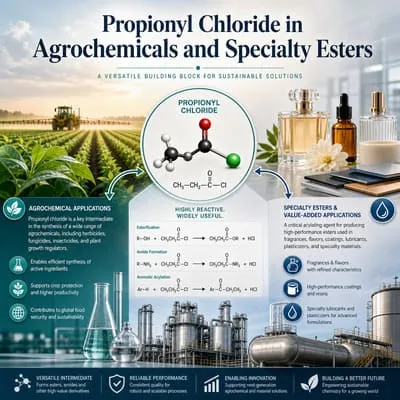
🌱 Agrochemicals & specialty esters: used in the manufacture of crop-protection intermediates, dyes, and flavor/fragrance esters. See propionyl chloride in agrochemicals & specialty esters.
🧪 Research & fine chemicals: a standard acylating reagent for laboratory derivatization and small-scale synthesis. The broad overview is in industrial applications of propionyl chloride.
⚠️ Safety, Hazards & Handling (Honest Overview)
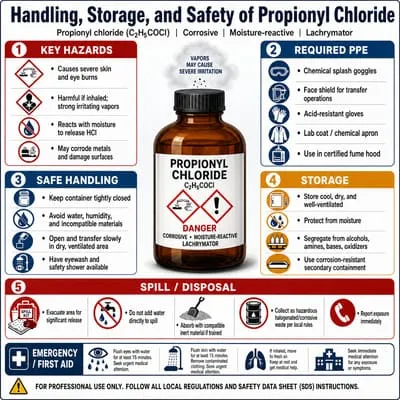
Propionyl chloride is a hazardous material and should be treated as such - we believe in clear, honest labeling rather than reassuring language. Under GHS it is classified Danger, with H225 (highly flammable liquid and vapor) and H314 (causes severe skin burns and eye damage). It reacts violently with water, releasing corrosive hydrogen chloride, and its vapors are irritating and corrosive to the respiratory tract.
🚨 Always handle under inert, dry conditions with full PPE, adequate ventilation, and water-free fire-response planning. Keep away from water, alcohols, amines, and oxidizers.
Detailed PPE, storage, spill-response, and disposal guidance is in handling, storage & safety of propionyl chloride. Always consult the official SDS before use.
📋 Regulatory & Compliance Status
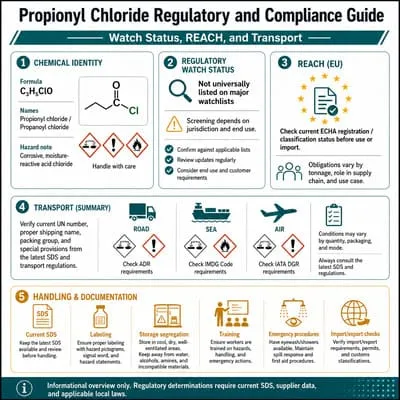
Propionyl chloride is a legitimate industrial reagent, but responsible buyers should be aware that it has attracted regulatory attention as a watched precursor in some jurisdictions. Reputable suppliers therefore apply know-your-customer (KYC) and end-use documentation, and shipments are regulated for transport as UN 1815. We recommend confirming the requirements in your own market.
A compliance-focused overview - covering watch status, REACH, transport classification, and customs (HS code) considerations - is in the propionyl chloride regulatory & compliance guide.
⚖️ How It Compares & Market Outlook
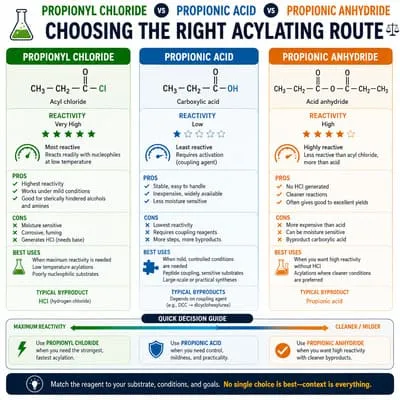
When choosing an acylating route, propionyl chloride is often weighed against propionic acid (less reactive, needs activation) and propionic anhydride (milder, fewer corrosive by-products). The right choice depends on reactivity, selectivity, by-product handling, and cost. See propionyl chloride vs propionic acid vs propionic anhydride.
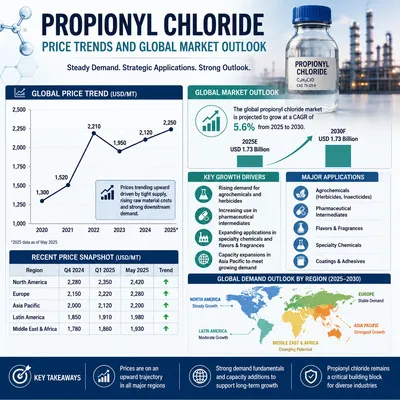
For supply, demand drivers, and feedstock-linked pricing trends, read propionyl chloride price trends & global market outlook. 📈
❓ Frequently Asked Questions
Q: Is propionyl chloride the same as propanoyl chloride?
Yes. "Propanoyl chloride" is the preferred IUPAC name and "propionyl chloride" is the common industrial name for the same compound, CAS 79-03-8.
Q: What functional group does it contain?
It contains an acyl chloride (acid chloride) group, –COCl, which makes it a strong acylating agent.
Q: Why does propionyl chloride fume in air?
It reacts with atmospheric moisture to produce propionic acid and hydrogen chloride, and the HCl appears as visible fumes.
Q: What is propionyl chloride used for?
It is mainly used as an acylating reagent to make pharmaceutical intermediates, agrochemicals, flavor and fragrance esters, dyes, and other specialty chemicals.
Q: Where can I buy high-purity propionyl chloride?
Sinolook Chemical supplies high-purity propionyl chloride to 50+ countries. Visit our product page or contact us for a quote.
🔗 Authoritative References
For independent identity and property data, see PubChem (CID 62324), the ECHA substance infocard, and the NIST Chemistry WebBook.
📚 Related Articles
Propionyl Chloride Reactions Explained
Water, alcohols, amines, ammonia and the mechanisms behind them.
Read more →🤝 Source High-Purity Propionyl Chloride from Sinolook
Sinolook Chemical Co., Ltd. is a China-based specialty chemical manufacturer and exporter supplying customers in 50+ countries. Contact our team for specifications, samples, pricing, and compliant export documentation.
📱 WhatsApp: 0086 18150362095
💬 WeChat / Tel: 0086 13400715622
✉️ Email: sales@sinolookchem.com
View Product & Request a Quote →