TOPM as a Polar Additive Solubiliser in PAO & Group III Base Oils
The cleanest synthetic base oils are also the worst solvents. Here's how a polar ester fixes that.
There is a paradox at the heart of modern synthetic lubricants: the base oils with the best oxidation stability - PAO (Group IV) and hydrocracked Group III - are so highly refined and saturated that they are poor solvents. They resist degradation beautifully, but they also resist dissolving the very additives and degradation products a working oil has to keep in suspension. The classic answer is to add a polar co-base, and that is exactly the job a high-molecular-weight ester like TOPM does. 🧲
🔬 Why non-polar base oils struggle with solvency
Solvency is a "like dissolves like" story. Most lubricant additives - antioxidants, detergents, some anti-wear and EP chemistries - are polar molecules. A non-polar hydrocarbon base like PAO has little to grip them with, so it holds them only weakly. One common way to see this is the aniline point: the higher it is, the less solvent the oil (PAO sits high; polar esters sit low). The consequence is predictable trouble. ⚗️
⚠️ What poor solvency looks like in the field
Additive dropout
Additives precipitate out during storage or cold soak, leaving haze or sediment and robbing the oil of the protection you paid for.
Sludge & varnish
When oxidation by-products can't stay dissolved, they deposit as varnish and sludge on surfaces instead of being carried away.
Seal shrinkage & leaks
Non-polar oils tend to shrink elastomer seals, which then leak. A measured amount of polar ester swells the seals back toward neutral, restoring the balance.
🛠️ The fix: a polar ester co-base
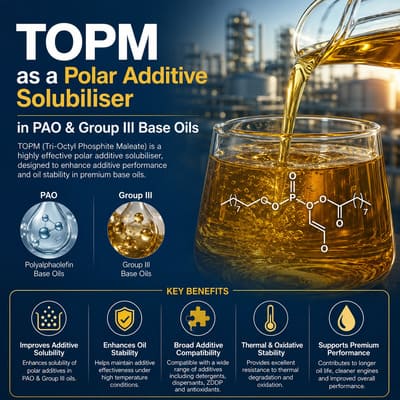
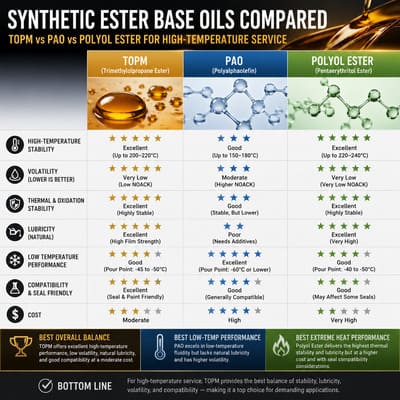
Blend a polar ester into the non-polar base and its ester groups do the solvency work the hydrocarbon can't: they keep additives dissolved, carry degradation products, and balance seal behaviour. Esters are the standard solubiliser precisely because polarity is built into the molecule. The question is which ester - because a solubiliser that boils off at high temperature just trades one problem for another. See the broader base-oil picture in TOPM vs PAO vs polyol ester. 🔀
🌡️ Why TOPM specifically
Two features make the pyromellitate ester TOPM a strong solubiliser for high-temperature systems:
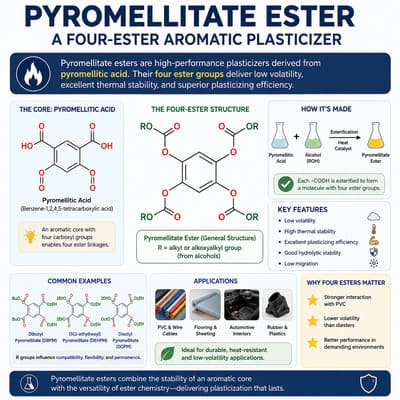
🔹 High polarity - four ester groups give strong solvency, so a modest dose restores additive solubility. (See why four groups matter in what is a pyromellitate ester.)
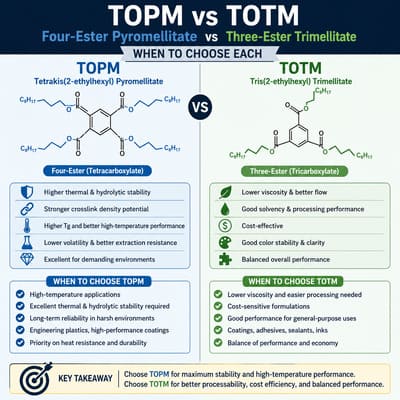
🔹 Low volatility & high thermal stability - unlike a light diester, TOPM stays in the oil at high temperature, so it adds polarity without undermining the high-heat performance you chose PAO for.
In other words, a light ester can boost solvency but evaporates away in hot service; TOPM boosts solvency and endures the heat. Full data is on the TOPM product page.
⚗️ How much to use
A polar ester is usually a co-base or minor component, not the whole base. The dose is tuned to restore solvency and seal balance - enough polarity to hold additives and neutralise seal shrinkage, without so much that you over-swell seals, lift the pour point, or add unnecessary cost. In practice that means:
🔹 Start from the solvency gap (aniline point / additive solubility) and the seal-swell target.
🔹 Add ester incrementally and re-test additive solubility, seal swell and pour point.
🔹 Verify storage and cold-soak stability - the conditions where dropout usually appears.
📋 TOPM vs lighter ester solubilisers
| Solubiliser | Solvency | High-temp durability | Best for |
|---|---|---|---|
| Diester (light) | High | Lower (more volatile) | Moderate-temp, cost-sensitive |
| Polyol ester | Good | High | Broad high-temp use |
| TOPM (pyromellitate) | High | Very high (low volatility) | Hot systems needing lasting solvency |
Directional; the right choice depends on temperature, seals and cost. Thermophysical data can be checked on the NIST Chemistry WebBook.
💡 The honest limits: ester co-bases must be dosed with care - too much can over-swell seals and raise the pour point, esters are more hydrolysis-sensitive than PAO, and TOPM carries a premium price. It earns its place where the system runs hot and solvency must last, not as a cheap universal additive.
❓ Frequently asked questions
🔹 Why does my PAO oil throw a haze or sediment in storage?
That is usually additive dropout - the non-polar base can't hold the polar additives in solution, especially when cold. Adding a polar ester co-base typically resolves it.
🔹 How much ester do I need to fix solvency?
It varies with the base oil, additive package and seals - often a minor fraction is enough. Dose incrementally and verify additive solubility, seal swell and pour point rather than guessing.
🔹 Why choose TOPM over a cheaper diester?
Diesters are effective solubilisers but more volatile, so they can boil off in hot service. TOPM keeps its solvency at high temperature because of its low volatility - worth it specifically for hot-running systems.
🔹 Will adding an ester hurt oxidation stability?
Used at sensible levels, a stable ester co-base keeps degradation products dissolved, which can actually reduce deposits. Balance is key - the goal is enough polarity, not maximum ester.
🔗 Related articles
The full base-oil comparison behind the co-base idea.
📞 Fighting additive dropout or seal shrinkage?
Tell us your base oil, additive package and seal materials - we'll advise on TOPM as a polar co-base to restore solubility and seal balance, with samples and documentation for your trials.