TOPM vs DEHP: The Medical & Regulatory Case for Replacing DEHP
A hazard, migration and cost comparison - plus an honest look at when to switch and when not to.
When buyers ask about TOPM as a "DEHP replacement," they are comparing two very different molecules. DEHP is a low-molecular-weight ortho-phthalate: inexpensive, an efficient softener, and the flexible-PVC default for decades - but now a classified reproductive toxicant under growing restriction. TOPM is a high-molecular-weight pyromellitate tetra-ester with far lower migration and no CMR classification. Here is how they stack up, and where the switch actually makes sense. 🔄
⏱️ The short answer
Switch to TOPM when you need a non-CMR, low-migration, high-temperature ester for demanding medical PVC or heat-resistant applications. For ordinary flexible PVC where you just need to get off phthalates at low cost, a terephthalate (DOTP) is usually the closer, cheaper drop-in - TOPM would be over-specifying.
⚗️ Two different molecules, two different behaviours
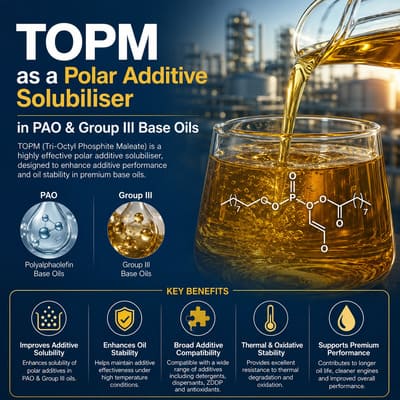
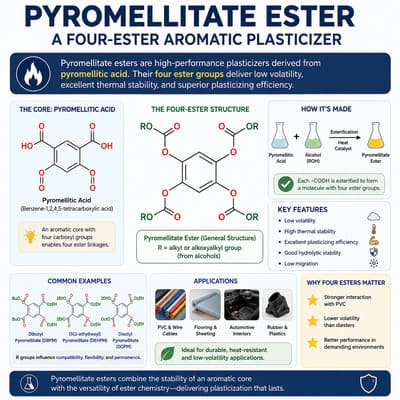
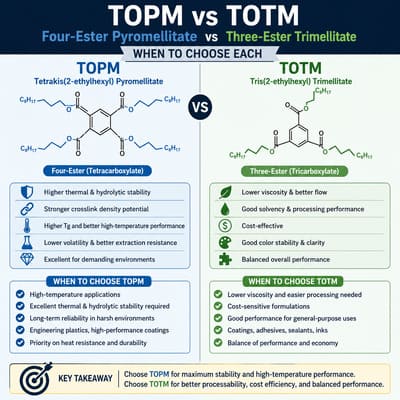
The root of every difference below is molecular size and structure. DEHP is a di-ester (two ester groups, MW ≈ 391); TOPM is a tetra-ester (four ester groups, MW ≈ 703). A bigger, more anchored molecule migrates and evaporates far less - but it is also a less efficient softener per unit and costs more to make. Full TOPM data is on the product page; for the structural family context, see TOPM vs TOTM. 🔬
⚖️ Hazard & regulatory status - the decisive gap
DEHP
Classified as toxic to reproduction (Repr. 1B). It is on the EU SVHC Candidate List, listed in Annex XIV (Authorisation List) - meaning use in the EU requires authorisation past the sunset date - and further restricted under Annex XVII. The U.S. CPSC restricts it in children's articles.
TOPM
No CMR classification, not on the SVHC Candidate List, not in Annex XIV or Annex XVII. This clean regulatory profile - not a marketing "non-toxic" claim - is the core reason it is chosen to replace DEHP in regulated markets.
📋 Head-to-head
| Dimension | DEHP (phthalate) | TOPM (pyromellitate) |
|---|---|---|
| Structure | Di-ester, MW ≈ 391 | Tetra-ester, MW ≈ 703 |
| CMR classification | Repr. 1B | None |
| EU REACH status | SVHC + Annex XIV + Annex XVII | Not listed |
| Migration / extractables | Higher | Much lower |
| Volatility / heat resistance | Moderate | Very low volatility |
| Plasticizing efficiency | High (efficient softener) | Lower (higher MW) |
| Cost | Low | Premium |
Directional comparison. Confirm exact figures from the current datasheet and SDS for each material.
✅ The case for switching to TOPM
🔹 Compliance & future-proofing: a non-CMR, non-SVHC ester removes the authorisation and restriction risk that follows DEHP through the EU market.
🔹 Patient/consumer exposure: much lower migration means far less plasticizer leaching into blood, lipids or drug solutions.
🔹 Durability: low volatility keeps parts flexible longer and suits high-temperature service DEHP cannot reach.
🔹 Reputation: a clean "phthalate-free" story for products and tenders.
💡 The honest trade-offs
TOPM is not a free upgrade, and it is not the right answer for every DEHP replacement:
⚠️ It costs more - higher-value feedstock and more esterification steps.
⚠️ It is a less efficient softener - its higher molecular weight means you may need a higher loading or a co-plasticizer to hit the same flexibility, so it is not a 1:1 drop-in.
⚠️ Switching requires re-validation - processing, mechanical properties and (for medical) biocompatibility all need re-testing.
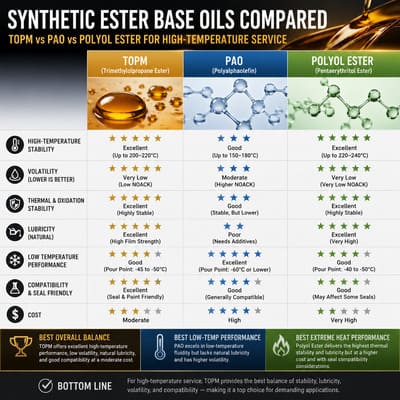
For plain flexible PVC where the only goal is leaving phthalates behind at low cost, a terephthalate like DOTP is usually the more sensible, economical replacement. TOPM earns its premium specifically where low migration and heat resistance matter - demanding medical PVC and high-temperature parts. See the full non-phthalate landscape to place it correctly.
❓ Frequently asked questions
🔹 Can TOPM directly replace DEHP one-for-one?
Not exactly. Because TOPM is higher in molecular weight and a less efficient softener, you often need to adjust loading or add a co-plasticizer to match DEHP's flexibility. Treat it as a reformulation, not a swap.
🔹 Is DEHP illegal now?
Not outright everywhere. In the EU it needs authorisation for continued use and is restricted in many articles; elsewhere it remains legal in various uses. But the regulatory direction is clearly tightening, which is why buyers plan replacements.
🔹 Why not just use DOTP or DINCH instead of TOPM?
For general-purpose flexible PVC, often you should - they are cheaper and closer to DEHP in efficiency. TOPM is the right choice when you specifically need the lowest migration or high-temperature performance those lighter esters can't deliver.
🔹 Does replacing DEHP with TOPM guarantee compliance?
It removes the DEHP-specific hazard and REACH issues, but the finished product must still meet all applicable standards - for medical devices, that means ISO 10993 biocompatibility and the relevant regulatory pathway.
🔗 Related articles
Replacing DEHP in IV bags, catheters and blood tubing.
📞 Planning a move away from DEHP?
Tell us your application and performance targets - we'll advise whether TOPM or a lighter non-phthalate is the right replacement, and provide samples and documentation to support your reformulation.