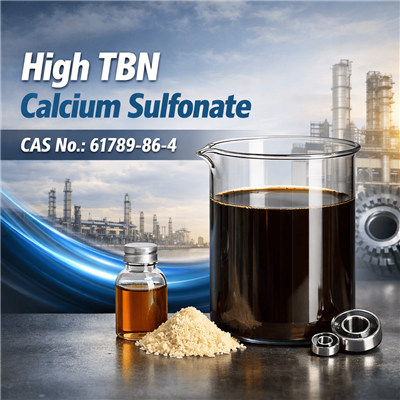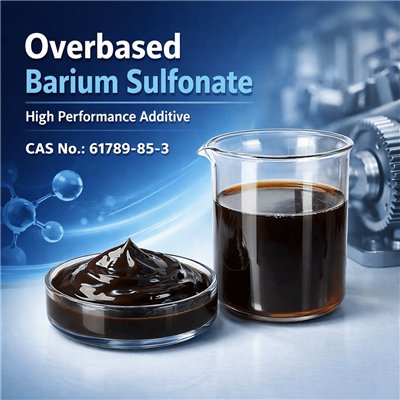


Lubricant Additives - Sulfonate Detergents Series: Medium TBN Calcium Sulfonate (TBN 150–300 mgKOH/g) delivers balanced detergency and acid neutralisation for standard PCMO, light-duty diesel engine oils, and is the primary raw material for calcium sulfonate grease manufacturing. Sinolook supplies the full TBN range: Low (0–50) · Medium (150–300) · High (300–400) · Overbased (>400 mgKOH/g) Ca and Overbased Mg sulfonate. COA, TDS, SDS with every shipment.
Lubricant Additive · Sulfonate Detergent · Acid Neutraliser · Grease Base Raw Material
Medium TBN Calcium Sulfonate
Moderately Overbased / TBN 150–300 mgKOH/g / Engine Oil Detergent / Calcium Sulfonate Grease Base
| Chemical Type | Moderately overbased calcium alkylbenzene sulfonate in mineral oil - colloidal CaCO₃ micelles stabilised by sulfonate surfactant |
| Structure | [R–SO₃⁻]₂ Ca²⁺ · CaCO₃ (colloidal) · Alkyl chain C₁₂–C₂₄; Ca²⁺ counter-ion bridges sulfonate head groups; excess CaCO₃ encapsulated in reverse micelles |
| TBN Range | 150–300 mgKOH/g (ASTM D2896) |
| Physical State | Brown to dark brown transparent to slightly opaque liquid; mild sulfonate odour; viscous at ambient - warm to 40–50°C for pumping |
| Key Applications | PCMO / Diesel Engine Oil Ca Sulfonate Grease Base Marine Lubricant ✓ REACH / TSCA |
| GHS Hazards | Combustible liquid FP ≥180°C Skin/Eye irritant H315/H319 |
What Is Medium TBN Calcium Sulfonate?
Medium TBN Calcium Sulfonate is a moderately overbased calcium alkylbenzene sulfonate detergent additive with TBN 150–300 mgKOH/g. It is produced by carbonating a mixture of calcium hydroxide and calcium sulfonate salt in the presence of a promoter, incorporating excess calcium carbonate (CaCO₃) as a colloidal dispersion stabilised by the sulfonate surfactant molecules - forming reverse micelles of 1–10 nm diameter in the base oil. This colloidal CaCO₃ reserve is the source of the product's acid-neutralisation capacity and distinguishes it structurally from the near-stoichiometric Low TBN grade.
At the Medium TBN level, the product strikes the optimal balance between acid neutralisation reserve (adequate for standard PCMO and light-to-medium diesel applications) and sulphated ash contribution (higher than Low TBN but within the range allowed by API SP, ACEA A/B sequences, and most commercial vehicle oil specifications). Medium TBN calcium sulfonate is also the primary raw material for calcium sulfonate grease manufacturing - the colloidal CaCO₃ micelle structure converts to a crystalline calcite network thickener during the grease production process.
| ○ Low TBN (0–50) | ACEA C1/C2/C3 low-ash · API SP-RC · Hydraulic oil · Rust preventive |
| ● Medium TBN (150–300) - This product | Standard PCMO · API SP/SN · ACEA A3/B4 · Diesel engine oil · Ca sulfonate grease base · Medium-speed marine engine |
| ○ High TBN (300–400) | Heavy-duty diesel · API CK-4/FA-4 · ACEA E6/E9 · High acid load |
| ○ Overbased (>400) | Marine TPEO · Bunker fuel · Maximum acid reserve |

Technical Specification
| Sub-Grade | TBN (mgKOH/g) | Ca Content (%) | Viscosity @100°C (cSt) | Density @20°C | Typical Use |
|---|---|---|---|---|---|
| Medium-Low (ca. 150–200) | ~150–200 | ~3–6 | ~10–20 | ~0.95–1.00 | Standard PCMO · API SP · ACEA A3/B4 · Light diesel · Ca sulfonate grease base |
| Medium (ca. 200–250) | ~200–250 | ~6–8 | ~20–35 | ~1.00–1.03 | Medium-duty diesel · Gas engine · Industrial diesel genset · Complex Ca sulfonate grease |
| Medium-High (ca. 250–300) | ~250–300 | ~8–10 | ~30–45 | ~1.03–1.05 | Medium-speed marine engine · Blending component for High TBN blends · High-TBN grease base |
| Parameter | Specification | Test Method | Note |
|---|---|---|---|
| Appearance | Brown to dark brown liquid | Visual | Transparent to slightly opaque at higher TBN; mild sulfonate odour |
| TBN | 150–300 mgKOH/g | ASTM D2896 | Grade-specific TBN on COA; nominal sub-grades at 150, 200, 250, 300 available |
| Calcium Content | 3–10 wt% | ASTM D5185 / ICP-OES | Increases with TBN sub-grade; Ca% × 3.4 ≈ sulphated ash wt% in blend |
| Kinematic Viscosity @100°C | 10–45 cSt | ASTM D445 | Higher at higher TBN sub-grade; warm product to 40–50°C for cold-weather pumping |
| Flash Point (COC) | ≥ 180°C | ASTM D92 | Combustible liquid - standard industrial storage; not classified DG under IMDG/ADR/IATA |
| Density @20°C | 0.95–1.05 g/cm³ | ASTM D4052 | Higher than Low TBN grade due to colloidal CaCO₃ micelle content |
| Solubility | Fully miscible | - | Group I–V mineral oil and synthetic base stocks; verify in pure Group III/PAO by bench test |
| Packaging | 200 kg drum · 1000 L IBC · Flexitank | - | Steel drum standard; ISO tank for bulk ≥16 MT; heat tracing recommended for high-TBN grades in cold climate |
Performance Profile
Acid Neutralisation Reserve
The colloidal CaCO₃ reserve in Medium TBN Ca sulfonate neutralises acidic combustion by-products - sulphuric acid (from sulphur in fuel), nitric acid (from NOₓ blow-by), and organic acids from oil oxidation - before they can corrode cylinder liners, bearing surfaces, and other ferrous and non-ferrous components. At TBN 150–300 mgKOH/g, the neutralisation capacity is sufficient for standard PCMO drain intervals (5,000–15,000 km) and light-to-medium diesel applications without excess sulphated ash accumulation.
Detergency & Deposit Control
The sulfonate head group adsorbs onto hot metal surfaces, solubilising and dispersing combustion deposits, piston crown varnish, ring belt carbonaceous buildup, and lacquer precursors into the oil bulk. Medium TBN provides stronger detergency than Low TBN grades at equivalent treat rates because the higher colloidal CaCO₃ content acts synergistically with the sulfonate surfactant to mobilise polar deposits - maintaining high-temperature engine cleanliness through extended drain intervals.
Rust & Corrosion Protection
The hydrophobic alkyl tail forms a tenacious adsorption film on metal surfaces, displacing moisture and providing a physical barrier against water, oxygen, and salt spray. The alkaline reserve additionally buffers against acidic corrosion, providing dual-mechanism protection: physical film-forming (like Low TBN) plus chemical acid-neutralisation - making Medium TBN Ca sulfonate particularly effective in applications with moderate acidic contamination.
Thermal & Oxidative Stability
The aromatic sulfonate backbone resists free-radical oxidation. The colloidal CaCO₃ reserve also acts as a mild acid scavenger for oxidative degradation products (carboxylic acids, peroxy acids) generated during high-temperature oil oxidation, retarding viscosity increase and acid buildup in long-drain engine oils. Maintains performance stability at 120–160°C sustained operation typical of modern turbocharged engines.
Applications & Formulation Guidance
1. Automotive Engine Oils - Gasoline PCMO & Light-to-Medium Diesel
Medium TBN Calcium Sulfonate is the workhorse detergent for standard passenger car motor oils (0W-20 through 15W-40) and light-to-medium diesel engine oils not subject to ACEA C-sequence low-SAPS restrictions. It provides the full TBN contribution, high-temperature detergency, and corrosion protection required by API SP/SN, ACEA A3/B4, and similar specifications at economically optimal treat rates - balancing TBN delivery, sulphated ash, and cost per formulated litre.
2. Calcium Sulfonate Grease Manufacturing - Base Stock Raw Material
This is the primary application differentiating Medium TBN from Low TBN calcium sulfonate. Calcium sulfonate grease is produced by converting the colloidal CaCO₃ micelles in Medium TBN (or High TBN) calcium sulfonate into a crystalline calcite network thickener structure, using a promoter (typically 12-hydroxystearic acid or boric acid) and a controlled thermal conversion process. The resulting grease thickener is amorphous at first, then crystallises to a calcite structure on cooling - providing the grease with exceptional mechanical stability and high dropping point (>300°C).
3. Marine Lubricants - Medium-Speed Engines & Stationary Gas/Diesel Generators
Medium-speed marine trunk piston engines (TPEO, TBN typically 20–40 mgKOH/g in finished oil), gas engines, and stationary diesel generators operating on distillate or natural gas fuels require moderate TBN detergent additives. Medium TBN Calcium Sulfonate provides the acid neutralisation reserve needed for moderate fuel sulphur content and the rust inhibition required in marine environments (seawater exposure, humidity) without the extreme TBN levels of crosshead marine TPEO grades.
4. Industrial Lubricants - Gear Oils, Compressor Oils & Turbine / Circulating Oils
In heavy-duty industrial gear oils, compressor oils, and turbine/circulating oils subject to moderate acid loads and extended service periods, Medium TBN Ca sulfonate provides detergency, rust inhibition, and acid-scavenging performance in a single component. At lower treat rates (0.5–2.0 wt%), it supplements the primary antioxidant and rust inhibitor packages with alkalinity reserve - extending the service life of the lubricant by retarding acid-induced degradation and metal corrosion.
Additive Compatibility & Blending Notes
| Co-Additive | Compatibility | Formulation Note |
|---|---|---|
| ZDDP (Primary / Secondary) | ● Excellent | Core engine oil pairing. Ca sulfonate provides TBN/detergency; ZDDP provides antiwear, antioxidancy, and secondary TBN. Monitor total sulphated ash (Ca sulfonate + ZDDP) vs finished oil limit. |
| PIB Succinimide Dispersant (PIBSI) | ● Excellent | Complementary - Ca sulfonate handles high-temp ring belt deposits; PIBSI handles low-temp piston sludge and soot dispersion. Standard combination in all PCMO and diesel engine oil packages. |
| Phenolic / Aminic Antioxidants | ● Excellent | No adverse interaction. Ca sulfonate's alkaline reserve complements primary antioxidants by scavenging oxidation by-product acids - synergistic TBN retention effect in long-drain oils. |
| MoDTC / MoDTP Friction Modifiers | ● Good | Compatible. Alkaline Ca sulfonate may slightly reduce MoDTC efficiency at very high treat rates (>5 wt%) - benchmark tribological performance in specific combination. |
| VI Improvers (OCP / PMA) | ● Good | Solubility-compatible. Verify finished blend shear stability (KRL 20h, ASTM D6278) if high-MW OCP is used at high treat rate with high-TBN Ca sulfonate. |
| Yellow Metal Passivators (BTA/TTA) | ◑ Check | At higher Ca sulfonate treat rates, verify copper strip corrosion (ASTM D130). Adjust BTA/TTA passivator level - alkaline Ca sulfonate can compete with passivator for surface adsorption on copper alloys. |
| Low TBN / High TBN Ca Sulfonate | ● Good | Can be blended to achieve target TBN between grades or to tune ash-per-TBN ratio. Medium TBN + Low TBN for PCMO near SAPS limit; Medium TBN + High TBN for heavy diesel without max-TBN concentrate cost. |
Frequently Asked Questions
Q: What TBN sub-grade of Medium TBN Calcium Sulfonate is best for calcium sulfonate grease production?
The most widely used sub-grades for calcium sulfonate grease manufacturing are TBN 150–250 mgKOH/g. Higher TBN within the Medium range (250–300) provides a higher colloidal CaCO₃ content per kilogram, which translates to a higher thickener yield per unit weight of base material - meaning less raw material is required to reach the target NLGI grade. However, higher TBN sub-grades are also more viscous and more costly. The optimal sub-grade depends on your grease formulation target (NLGI grade, base oil ratio, complex agent content) and process parameters. Sinolook's technical team can recommend the appropriate sub-grade for your specific grease production process.
Q: What is the difference between Medium TBN and High TBN Calcium Sulfonate for engine oil formulation?
The key trade-off is TBN delivery vs sulphated ash contribution. High TBN (300–400 mgKOH/g) delivers more acid-neutralisation reserve per kilogram of additive - essential for heavy-duty diesel on sulphur-containing fuel, long-drain commercial vehicle oils (API CK-4, ACEA E6/E9), and other applications where TBN must remain above a minimum threshold throughout an extended drain interval. Medium TBN is the preferred choice where a moderate TBN contribution is required without the high sulphated ash of High TBN concentrate - particularly for standard PCMO and light commercial vehicle oils where total finished oil sulphated ash of 1.0–1.5 wt% is the target range. Many formulations blend Medium and High TBN to achieve cost-optimised TBN delivery.
Q: Can Medium TBN Calcium Sulfonate be used in ACEA C-sequence (low-SAPS) engine oils?
Generally not as the primary detergent at standard treat rates. ACEA C1/C2/C3/C5 limit sulphated ash to 0.5–1.0 wt% in the finished oil. At the Ca content of Medium TBN grade (3–10 wt% Ca), even a modest 2 wt% treat rate would contribute 0.20–0.68 wt% sulphated ash - significantly limiting the ash headroom available for ZDDP and potentially exceeding C1/C2 limits. Low TBN Calcium Sulfonate is the specified grade for ACEA C-sequence formulation. However, very small blending proportions of Medium TBN Ca sulfonate (<1 wt%) can be used in C-sequence formulations if the ash balance permits, to supplement the TBN contribution of the Low TBN base detergent.
Q: Why does Medium TBN Calcium Sulfonate have higher viscosity and density than Low TBN?
Both viscosity and density increase with TBN because higher TBN requires more colloidal CaCO₃ micelles per unit volume of product. CaCO₃ (density ~2.7 g/cm³) is significantly denser than base oil (~0.86 g/cm³), raising the overall product density to 0.95–1.05 g/cm³ at Medium TBN vs ~0.90–0.96 g/cm³ for Low TBN. The colloidal micelles also increase the product's intrinsic viscosity. In practice, this means Medium TBN Ca sulfonate may require warming to 40–50°C for effective pumping and blending in cold weather - and density must be accounted for when converting treat rates from wt% to vol% in blending calculations.
Technical & Regulatory References
D2896 (TBN) · D5185 (metals by ICP-OES) · D92 (flash point COC) · D445 (kinematic viscosity) · D4052 (density) · D874 (sulphated ash) · D130 (copper strip corrosion) · D6278 (shear stability)
API SP / SN Plus / SN (gasoline PCMO) · ACEA 2021 A3 / B4 / B5 (European PCMO) · API CJ-4 / CK-4 (heavy-duty diesel) · ACEA E6 / E9 (European HDO) · ISO 6743-2 (marine lubricant categories) · NLGI GC-LB (wheel bearing and chassis grease) · DIN 51502 (grease designations)
REACH registered · TSCA inventory listed · No SVHC designation · RoHS compliant · Transport: Combustible liquid FP ≥180°C - not classified dangerous goods under IMDG / ADR / IATA at standard packaging
Low TBN Calcium Sulfonate (0–50 mgKOH/g) · High TBN Calcium Sulfonate (300–400 mgKOH/g) · Overbased Calcium Sulfonate (>400 mgKOH/g) · Overbased Magnesium Sulfonate · Overbased Barium Sulfonate · Primary ZDDP (antiwear / antioxidant) · PIB Succinimide Dispersant (PIBSI) · PMA Viscosity Index Improver
Medium TBN Calcium Sulfonate · TBN 150–300 mgKOH/g · Full Range · COA / TDS / SDS per Shipment
Request Pricing, TDS & Qualification Sample
Specify your required TBN sub-grade (150 / 200 / 250 / 300 mgKOH/g or custom), intended application (engine oil or grease production), volume, and destination port. Competitive FOB pricing, full COA (TBN, Ca%, viscosity, flash point, S/A), TDS, and SDS within 12 hours. Qualification samples (1–5 L) at nominal charge. Full calcium sulfonate TBN range from a single source.
Related: Low TBN Calcium Sulfonate · High TBN Calcium Sulfonate · Overbased Calcium Sulfonate · Overbased Magnesium Sulfonate · Primary ZDDP · PIB Succinimide Dispersant
Hot Tags: medium tbn calcium sulfonate, China medium tbn calcium sulfonate manufacturers, suppliers