Lubricant Additives - Sulfonate Detergents Series: Overbased Magnesium Sulfonate (TBN 300–400 mgKOH/g) delivers more TBN per unit sulphated ash than any calcium sulfonate grade - the defining advantage for ACEA E6/E9 low-ash HDEO and ash-optimised marine cylinder oil formulations. Sinolook supplies: Low/Medium/High/Overbased Ca Sulfonate · Overbased Mg Sulfonate · Overbased Ba Sulfonate · Zinc Sulfonate Complex. COA, TDS, SDS with every shipment.
Lubricant Additive · Overbased Mg Sulfonate Detergent · Ash-Efficient TBN Carrier · Marine & HDEO
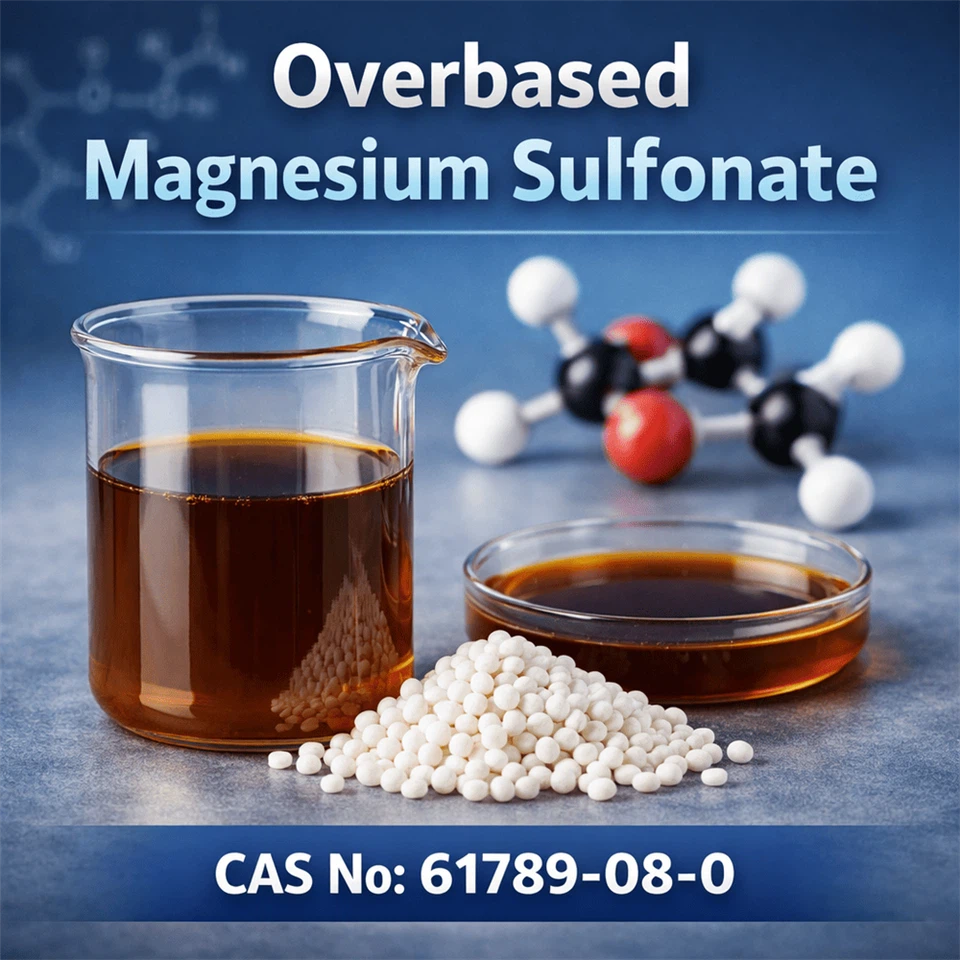
Overbased Magnesium Sulfonate
TBN 300–400 mgKOH/g / Ash-Efficient TBN Delivery / Marine Cylinder Oil & ACEA E6/E9 HDEO Detergent
| Chemical Type | Overbased magnesium alkylbenzene sulfonate - colloidal MgCO₃ micelles stabilised by sulfonate surfactant in mineral oil diluent; Mg²⁺ counter-ion bridges sulfonate head groups |
| Reaction Scheme | Mg(OH)₂ + R–Ar–SO₃H + CO₂ → [R–Ar–SO₃⁻]₂ Mg²⁺ · MgCO₃ (colloidal) · base oil diluent |
| TBN Range | 300–400 mgKOH/g (ASTM D2896 · customisable sub-grades) |
| Physical State | Brown to dark brown viscous liquid; less opaque than equivalent-TBN Ca sulfonate at ambient; heat to 60–80°C for pumping at high TBN sub-grades |
| Key Advantage | ✓ Higher TBN per unit S/A vs Ca sulfonate Marine Cylinder Oil ACEA E6/E9 HDEO |
| GHS Hazards | Combustible liquid FP ≥180°C Skin/Eye irritant H315/H319 |
What Is Overbased Magnesium Sulfonate?
Overbased Magnesium Sulfonate is produced by reacting magnesium hydroxide [Mg(OH)₂] with alkylbenzene sulfonic acid in base oil, then carbonating the reaction mixture with CO₂ to form colloidal magnesium carbonate (MgCO₃) micelles - structurally analogous to overbased calcium sulfonate, but with Mg²⁺ as the cation. The fundamental difference between magnesium and calcium sulfonate chemistry is governed by atomic weight: magnesium (MW 24.3) is 60% lighter than calcium (MW 40.1), meaning that a given mass of Mg contributes significantly more moles of divalent cation - and therefore more moles of CO₃²⁻ TBN reserve - than the same mass of Ca. This translates directly into the defining formulation advantage of Mg sulfonate over Ca sulfonate.
Sulphated ash (ASTM D874) is the key constrained parameter in ACEA E6/E9 (≤1.0 wt%) and API CK-4/FA-4 formulations. Both Ca and Mg sulfonate contribute sulphated ash, but at different efficiencies:
| Property | Ca Sulfonate (Ca²⁺) | Mg Sulfonate (Mg²⁺) | Mg Advantage |
|---|---|---|---|
| Cation atomic weight | 40.1 g/mol | 24.3 g/mol | Mg is 40% lighter |
| Sulphated oxide form | CaO (MW 56.1) | MgO (MW 40.3) | Lower MW oxide |
| S/A conversion factor (metal% → S/A%) | Ca% × 3.40 | Mg% × 3.32 | Similar S/A factor |
| Metal content at TBN 350 (approx.) | ~13 wt% Ca | ~8 wt% Mg | Mg product: 38% lower metal% |
| Sulphated ash at TBN 350, 2 wt% treat | ~0.88 wt% S/A | ~0.53 wt% S/A | 40% LESS ash for same TBN |
Conclusion: At the same TBN and treat rate, Mg sulfonate contributes ~40% less sulphated ash to the finished oil than Ca sulfonate - freeing critical ash headroom for ZDDP and other ash-bearing additives in tight S/A-limited formulations.
| ● Mg Sulfonate - This product | When ash budget is constrained (ACEA E9 ≤1.0% S/A) · MCO needing max TBN/ash efficiency · Supplementary TBN in PCMO C-sequence · Lower viscosity vs same-TBN Ca grade |
| ○ Ca Sulfonate (all TBN levels) | When rust inhibition / film-forming is primary · Ca sulfonate grease base · No ash constraint · Broader global supply availability |
Best practice: blend Ca + Mg sulfonates - Ca provides rust inhibition film; Mg provides TBN-efficient acid neutralisation. Standard approach in commercial MCO and premium HDEO formulations.

Technical Specification
| Parameter | Specification | Test Method | Note |
|---|---|---|---|
| Appearance | Brown to dark brown liquid | Visual | Slightly less opaque than equivalent-TBN Ca sulfonate at ambient; mild sulfonate odour |
| TBN | 300–400 mgKOH/g | ASTM D2896 | Customisable; nominal sub-grades at 300, 350, 400 available on request |
| Magnesium Content | 8–12 wt% | ASTM D5185 / ICP-OES | Mg% × 3.32 ≈ S/A% in finished oil; much lower than Ca sulfonate at equivalent TBN |
| Kinematic Viscosity @100°C | 50–150 cSt | ASTM D445 | Lower than Ca sulfonate at equivalent TBN; heat to 60–80°C for comfortable pumping |
| Flash Point (COC) | ≥ 180°C | ASTM D92 | Combustible liquid; standard industrial storage; not DG under IMDG / ADR / IATA |
| Density @20°C | 1.00–1.08 g/cm³ | ASTM D4052 | Lower density than Ca sulfonate at equivalent TBN - benefits vol-to-wt conversion in blend calculations |
| Sulphated Ash (neat) | 27–40 wt% | ASTM D874 | Lower than Ca sulfonate (35–55 wt% S/A at similar TBN) - core ash-efficiency advantage |
| Sulphur Content | Per industry standard | ASTM D2622 / D5185 | Confirm on COA; Mg sulfonate contributes to finished oil sulphur via the sulfonate backbone |
| Packaging | 200 kg drum · 1000 L IBC · ISO tank | - | Heated drum/IBC recommended in cold climates; ISO tank with heating coil for bulk >16 MT; 24-month shelf life sealed |
Performance Profile
Ash-Efficient Acid Neutralisation
At equivalent TBN and treat rate, overbased Mg sulfonate contributes approximately 40% less sulphated ash than equivalent-TBN Ca sulfonate. This is the critical advantage when formulating to ACEA E9 (≤1.0 wt% S/A), API FA-4 (≤1.0 wt% S/A), or ACEA C3/C5 (≤0.8 wt% S/A) specifications - the ash "saved" by using Mg sulfonate can be reallocated to ZDDP for additional antiwear and antioxidancy without breaching the ash ceiling. In marine applications, the higher TBN-per-unit-ash allows more efficient MCO formulation at a given finished oil BN target.
Excellent Detergency
Like Ca sulfonate, the Mg sulfonate surfactant head group adsorbs strongly to metal surfaces and solubilises polar combustion deposits, carbonaceous ring-belt buildup, and lacquer precursors. The slightly lower polarity of Mg²⁺ vs Ca²⁺ in the sulfonate salt provides marginally different deposit-dispersing characteristics - some MCO formulators prefer a Ca/Mg blend specifically because the combination covers a broader range of deposit polarities than either alone, achieving more complete ring-belt cleanliness across different fuel types.
Corrosion Protection
Mg sulfonate forms a protective hydrophobic adsorption film on ferrous and non-ferrous metal surfaces, providing rust inhibition and acidic corrosion protection. The film-forming strength of Mg sulfonate is slightly less than that of Ca sulfonate (Ca²⁺ adsorbs more strongly to Fe surfaces than Mg²⁺ due to ionic radius effects), which is why Ca + Mg sulfonate blends are preferred in applications where both maximum TBN efficiency and rust inhibition are required - each cation complementing the other's weaker function.
Thermal & Oxidative Stability
Overbased Mg sulfonate maintains its colloidal micelle structure and TBN reserve under sustained high-temperature exposure. The aromatic sulfonate backbone resists free-radical oxidation, and the colloidal MgCO₃ reserve scavenges acidic oxidation by-products - providing synergistic TBN maintenance when combined with primary antioxidants (phenolic/aminic) in long-drain HDEO and gas engine oil formulations operating at sustained oil temperatures of 120–160°C.
Applications & Formulation Guidance
1. Marine Cylinder Oils (MCO) & TPEO - Ash-Optimised Marine Lubricant Formulation
In marine cylinder oil (MCO) formulation, overbased Mg sulfonate is almost always used in conjunction with overbased Ca sulfonate - the combination leverages Ca²⁺'s superior film-forming/rust-inhibition with Mg²⁺'s superior TBN-per-ash efficiency. A typical commercial MCO for VLSFO service (target BN 40–70 mgKOH/g) might use 8–12 wt% Overbased Ca Sulfonate (TBN 450) for primary rust protection and film formation, combined with 5–10 wt% Overbased Mg Sulfonate (TBN 350) to deliver supplementary TBN with lower ash contribution - achieving the target BN at lower total sulphated ash than a Ca-only formulation would require.
2. Heavy-Duty Diesel Engine Oils - ACEA E9/E6 Low-Ash Formulation
ACEA E9 (low-ash Euro VI HDEO for DPF-equipped trucks) and API FA-4 (fuel-efficient low-viscosity HDEO) limit finished oil sulphated ash to ≤1.0 wt%. At the TBN targets required for 60,000–100,000 km drain intervals (finished oil TBN 12–18 mgKOH/g), achieving both high TBN and low S/A requires the formulator to maximise Mg sulfonate and minimise Ca sulfonate in the detergent package. Overbased Mg Sulfonate is the preferred TBN delivery component for these tight ash-budget formulations - it frees ash headroom for ZDDP's antiwear contribution (essential for DPF-equipped engines using API FA-4 low-viscosity grades) and for borated dispersants' supplementary TBN.
3. Gas Engine Oils & High-Temperature Industrial Lubricants
Gas engine oils must provide TBN for nitric acid neutralisation (from NOₓ blow-by) while maintaining oxidative stability under lean-burn conditions. Mg sulfonate is well-suited here because its lower ash contribution allows achieving the required finished oil TBN of 8–15 mgKOH/g without excessive sulphated ash in gas engines where deposit sensitivity is a concern. For high-temperature compressor and turbine oils requiring long-drain stability combined with modest acid neutralisation, low-treat-rate Mg sulfonate provides detergency and alkalinity supplementation at minimal viscosity penalty.
4. Metalworking Fluids & Rust-Preventive Oils
Overbased Mg sulfonate is used in neat metalworking fluids and rust-preventive oils for its combined emulsification, corrosion inhibition, and mild alkalinity. In rolling mill oils and neat cutting fluids, the sulfonate surfactant reduces interfacial tension between the oil and metal workpiece, improving surface wetting and lubrication film formation. The alkalinity reserve buffers acidic contaminants from machining operations. Mg sulfonate is preferred over Ca sulfonate in some metalworking applications where calcium soap formation on workpiece surfaces must be avoided.
Additive Compatibility & Blending Notes
| Co-Additive | Compatibility | Formulation Note |
|---|---|---|
| Overbased Ca Sulfonate (all TBN grades) | ● Excellent | Industry-standard pairing. Ca provides film-forming rust inhibition; Mg provides TBN efficiency. Blend ratio tuned to target finished oil BN and S/A limit - optimise with TBN contribution calculation from each component. |
| ZDDP (Primary / Secondary) | ● Excellent | Mg sulfonate's lower ash frees headroom for higher ZDDP treat rates vs Ca-only formulations. Particularly advantageous in ACEA E9/FA-4 where maximising ZDDP (for antiwear) within the 1.0% S/A cap is a key formulation challenge. |
| PIB Succinimide / Borated Dispersant | ● Excellent | Standard combination. Borated dispersants add TBN without ash - particularly valuable when paired with Mg sulfonate to maximise finished oil TBN/ash ratio in ACEA E9 formulations. |
| Phenolic / Aminic Antioxidants | ● Excellent | Synergistic - Mg sulfonate alkalinity scavenges oxidation by-product acids; antioxidants prevent base oil oxidative thickening. Combine for maximum TBN retention and viscosity stability over long drain intervals. |
| Overbased Barium Sulfonate | ● Good | Blendable. Ba sulfonate provides a distinct rust inhibition profile (especially for non-ferrous alloys and humidity-resistance). Verify regulatory acceptance of Ba-containing additives in the end-market - Ba sulfonate use is declining in some regions. |
| Yellow Metal Passivators (BTA/TTA) | ◑ Check | At high treat rates, verify ASTM D130 copper strip corrosion. Mg sulfonate's alkalinity may compete with BTA/TTA at copper alloy surfaces - adjust passivator level if ASTM D130 rating exceeds 2a at target treat rate. |
Frequently Asked Questions
Q: Why does magnesium sulfonate deliver more TBN per unit sulphated ash than calcium sulfonate?
The difference is atomic weight. TBN is measured in milligrams of KOH equivalent per gram - it reflects the moles of alkalinity per unit mass. Magnesium (MW 24.3 g/mol) is 60% lighter than calcium (MW 40.1 g/mol). When both form carbonates (MgCO₃ vs CaCO₃), each mole of Mg²⁺ contributes the same 2 moles of base equivalents as Ca²⁺ - but per gram, Mg contributes 40.1/24.3 = 1.65× more moles of TBN than Ca. However, MgO (MW 40.3) is only slightly lighter than CaO (MW 56.1), so the sulphated ash conversion factor is similar for both (Mg× 3.32 vs Ca × 3.40). The net result: at the same TBN and treat rate, Mg sulfonate contributes ~38–42% less sulphated ash to the finished oil than Ca sulfonate - a significant formulation advantage in ash-constrained specifications.
Q: Can I use Mg sulfonate as a direct substitute for Ca sulfonate in my existing formulation?
Not as a drop-in one-for-one substitute without bench evaluation. While Mg sulfonate is chemically compatible with Ca sulfonate and all standard co-additives, a direct replacement changes the finished oil's: (1) total sulphated ash - lower with Mg; (2) rust inhibition performance - Ca sulfonate provides a stronger film on iron surfaces; (3) viscosity and density of the blend. In practice, most formulators partial-substitute: replace 30–60% of the Ca sulfonate TBN contribution with Mg sulfonate, then verify the full finished oil against specification tests (ASTM D2896, D874, D130, and any engine performance tests required by the target spec). Contact Sinolook's technical team for guidance specific to your current formulation.
Q: Is Mg sulfonate suitable for ACEA C-sequence (low-SAPS) passenger car engine oils?
Yes - Mg sulfonate is a useful supplementary TBN component in ACEA C3/C5 (S/A ≤0.8 wt%) and C1/C2 (S/A ≤0.5 wt%) formulations, but the primary detergent should still be Low TBN Ca Sulfonate. At very small treat rates (0.3–0.8 wt%), Mg sulfonate contributes supplementary TBN of 0.9–2.4 mgKOH/g while adding only 0.08–0.22 wt% S/A - a reasonable trade-off where the ash budget allows. However, the primary low-SAPS PCMO detergent strategy relies on Low TBN Ca Sulfonate as the base detergent; Mg sulfonate serves as a supplementary TBN booster where needed.
Q: Does overbased Mg sulfonate have any disadvantages vs Ca sulfonate?
The main practical differences are: (1) Weaker rust inhibition - Ca²⁺ adsorbs more strongly to iron oxide surfaces than Mg²⁺, so Ca sulfonate provides superior rust-preventive film formation; Mg sulfonate alone is generally not recommended where rust protection is the primary function. (2) Narrower supply base - Ca sulfonate is produced in larger commercial volumes globally, so Mg sulfonate may have slightly longer lead times in some markets. (3) Less commonly available in Low/Medium TBN grades - most commercial Mg sulfonate is produced at High/Overbased TBN levels; for low-ash PCMO applications requiring low-TBN detergents, Ca sulfonate remains the standard. Sinolook supplies both Ca and Mg sulfonate across all TBN grades to support optimal Ca/Mg blend formulation.
Technical & Regulatory References
D2896 (TBN perchloric acid) · D4739 (TBN HCl supplementary) · D5185 (Mg/Ca/Zn by ICP-OES) · D92 (flash point COC) · D445 (kinematic viscosity) · D4052 (density) · D874 (sulphated ash) · D2622 (sulphur) · D130 (copper strip)
ACEA 2022 E9 / E6 (European HDEO low-ash) · API FA-4 (fuel-efficient heavy-duty diesel, ≤1.0% S/A) · API CK-4 · ACEA C3/C5 (low-SAPS PCMO, supplementary Mg S/A use) · ISO 6743-2 (marine) · MAN Energy Solutions / WinGD / Wärtsilä cylinder oil BN recommendations (MCO Ca/Mg blend)
REACH registered · TSCA inventory listed · No SVHC designation · No Ba/Pb content (unlike Ba sulfonate) · RoHS compliant · Transport: Combustible liquid FP ≥180°C - not classified DG under IMDG / ADR / IATA at standard packaging
Low TBN Calcium Sulfonate · Medium TBN Calcium Sulfonate · High TBN Calcium Sulfonate · Overbased Calcium Sulfonate · Overbased Barium Sulfonate (next in series) · Zinc Sulfonate Complex · Primary ZDDP · PIB Succinimide / Borated Bis-Succinimide Dispersant
Overbased Magnesium Sulfonate · TBN 300–400 mgKOH/g · ~40% Less Ash vs Ca Sulfonate · COA / TDS / SDS
Request Pricing, TDS & Qualification Sample
Specify target TBN sub-grade (300 / 350 / 400 mgKOH/g or custom), application (MCO / HDEO ACEA E9 / gas engine / metalworking), volume, and destination port. Full COA (TBN, Mg%, viscosity, flash point, S/A), TDS, and SDS within 12 hours. Qualification samples (1–5 kg) available at nominal charge. Sinolook supplies the full Ca and Mg sulfonate TBN range - single-source supplier for optimised Ca/Mg blend formulations.
Related: Overbased Calcium Sulfonate · High TBN Calcium Sulfonate · Overbased Barium Sulfonate · Zinc Sulfonate Complex · Primary ZDDP · Borated PIB Bis-Succinimide Dispersant
Hot Tags: overbased magnesium sulfonate, China overbased magnesium sulfonate manufacturers, suppliers