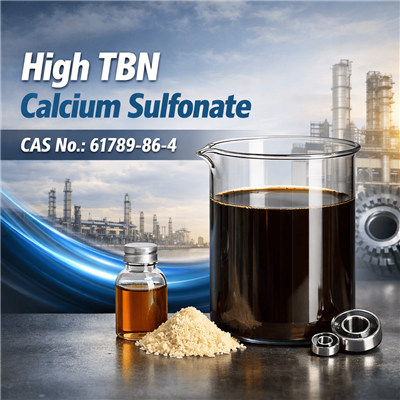

Lubricant Additives - Sulfonate Detergents Series: Overbased Calcium Sulfonate (TBN 400–500 mgKOH/g) delivers maximum acid-neutralisation reserve for marine cylinder oils (BN 40–100 mgKOH/g finished oil), crosshead engine lubricants on HFO/VLSFO, and as a concentrated TBN blending base for severe-duty formulations. Sinolook supplies the full TBN range: Low (0–50) · Medium (150–300) · High (300–400) · Overbased (>400 mgKOH/g) Ca and Overbased Mg sulfonate. COA, TDS, SDS with every shipment.
Lubricant Additive · Overbased Sulfonate Detergent · Marine Cylinder Oil Component · Maximum TBN Reserve
Overbased Calcium Sulfonate
Ultra-High TBN / TBN 400–500 mgKOH/g / Marine Cylinder Oil (MCO) / HFO / VLSFO Crosshead Engine Lubricant
| Chemical Type | Ultra-highly overbased calcium alkylbenzene sulfonate - maximum colloidal CaCO₃ micelle loading; Ca₂(C₁₆H₃₇OSO)₂–xCO₃²⁻ structure with high x (CO₃/sulfonate) ratio in mineral oil diluent |
| Structure | Ca₂(C₁₆H₃₇OSO)₂–xCO₃²⁻ · Alkyl chain C₁₄–C₂₄; the sulfonate shell stabilises extremely large colloidal CaCO₃ aggregates; x (CO₃/sulfonate molar ratio) is maximal in this grade |
| TBN Range | 400–500 mgKOH/g (ASTM D2896 · perchloric acid titration) |
| Physical State | Dark brown highly viscous liquid to semi-paste at ambient; requires heating to 80–100°C for effective pumping and blending; dense, opaque appearance |
| Key Applications | Marine Cylinder Oil (MCO) HFO / VLSFO Crosshead Engine TBN Blending Base ✓ REACH / TSCA |
| GHS Hazards | Combustible liquid FP ≥180°C Skin/Eye irritant H315/H319 |
What Is Overbased Calcium Sulfonate?
Overbased Calcium Sulfonate (TBN 400–500 mgKOH/g) represents the top of the calcium sulfonate TBN range - produced by maximising the carbonation step to incorporate the highest achievable loading of colloidal calcium carbonate (CaCO₃) micelles in the sulfonate shell structure. The simplified formula Ca₂(C₁₆H₃₇OSO)₂–xCO₃²⁻ illustrates that the CO₃/sulfonate molar ratio (x) is at its maximum in this grade, delivering exceptional acid-neutralisation reserve per unit weight of additive at the cost of significantly increased viscosity and density.
Overbased Calcium Sulfonate is the defining detergent for marine cylinder oils (MCO) - the specialised lubricant used in the cylinder-liner region of two-stroke crosshead marine diesel engines burning heavy fuel oil (HFO, VLSFO, or LSFO). Cylinder oils require finished-oil BN of 40–100 mgKOH/g to neutralise sulphuric acid generated from sulphur in the fuel (up to 3.5% S in HFO; 0.1–0.5% S in VLSFO post-IMO 2020) before it reaches the liner surface. Only the Overbased grade delivers sufficient TBN per unit volume at commercially viable treat rates for these extreme marine cylinder applications.
| ○ Low TBN (0–50) | ACEA C1/C2/C3 low-ash · API SP-RC · Hydraulic oil · Rust preventive |
| ○ Medium TBN (150–300) | Standard PCMO · ACEA A3/B4 · API SP · Ca sulfonate grease base |
| ○ High TBN (300–400) | HDDEO API CK-4/FA-4 · ACEA E6/E9 · Marine TPEO (distillate fuel) |
| ● Overbased (>400) - This product | Marine cylinder oil (HFO/VLSFO) BN 40–100 · Two-stroke crosshead MCO · Concentrated TBN blending base · Severe high-sulphur residual fuel applications |

Technical Specification
For Overbased Ca Sulfonate at TBN ~450 mgKOH/g, Ca ~15 wt%, density ~1.12 g/cm³:
TBN contribution to finished oil ≈ treat rate (wt%) × 4.5 mgKOH/g per 1 wt%
| Target Finished Oil BN | Fuel Type | Approx. Ca Sulfonate Treat Rate | Notes |
|---|---|---|---|
| BN 25–40 mgKOH/g | LSMGO / ECA (<0.1% S) | ~6–9 wt% | Post-IMO 2020 ECA operations; lower BN sufficient for low sulphur fuel |
| BN 40–70 mgKOH/g | VLSFO (0.5% S) / MGO blend | ~9–16 wt% | Standard post-IMO 2020 ocean-going vessels; most common current BN target |
| BN 70–100 mgKOH/g | HFO (3.5% S) / pre-IMO legacy | ~16–22 wt% | High-sulphur HFO in non-ECA zones; declining usage post-2020 but still relevant in some markets |
Treat rates are indicative only. Final formulation depends on co-additive TBN contribution, base oil type, and OEM requirements. Sinolook provides formulation support on request.
| Parameter | Specification | Test Method | Note |
|---|---|---|---|
| Appearance | Dark brown viscous liquid to semi-paste | Visual | Opaque at ambient; very dark brown; strong sulfonate odour; nearly solid at <15°C |
| TBN | 400–500 mgKOH/g | ASTM D2896 | Nominal sub-grades at 400, 450, 500; grade-specific TBN on COA |
| Calcium Content | 12–18 wt% | ASTM D5185 / ICP-OES | Highest Ca% in sulfonate range; Ca% × 3.4 ≈ sulphated ash wt% in finished oil |
| Kinematic Viscosity @100°C | 150–400 cSt | ASTM D445 | Heat to 80–100°C for accurate measurement and handling; grade at lower TBN end has lower viscosity |
| Flash Point (COC) | ≥ 180°C | ASTM D92 | Combustible liquid; standard storage; not classified DG under IMDG/ADR/IATA |
| Density @20°C | > 1.10 g/cm³ | ASTM D4052 | Density >1.10 - volume-to-weight conversion essential for MCO blend accuracy (litres ≠ kg) |
| Sulphated Ash (neat) | 45–60 wt% | ASTM D874 | Note: MCO has no S/A limit - the sulphated ash in the finished cylinder oil can be high; limits apply only in non-marine engine oil specs (ACEA/API) |
| Packaging | 200 kg drum · 1000 L IBC · ISO tank | - | Heated drum / IBC mandatory in temperatures <20°C; ISO tank with heating coil for bulk; heated warehouse storage preferred for large inventories |
Performance Profile
Maximum Acid-Neutralisation Capacity
The extreme CaCO₃ loading (45–60 wt% sulphated ash neat; Ca 12–18 wt%) provides the highest acid-neutralisation reserve of any Ca sulfonate grade. In marine cylinder applications, H₂SO₄ from HFO combustion (at fuel S content 3.5 wt%, every kg of fuel generates ~1 g H₂SO₄ equivalents in blow-by) must be neutralised before reaching the liner wall. Overbased Ca sulfonate efficiently buffers this acid load, preventing cold corrosion of cylinder liner surfaces - the dominant wear mechanism in two-stroke crosshead engines on heavy fuels.
Cylinder Liner Cold Corrosion Protection
In two-stroke crosshead engines, the cylinder oil is applied directly to the liner surface by quill injectors - it does not recirculate and cannot carry residual TBN from previous lubrication events. Every application of cylinder oil must deliver sufficient BN to neutralise the local acid generated by fuel combustion at that liner zone. Overbased Ca sulfonate provides the concentrated, instantaneously available alkalinity required for this demanding application - the colloidal CaCO₃ reacts with H₂SO₄ on contact at the liner surface.
Marine Corrosion Resistance
Calcium sulfonate provides outstanding resistance to marine saltwater corrosion through a strongly adsorbed hydrophobic film on metal surfaces. In the extreme marine environment - high humidity, salt spray, and potential condensation water in engine blow-by - the alkaline reserve additionally neutralises acidic corrosion initiators. This dual-mechanism protection (film-forming + alkalinity) makes overbased Ca sulfonate indispensable in all grades of marine lubricant, from cylinder oils to crosshead system oils and stern tube lubricants.
Deposit Control in Marine Combustion Chambers
HFO and VLSFO contain asphaltenes, heavy aromatic fractions, and residual catalyst fines (in cracked residual fuels) that deposit on piston crown, piston ring grooves, and exhaust valve seats during combustion. The sulfonate surfactant component of overbased Ca sulfonate solubilises and disperses these combustion deposits - maintaining ring mobility, preventing ring sticking, and keeping combustion chamber geometry stable over extended running periods between cylinder overhauls.
Applications & Formulation Guidance
1. Marine Cylinder Oils (MCO) - Two-Stroke Crosshead Engine Lubrication
Marine cylinder oil is the primary and most technically demanding application of overbased Ca sulfonate. Two-stroke crosshead marine diesel engines (MAN B&W, WinGD, Wärtsilä types) use a dedicated cylinder lubricant applied directly to the liner surface via quill injectors - separate from the crankcase system oil. Cylinder oils are formulated at BN 40–100 mgKOH/g depending on fuel sulphur content, with overbased Ca sulfonate as the primary TBN carrier. Unlike engine crankcase oil, MCO has no sulphated ash or SAPS limits - the formulator simply uses as much overbased Ca sulfonate as needed to reach the target BN.
2. Marine Trunk Piston Engine Oils (TPEO) - Residual Heavy Fuel
Medium-speed trunk piston engines (TPEO) operating on residual fuels (HFO, VLSFO blends) require higher finished oil BN - typically BN 30–50 mgKOH/g - than those on distillate fuels. Overbased Ca sulfonate (TBN 400–500) can be used as a blending component (often in conjunction with High TBN Ca sulfonate TBN 300–400) to achieve the higher BN targets at competitive treat cost. The overbased grade provides concentrated TBN per unit volume, reducing the total Ca sulfonate volume required in the formulation.
3. Concentrated TBN Blending Base for Additive Packages
Overbased Ca sulfonate (TBN 400–500) is used by additive manufacturers as a concentrated TBN carrier in heavy-duty engine oil (HDEO) detergent/inhibitor (DI) additive packages and marine additive concentrates. By using the highest TBN grade available, additive compounders can maximise the TBN delivery per unit volume of the DI package, minimising package treat rates in the finished oil. Sinolook can supply overbased Ca sulfonate in bulk ISO tank quantities for direct use in additive package blending operations.
4. High-Performance Calcium Sulfonate Grease - Maximum Thickener Yield
Overbased Ca sulfonate (TBN 400–500) provides the highest thickener yield of any grade when converted to a calcium sulfonate grease - the large colloidal CaCO₃ content yields the most crystalline calcite thickener per unit weight. This makes it attractive for complex calcium sulfonate grease production where a very high dropping point (>320°C) and maximum mechanical stability are the targets. However, the very high viscosity requires careful process temperature control during the thermal conversion (typically 180–220°C). Sinolook's technical team can advise on sub-grade selection for your specific grease production equipment and NLGI target grade.
Additive Compatibility & Blending Notes
| Co-Additive | Compatibility | Formulation Note |
|---|---|---|
| Overbased Magnesium Sulfonate | ● Excellent | Standard pairing in MCO and high-TBN HDEO. Mg sulfonate delivers more TBN per gram of sulphated ash (lower atomic weight) - combining Ca + Mg sulfonates optimises BN delivery vs ash efficiency. Typical MCO uses both Ca and Mg overbased sulfonates. |
| High TBN Calcium Sulfonate (300–400) | ● Excellent | Often blended to tune viscosity and TBN level. High TBN has lower viscosity than Overbased - adding High TBN improves processability of the overbased concentrate while maintaining total BN contribution. |
| Fatty Acid / Ester Friction Modifiers (MCO) | ● Good | Fatty acids (oleic, stearic) used as boundary lubrication aids in MCO are chemically compatible but may saponify at high alkalinity. Monitor dosage and verify bench storage stability of the blend before formulation freeze. |
| Antioxidants (Phenolic / Aminic) | ● Excellent | Standard inclusion in any formulation containing overbased Ca sulfonate to prevent oxidative thickening of the base oil diluent during high-temperature storage or use. |
| ZDDP (if used in TPEO / HDEO) | ● Good | Compatible in TPEO and HDEO formulations. Note: MCO does not typically contain ZDDP - ZDP ash would add to the finished cylinder oil ash budget without benefit in the single-pass lubrication system. |
| Yellow Metal Passivators (BTA/TTA) | ◑ Check | High alkalinity at extreme overbasing level can compete with passivator at copper alloy surfaces. In TPEO containing yellow metal components, verify ASTM D130 copper strip test and adjust TTA level accordingly. |
Frequently Asked Questions
Q: What BN cylinder oil should I use after switching from HFO to VLSFO under IMO 2020?
The recommended switch is from BN 70–100 (HFO, 3.5% S) to BN 40–70 (VLSFO, 0.5% S). Using a BN 70–100 cylinder oil on VLSFO risks over-alkalinity - excess un-reacted Ca sulfonate alkalinity on the liner surface can react with sulphate ash deposits from other sources (residual HFO traces, additive ash) to form hard calcium deposits (calcium carboxylate soaps) that abrade the liner. MAN Energy Solutions, WinGD, and Wärtsilä all issued BN 40–70 recommendations for VLSFO operations. Sinolook's overbased Ca sulfonate (TBN 400–500) enables formulation of any target finished oil BN by adjusting the treat rate - contact us for specific treat rate guidance for your target MCO BN.
Q: Why is overbased calcium sulfonate preferred over overbased magnesium sulfonate in some MCO formulations?
Calcium sulfonate and magnesium sulfonate serve complementary roles in MCO formulation. Ca sulfonate provides a stronger physical rust-inhibition film (Ca²⁺ adsorbs more strongly to iron surfaces than Mg²⁺) and better water resistance - advantages in the marine environment. Mg sulfonate delivers more TBN per unit of sulphated ash (magnesium's lower atomic weight means more moles of alkalinity per gram of ash). Most commercial MCO formulations use a blend of both - typically Ca sulfonate for rust protection and film-forming, Mg sulfonate for TBN-efficient acid neutralisation - with the Ca/Mg ratio tuned to the target BN, ash level, and liner material. Sinolook supplies both overbased Ca and Mg sulfonates to support optimised MCO formulations.
Q: Is overbased calcium sulfonate the same as calcium lignosulfonate?
No - these are entirely different chemicals used in completely different industries. Overbased calcium sulfonate (this product) is a synthetic alkylbenzene sulfonate–CaCO₃ colloidal complex produced from petroleum alkylbenzene sulfonation - used exclusively in lubricant oil formulation and grease manufacturing. Calcium lignosulfonate is a by-product of wood pulping (the Kraft process), used as a dispersant in construction (concrete admixtures), agriculture (pesticide dispersants), and dust control. The two products share only the word "sulfonate" and have no overlap in chemistry, production process, or application.
Q: How do I store overbased calcium sulfonate in a warm climate vs cold climate?
In warm climates (>25°C), overbased Ca sulfonate has acceptable fluidity for pumping and blending from standard heated drums. In temperate or cold climates (<15°C), the product solidifies toward a semi-paste and requires 24–48 hours of drum heating at 80–100°C before use - use electrical drum heaters or a heated warehouse. Never use open flame. For bulk ISO tank storage, specify tanks with full heating coils; maintain tank temperature at ≥60°C throughout storage and discharge. For heated warehouse storage of large drum inventories, maintain ambient temperature ≥25°C and rotate stock (oldest drums first) to prevent extended cold exposure. Shelf life: 2 years from production date in sealed original packaging at recommended storage conditions.
Technical & Regulatory References
D2896 (TBN perchloric acid) · D4739 (TBN HCl - supplementary for high-TBN verification) · D5185 (Ca/Mg/Zn by ICP-OES) · D92 (flash point COC) · D445 (kinematic viscosity) · D4052 (density) · D874 (sulphated ash) · D130 (copper strip) · IP 47 / IP 139 (marine lubricant BN)
ISO 8217 (marine fuel sulphur classifications) · MARPOL Annex VI / IMO 2020 (0.5% S global cap; 0.1% S ECA) · MAN Energy Solutions L21/31 / S50ME-C10 cylinder lubrication recommendations · WinGD X-DF / X92DF dual-fuel engine cylinder oil specs · Wärtsilä RT-flex cylinder oil requirements · ISO 6743-2 (marine lubricant classification) · ExxonMobil / Shell / TotalEnergies MCO approval benchmarks
REACH registered · TSCA inventory listed · No SVHC designation · RoHS compliant · Transport: Combustible liquid FP ≥180°C - not classified dangerous goods under IMDG / ADR / IATA at standard packaging. Note: no Ca sulfonate limit under MARPOL for lubricant oil in use onboard vessels.
Low TBN Calcium Sulfonate (0–50 mgKOH/g) · Medium TBN Calcium Sulfonate (150–300 mgKOH/g) · High TBN Calcium Sulfonate (300–400 mgKOH/g) · Overbased Magnesium Sulfonate (next in series) · Overbased Barium Sulfonate · Primary ZDDP · PIB Bis-Succinimide Dispersant · PMA Viscosity Index Improver
Overbased Calcium Sulfonate · TBN 400–500 mgKOH/g · Marine Cylinder Oil · COA / TDS / SDS per Shipment
Request Pricing, TDS & Qualification Sample
Specify target TBN sub-grade (400 / 450 / 500 mgKOH/g or custom), application (MCO BN target / TPEO / HDEO additive pack / grease), volume, and destination port. Competitive FOB pricing, full COA, TDS, and SDS within 12 hours. Qualification samples (1–5 kg) available. Full sulfonate TBN range - Low / Medium / High / Overbased Ca and Mg - from a single source.
Related: High TBN Calcium Sulfonate (300–400) · Overbased Magnesium Sulfonate · Overbased Barium Sulfonate · Medium TBN Calcium Sulfonate · PIB Bis-Succinimide Dispersant · Primary ZDDP
Hot Tags: overbased calcium sulfonate, China overbased calcium sulfonate manufacturers, suppliers