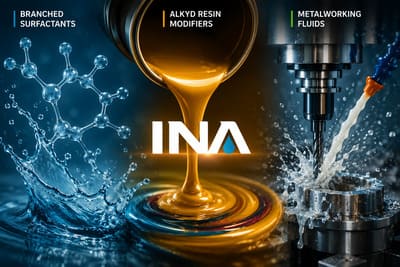
Branched Surfactants, Alkyd Resin Modifiers & Metalworking Fluids from INA
Three smaller application families for isononanoic acid - where the same branched C9 chain solves quite different problems.
💡 Quick answer: Beyond ester lubricants and metal salts, isononanoic acid serves three further roles. As a surfactant feedstock it is ethoxylated, amidated or sulfonated into branched-chain non-ionics and anionics with fast wetting and low foam. As a resin monomer it breaks up polyester crystallinity, improving aliphatic-solvent solubility and film flexibility in alkyds. In metalworking fluids it forms amine soaps that provide boundary lubrication and rust inhibition.
These are lower-volume uses than the polyol esters covered in synthetic ester lubricants or the driers in metal isononanoate driers - but each is a real, specifiable application where the branched C9 structure does something a linear acid cannot.
🧴 Part 1 - Branched-Chain Surfactants
A surfactant needs two halves: a hydrophobic tail that avoids water, and a hydrophilic head that loves it. Isononanoic acid supplies a branched C9 tail; three common chemistries attach the head:
🔹 Ethoxylation. Ethylene oxide units are added to build a polyethylene-glycol chain - giving a non-ionic surfactant whose HLB can be dialled in by adjusting the EO count.
🔹 Amide formation. Reaction with an amine or alkanolamine gives an amide-type surfactant, widely used as a foam modifier, thickener or emulsifier component.
🔹 Sulfonation / salt formation. Introducing an anionic head produces anionic surfactants for detergency and emulsification.
🔬 What Branching Changes - and What It Doesn't
Compared with a straight-chain fatty acid of similar carbon number, a branched tail behaves differently at the interface:
✅ Faster wetting. The bulky, irregular tail packs loosely at the interface, so the molecule reaches and spreads across a surface quickly - valuable in agricultural adjuvants and fast-acting industrial cleaners.
✅ Lower foam. Branched surfactants generally build less stable foam than their linear equivalents - an advantage in CIP cleaning, spray systems and machine washing where foam is a nuisance.
✅ Better cold-temperature handling. Branching lowers the melting point of the derivative, keeping concentrates pourable and clear in cold storage.
⚠️ Biodegradability is not automatic. This is worth stating plainly: branching historically tends to slow biodegradation, not accelerate it - the classic case being branched alkylbenzene sulfonates, which were phased out for exactly this reason. Modern branched surfactants vary widely, and biodegradability depends on the specific structure and head group. Treat it as something to test and certify per product (e.g. OECD 301 series), never as a claim inherited from the feedstock.
Typical outlets: industrial and institutional cleaners, agricultural adjuvants, oilfield chemicals, emulsion polymerisation aids and some personal-care formulations. Sinolook's broader surfactants range covers related raw materials.
🎨 Part 2 - Alkyd & Saturated Polyester Resin Modifier
Alkyd and saturated polyester resins are built from polyols and polyacids into long, repeating chains. Left to themselves, regular chains pack together into ordered, crystalline regions - which makes the resin harder to dissolve, more brittle, and less compatible with low-VOC solvent systems.
Adding a branched monobasic acid such as isononanoic acid changes that. Because INA has only one carboxyl group, it acts as a chain terminator rather than a chain extender - it caps a growing chain end with a bulky, irregular C9 group:
🔹 Reduced crystallinity. The branched cap prevents neat chain packing, keeping the resin amorphous.
🔹 Improved aliphatic-solvent solubility. Valuable in low-VOC alkyd reformulations moving away from aromatic solvents.
🔹 Greater film flexibility. Less crystallinity means a cured film that flexes rather than cracking - useful on substrates that move or expand.
🔹 Molecular-weight control. As a chain terminator, the monobasic acid loading is one lever for controlling final resin molecular weight and viscosity.
⚠️ The trade-off: chain termination cuts both ways. Too much monobasic acid lowers molecular weight and crosslink density, which can soften the film and slow hardness development. INA is a formulation lever to be balanced, not a universal improvement - optimise loading against your hardness and dry-time targets.
These modified resins are typically cured with the same metal driers discussed in metal isononanoate driers for coatings - meaning INA can appear twice in one coating: once in the resin backbone, once in the drier.
⚙️ Part 3 - Metalworking Fluid Concentrates
Cutting, grinding and forming fluids have to do several jobs at once: cool the workpiece, lubricate the tool-workpiece interface, protect fresh metal from flash rust, and stay stable in a recirculating sump. Carboxylic acids earn their place in the concentrate by being neutralised with an amine or alkanolamine to form a soap, which then delivers:
| Function | How the C9 acid soap contributes |
|---|---|
| Boundary lubrication | The soap adsorbs onto the metal surface, forming a thin film that reduces friction where fluid film alone can't reach |
| Rust & corrosion inhibition | Adsorbed carboxylate protects freshly machined ferrous surfaces from flash rust between operations |
| Emulsion stability / solubilising | Acts as a coupling agent, helping keep oil and additives dispersed in soluble-oil and semi-synthetic fluids |
| Low-temperature clarity | Branching keeps the soap soluble, reducing cloudiness and separation in cold concentrate storage |
⚠️ Formulation realities. Metalworking fluids are demanding systems. Acid–amine soaps need pH control to stay effective and non-aggressive to skin and machine seals; sump biostability and non-ferrous compatibility (yellow metals) must be validated separately. Also note that isononanoic acid attacks copper and aluminium alloys over time - relevant to both storage vessels and to any non-ferrous metals in the fluid's service environment. Validate with real machining trials rather than bench data alone.
Sinolook's lubricant additives range includes complementary components for these formulations.
💡 Why reach for INA rather than 2-EHA in these roles? All three applications have traditionally used 2-ethylhexanoic acid. The C9 acid brings slightly better solubility and cold stability - but the bigger driver is regulatory: 2-EHA carries Repr. 1B, SVHC candidate status and US HAP listing, which cascade into every derivative made from it. That matters especially for cleaners, adjuvants and workplace fluids with direct human contact. See isononanoic acid vs 2-EHA.
❓ Frequently Asked Questions
🔹 Are branched surfactants more biodegradable than linear ones?
Generally the opposite - branching has historically slowed biodegradation, which is why branched alkylbenzene sulfonates were phased out. Modern branched surfactants vary considerably, so biodegradability must be tested and certified for the specific product (OECD 301 series), not assumed from the feedstock.
🔹 Why add a monobasic acid to an alkyd resin?
Because it has only one carboxyl group, it caps a growing polyester chain rather than extending it. A branched cap like isononanoic acid reduces crystallinity, improves aliphatic-solvent solubility and film flexibility, and helps control molecular weight - though excessive loading softens the film.
🔹 How is isononanoic acid used in metalworking fluids?
It is neutralised with an amine or alkanolamine to form a soap, which adsorbs onto metal surfaces to provide boundary lubrication and rust inhibition, and helps stabilise emulsions in soluble-oil and semi-synthetic fluids.
🔹 Is there a compatibility concern with non-ferrous metals?
Yes. Isononanoic acid forms metal soap films with copper and aluminium alloys over time. Avoid copper and aluminium storage vessels (galvanised steel and HDPE are compatible), and validate yellow-metal compatibility in any fluid application.
📚 Authoritative References
🔗 Related Articles
Metal Isononanoate Driers for Coatings
The drier that cures the alkyd resin INA helps modify. →
INA in Synthetic Ester Lubricants
✅ Formulating Surfactants, Resins or MWF? Source INA from Sinolook
Water-white isononanoic acid (≥ 99.5% C9, Pt-Co ≈ 3.2, no Repr. 1B, non-SVHC, non-HAP) for surfactant, resin and metalworking-fluid development - with COA, SDS and REACH/TSCA documentation. Qualification samples available.