Isononanoic Acid Market Trends, Demand Drivers & Supply Outlook
A specialty acid whose demand is driven mostly by regulatory pressure on the chemistries it replaces.
💡 Quick answer: Isononanoic acid demand is best understood as a substitution market. Volume growth comes less from new applications than from regulatory pressure displacing incumbent chemistries - 2-ethylhexanoic acid in metal salts and esters, cobalt in coating driers, organotin in PU catalysis, lead in PVC stabilisers, and phthalates in flexible PVC. On the supply side, INA is a niche Oxo derivative made by relatively few producers, so availability and price track C8 olefin feedstock economics and plant scheduling.
ℹ️ A note on scope: this article discusses structural market drivers rather than point-in-time figures. Chemical market volumes and prices move quickly and are best sourced from current commercial market reports. For live pricing, packaging and volume terms, contact us directly via the product page.
⚖️ Driver 1 - Regulatory Displacement of 2-Ethylhexanoic Acid
This is the single largest force behind INA demand growth. 2-EHA has been the default branched acid for metal carboxylates and polyol esters for decades because it is cheap, high in acid value and universally available. But it now carries three regulatory flags: Repr. 1B (H360D) under EU CLP, REACH SVHC candidate status, and US HAP listing.
Those flags matter disproportionately because they cascade downstream. An SVHC-listed input triggers Article 33 communication duties and SCIP notification obligations across every derivative product; a HAP listing brings emission tracking and MACT control costs at US sites. For a manufacturer producing dozens of metal-salt SKUs, switching the base acid can remove an entire administrative layer at once - a far bigger saving than the per-kilogram price difference suggests.
🔹 Where the substitution is strongest: EU-facing supply chains, US facilities managing air permits, and any manufacturer serving consumer, medical or food-contact end markets where customer questionnaires now routinely screen for CMR and SVHC content. The mechanics of the switch are in isononanoic acid vs 2-EHA, and the underlying frameworks in the INA regulatory guide.
⚠️ But substitution is not universal. Where cost dominates and the regulatory exposure is limited - some domestic-market applications, non-EU supply chains, industrial uses with no consumer contact - 2-EHA remains entrenched and competitive. INA competes on regulatory freedom and colour, not on price. Neodecanoic acid also competes for the same substitution volume where hydrolysis resistance is the priority - see the branched-acid selection guide.
🎨 Driver 2 - The Cobalt-Free Shift in Coatings
Cobalt driers have been the workhorse primary drier for alkyd coatings, but cobalt's own CMR classification has pushed formulators toward cobalt-free systems built on cerium, zirconium, manganese and calcium carboxylates. Because those replacement packages typically require more total metal carboxylate to reproduce cobalt's drying speed, the shift is mildly volume-accretive for the acid ligand.
The C9 isononanoate also has a structural advantage in these packages: higher oil solubility than the C8 octoate permits more concentrated, cold-stable drier solutions - useful when a formulator is already adding more metal. Details in metal isononanoate driers for coatings.
❄️ Driver 3 - Refrigerant Transitions and POE Lubricant Demand
The global phase-down of high-GWP refrigerants under the Kigali Amendment to the Montreal Protocol, and equivalent regional measures such as the EU F-Gas Regulation, keeps HVAC and refrigeration systems in a state of continuous transition - HCFC to HFC, and now HFC to lower-GWP HFO and HFO blends.
Each transition reinforces demand for polyol ester (POE) lubricants, because polar refrigerants require a polar, miscible oil that mineral oil cannot supply. Heat-pump adoption in building decarbonisation adds further installed base. Isononanoic acid is one of the acids used to build those POE base oils - see INA polyol esters in refrigeration & compressor lubricants and the wider synthetic ester lubricants overview.
🧫 Driver 4 - Non-Phthalate PVC and Non-Tin Catalysis
🔹 Non-phthalate plasticisers. Phthalate restrictions in toys, medical devices and food contact continue to expand the phthalate-free segment. Isononanoate diesters and triesters occupy a specialty niche within it - see non-phthalate ester plasticisers from INA.
🔹 Lead-free PVC stabilisers. Ca-Zn systems replacing lead keep steady demand for zinc and calcium carboxylate soaps.
🔹 Non-tin PU catalysts. Organotin restrictions support bismuth carboxylate catalysts - see bismuth isononanoate PU catalysts.
⚠️ Keep this in proportion. In the plasticiser market specifically, the dominant phthalate replacements are DOTP/terephthalates and DINCH by a wide margin. Isononanoate esters are a specialty co-plasticiser niche, not a mainstream volume play. Honest positioning matters here - overstating the opportunity leads to disappointed sourcing decisions.
Beyond these four, a set of smaller application families - branched surfactants for industrial cleaners and agricultural adjuvants, alkyd resin modification, and metalworking fluid additives - contributes steady incremental volume, largely driven by the same move away from 2-EHA in workplace-contact formulations. These are covered in branched surfactants, alkyd resin modifiers & metalworking fluids.
🏭 Supply Side: What Sets Availability and Cost
Understanding INA's cost structure helps buyers read the market rather than simply react to quotes:
| Factor | Effect on INA supply & price |
|---|---|
| C8 olefin feedstock | Diisobutylene economics trace back to isobutene and the wider C4 stream - petrochemical cycles pass through |
| Oxo capacity allocation | The same C9 aldehyde can go to the alcohol (isononanol, for DINP) or the acid - producers allocate to whichever nets more |
| Producer concentration | Relatively few plants make merchant-grade INA; a single turnaround can tighten the market noticeably |
| Purification intensity | Water-white, near-anhydrous grades require high-vacuum distillation and carbon treatment - premium grades cost more to make |
| Energy & logistics | Distillation is energy-intensive; freight and drum/IBC availability affect landed cost |
💡 The allocation point is worth dwelling on. Because isononanoic acid and isononanol share the same aldehyde intermediate - differing only in the final oxidation-versus-hydrogenation step (explained here) - strong DINP demand pulling on isononanol can indirectly tighten acid availability. Buyers with continuous requirements benefit from contracted volume rather than spot purchasing. The acid-versus-alcohol distinction itself is set out in isononanoic acid vs isononanol.
✅ What This Means for Sourcing
🔹 Qualify early. If a regulatory deadline is driving your substitution, start qualification trials well ahead - derivative validation, customer approvals and documentation all take time.
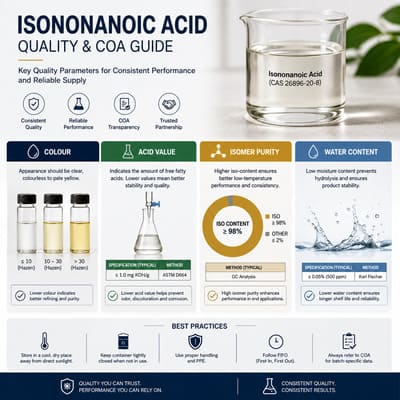
🔹 Specify grade, not just name. "Isononanoic acid" spans a range of colour and water specs. If you make water-white driers or refrigeration esters, the premium grade is not optional - see the INA quality & COA guide.
🔹 Secure documentation upfront. The compliance package is often the reason for switching; confirm your supplier can provide it. See the regulatory guide.
🔹 Consider dual qualification. Given producer concentration, qualifying more than one source protects continuity through turnarounds.
For current price levels and market commentary, commercial market intelligence services such as ICIS ↗ and S&P Global Commodity Insights ↗ publish specialty chemical pricing. For a direct quotation on certified-grade material, contact Sinolook via the isononanoic acid product page.
❓ Frequently Asked Questions
🔹 What is driving isononanoic acid demand growth?
Mainly regulatory substitution: pressure on 2-ethylhexanoic acid (Repr. 1B, SVHC, HAP), the cobalt-free shift in coating driers, organotin restrictions in PU catalysis, lead-free PVC stabilisers, and refrigerant transitions sustaining polyol ester lubricant demand.
🔹 Why is isononanoic acid more expensive than 2-EHA?
It is a smaller-volume specialty made by fewer producers, requires more intensive purification for premium colour and water specs, and has a lower acid value - meaning about 9% more mass per mole of acid. The offsetting saving is in avoided compliance overhead.
🔹 Can DINP demand affect isononanoic acid availability?
Indirectly, yes. The acid and isononanol (DINP's feedstock) share the same C9 aldehyde intermediate, so producers allocate that intermediate between oxidation and hydrogenation routes based on returns. Strong alcohol demand can tighten acid supply.
🔹 Will INA replace 2-EHA entirely?
Unlikely. 2-EHA remains cheaper and entrenched where regulatory exposure is limited, and neodecanoic acid competes for the same substitution volume where hydrolysis resistance matters most. INA is winning share in regulated, quality-sensitive segments rather than displacing 2-EHA wholesale.
📚 References & Further Reading
🔗 Related Articles
The switch that drives most of this demand growth. →
INA Regulatory Guide: REACH, TSCA, SVHC
✅ Securing Isononanoic Acid Supply? Talk to Sinolook
Certified-grade INA (≥ 99.5% C9, Pt-Co ≈ 3.2, water ≈ 0.01%, no Repr. 1B) from 200 kg drums to ISO tanks, with full SDS, REACH and TSCA documentation. Qualification samples for substitution trials; response within 24 hours.