Bismuth Isononanoate PU Catalysts & Ca-Zn PVC Co-Stabilisers from INA
Two metal-salt applications, one driver: moving away from organotin and lead toward lower-toxicity metal carboxylates.
💡 Quick answer: Bismuth isononanoate is a non-tin catalyst for polyurethane systems - an alternative to organotin catalysts such as dibutyltin dilaurate (DBTL), which face tightening restrictions. Zinc and calcium isononanoates are metal-soap components in Ca-Zn PVC heat stabiliser packages, the mainstream lead-free successor for flexible and rigid PVC. In both cases the C9 isononanoate ligand contributes high achievable metal loading and good compatibility with organic formulations.
Coating driers are covered separately in metal isononanoate driers for coatings. This article picks up the two remaining metal-salt families - polyurethane catalysis and PVC stabilisation - where the substitution story is about tin and lead rather than cobalt.
⚗️ Part 1 - Bismuth Isononanoate as a Non-Tin PU Catalyst
Polyurethane forms when an isocyanate (–NCO) reacts with a polyol (–OH) to create a urethane linkage. Left uncatalysed the reaction is too slow and poorly controlled for commercial processing, so a catalyst sets the cure profile - how fast the system gels, how it balances against the competing water/blowing reaction, and how the finished part performs.
For decades, organotin catalysts - above all dibutyltin dilaurate (DBTL) - dominated this role because they are highly active and predictable. The problem is regulatory: certain organotin compounds face restrictions in the EU, and formulators serving consumer-facing, medical and sensitive-application markets have been actively seeking alternatives.
🔹 Why bismuth? Bismuth carboxylates are catalytically active for the urethane (–NCO + –OH) reaction while being generally regarded as among the lower-toxicity heavy metals. They are the most established of the non-tin metal-carboxylate catalysts, often used alone or paired with zinc or zirconium co-catalysts.
🔹 Why the isononanoate ligand? The branched C9 carboxylate is lipophilic and bulky, which helps keep bismuth soluble in polyol blends at high metal loading (typically 15–25% Bi) - so formulators can dose a small amount of catalyst concentrate and still deliver the required bismuth.
🔬 How Bismuth Compares to Organotin - Honestly
A switch away from tin is rarely free. It is worth being clear about both sides:
| Aspect | Organotin (e.g. DBTL) | Bismuth carboxylate |
|---|---|---|
| Regulatory pressure | Increasing restrictions ⚠️ | More favourable profile ✅ |
| Catalytic activity | Very high, highly predictable | Active; may need loading/co-catalyst adjustment |
| Moisture sensitivity | Generally robust | ⚠️ More sensitive to hydrolysis; keep systems dry |
| Cost | Established, lower | ⚠️ Typically higher |
| Typical use | Broad, incumbent | Coatings, adhesives, sealants, elastomers, CASE |
⚠️ Be realistic about the switch. Bismuth catalysts are not a drop-in for organotin in every system. Expect to re-tune catalyst loading, watch moisture control more carefully, and validate the cure profile and shelf life of the catalysed system. Run application trials rather than assuming equivalence on paper.
🧫 Part 2 - Zinc & Calcium Isononanoates in Ca-Zn PVC Stabilisers
PVC has a processing problem: when heated for extrusion or moulding, it begins to dehydrochlorinate - shedding hydrogen chloride (HCl) from the polymer chain. The released HCl then catalyses further degradation, creating conjugated double bonds that discolour the polymer from yellow through brown to black. A heat stabiliser interrupts this cascade.
Historically, lead-based stabilisers did this job cheaply and effectively. As lead was phased out of PVC applications across many markets, calcium-zinc (Ca-Zn) systems became the mainstream lead-free replacement - and metal carboxylates are their core.
🔹 Zinc carboxylate - the fast scavenger. Zinc reacts quickly with the labile chlorine sites on the PVC chain, substituting them before they can initiate degradation. It gives excellent early colour hold.
🔹 Calcium carboxylate - the partner. Zinc alone has a catch: as it is consumed it forms zinc chloride, which is itself a strong degradation catalyst - the well-known "zinc burning" failure, where the compound suddenly blackens late in processing. Calcium carboxylate regenerates the zinc soap and takes up the chloride, delaying that collapse.
🔹 The isononanoate contribution. Within a multi-carboxylate package (typically alongside stearate, laurate and benzoate ligands), the branched C9 isononanoate offers a balance of HCl-scavenging speed, processing lubricity and thermal colour stability that sits between stearate (good lubricity, moderate scavenging) and 2-ethylhexanoate (fast scavenging, lower lubricity).
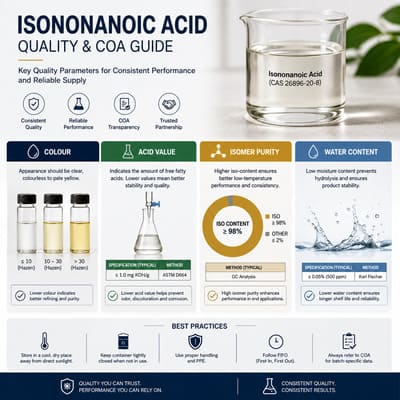
🎨 Why acid colour matters here too: the stabiliser concentrate's colour carries into the finished PVC compound. Water-white isononanoic acid (Pt-Co ≈ 3.2) supports pale stabiliser concentrates - important for light-coloured and transparent PVC where any yellow cast in the additive shows up in the part. How to verify that colour spec on a certificate is covered in the INA quality & COA guide.
Ca-Zn systems are honest about their trade-offs: they generally require careful co-stabiliser support (polyols, epoxidised oils, beta-diketones) to match the long-term stability that lead systems delivered, and formulation balance is more demanding. The isononanoate is one ligand in that balance, not a complete solution on its own.
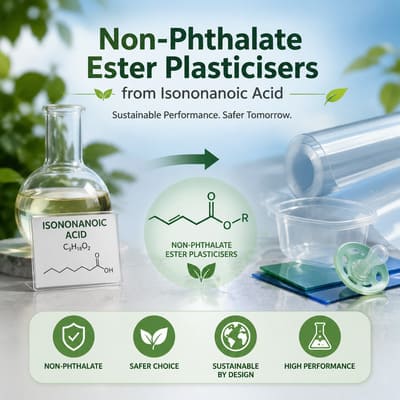
Note that a stabiliser is only half of a flexible PVC formulation - the other half is the plasticiser, where isononanoic acid also has a role. See non-phthalate ester plasticisers from isononanoic acid.
🧭 What the C9 Ligand Contributes Across Both Applications
✅ High metal loading. The bulky, lipophilic branched C9 chain keeps metals soluble in organic media, enabling concentrated catalyst and stabiliser products (e.g. 15–25% Bi).
✅ Formulation compatibility. Better solubility in polyol blends and PVC plasticiser systems than shorter C8 ligands, reducing haze and precipitation.
✅ Clean acid profile. Unlike 2-EHA (Repr. 1B, SVHC candidate, US HAP), isononanoic acid carries no CMR classification - so the acid ligand does not add regulatory burden to a derivative that was chosen precisely to reduce it. See isononanoic acid vs 2-EHA.
⚠️ But verify each derivative independently. The acid's clean status does not transfer to every metal. As with cobalt in the drier family, the metal ion carries its own classification - always check the specific salt against the regulatory guide.
Where maximum hydrolysis resistance matters - relevant given bismuth catalysts' moisture sensitivity - neodecanoic acid's quaternary alpha carbon outperforms INA's. The full three-way comparison is in the branched-acid selection guide.
❓ Frequently Asked Questions
🔹 What is bismuth isononanoate used for?
It is a non-tin catalyst for polyurethane systems - coatings, adhesives, sealants and elastomers (CASE) - catalysing the isocyanate–polyol reaction. It is used as an alternative to organotin catalysts such as dibutyltin dilaurate.
🔹 Can bismuth replace organotin catalysts directly?
Not as a straight drop-in. Bismuth is catalytically active but usually needs loading adjustment, sometimes a co-catalyst, and tighter moisture control. Validate cure profile and system shelf life with application trials.
🔹 Why do PVC stabilisers pair calcium with zinc?
Zinc scavenges labile chlorine quickly but forms zinc chloride, which accelerates degradation ("zinc burning"). Calcium carboxylate regenerates the zinc soap and takes up chloride, extending stability and preventing sudden late-stage blackening.
🔹 What does the isononanoate ligand add to a Ca-Zn package?
A balance of HCl-scavenging speed, processing lubricity and colour stability sitting between stearate and 2-ethylhexanoate, plus support for pale concentrates when made from water-white acid.
📚 Authoritative References
🔗 Related Articles
Metal Isononanoate Driers for Coatings
Cobalt, zirconium, cerium and the cobalt-free shift. →
Non-Phthalate Ester Plasticisers from INA
Related Sinolook products: TM810 (Tri(octyl,decyl) Trimellitate) · Plasticizers range
✅ Making Bismuth Catalysts or Ca-Zn Stabilisers? Source INA from Sinolook
Water-white isononanoic acid (≥ 99.5% C9, Pt-Co ≈ 3.2, water ≈ 0.01%, no Repr. 1B) for high-loading bismuth, zinc and calcium isononanoate synthesis - with COA, SDS and REACH/TSCA documentation. Samples available for catalyst and stabiliser trials.