
🚗 End Use: Automotive & EV
Brominated Polystyrene in Automotive & EV Plastics
Sustained under-hood heat, high-voltage faults, and a fast-growing flame-retardant brief. ⚡
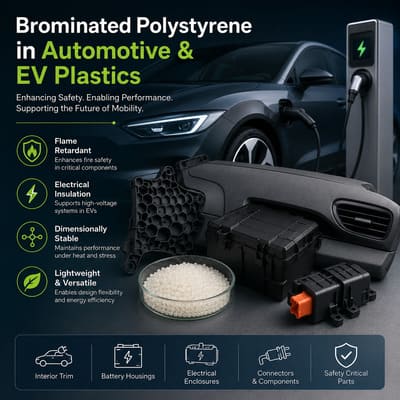
Cars have always been hard on materials, but two forces are raising the bar for flame-retardant plastics in vehicles. First, the traditional demand: under-hood parts endure sustained heat, vibration and chemical exposure for years. Second, and more dramatically, electrification - EVs pack high-voltage batteries, power electronics and heavy-current connections where an electrical fault carries real energy. Both trends favour a flame retardant that is heat-stable and permanent, which is precisely the profile of brominated polystyrene (BPS). 🚗
This article is part of our BPS knowledge base. For the overview, start with the complete guide to brominated polystyrene.
🌡️ Why Automotive Is Such a Demanding Home
Automotive parts must survive conditions that would retire a consumer product quickly:
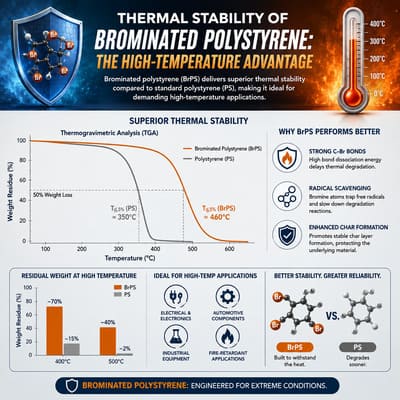
- 🔥 Sustained heat. Under-hood temperatures stay high for the vehicle's life, so both the polymer and its flame retardant must resist long-term thermal ageing - not just survive a single moulding cycle.
- ⏳ Long service life. A blooming or migrating additive that might be tolerable in a short-life product becomes a warranty problem over a decade of service.
- 🧵 Reinforced, structural parts. Many are glass-filled for strength, bringing the candlewick challenge to flame retardancy.
- 🛡️ Safety-critical function. Electrical and battery-adjacent parts must refuse to propagate fire under fault conditions.
💡 The fit: BPS's headline properties - thermal stability and non-blooming permanence - are precisely the qualities that survive years of under-hood heat.
🔧 Conventional Automotive Uses
Even before electrification, flame-retardant engineering plastics were well established in the vehicle, usually via PBT and glass-reinforced nylon:
- 🔌 Electrical connectors & junction boxes throughout the wiring harness.
- 🎛️ Sensor housings & control modules in the engine bay.
- 🧲 Relay and fuse-box components handling switching and protection.
- 💡 Lighting and ignition-adjacent parts exposed to heat.
⚡ The EV Effect: A Bigger Flame-Retardant Brief
Electrification is the biggest change to hit automotive flame retardancy in a generation. High-voltage architecture introduces parts that simply didn't exist in a conventional car, and many of them demand robust flame retardancy:
- 🔋 Battery-pack components - cell holders, module frames and structural parts where thermal-runaway safety is paramount.
- 🔌 High-voltage connectors - carrying far more energy than 12 V systems, so a fault is far more serious.
- 🚌 Busbar holders & insulation - supporting heavy current paths.
- ⚙️ Power-electronics & charging-inlet housings - inverters, on-board chargers and connectors.
📈 Demand driver: because EVs add these high-voltage, safety-critical plastic parts, the volume of flame-retardant engineering plastic per vehicle rises - a structural tailwind explored further in our BPS market trends & buyer's guide.
✅ Why BPS Fits the EV Brief
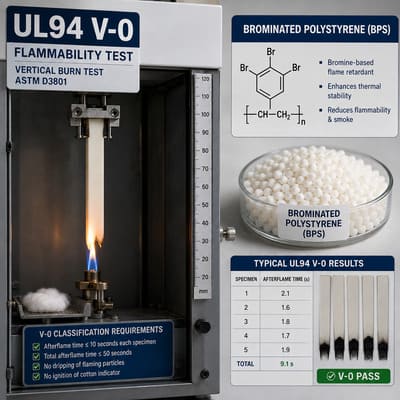
✅ Reliable V-0 at low loading for safety-critical parts - via the BPS + antimony system.
✅ Heat & ageing resistance for long-life battery and power-electronics environments.
✅ Electrical performance for high-voltage connectors and busbar supports.
✅ Non-blooming permanence so sealing and mating surfaces stay clean for the vehicle's life.
⚖️ An Honest Note on EV Battery Safety
EV battery safety is an area of intense engineering scrutiny, and material choices there deserve candour. BPS brings excellent flame retardancy and heat stability, but like all brominated systems it releases corrosive hydrogen bromide and smoke under fire. In sealed battery enclosures where corrosivity, smoke and toxicity are weighed carefully, some designs favour halogen-free systems. BPS remains a strong, widely used choice for many high-voltage connectors, housings and structural parts - but the right material is always application-specific, and battery-pack decisions should be made with full fire-effluent data.
❓ Frequently Asked Questions
❓ Why is BPS well suited to under-hood automotive parts?
💡 Under-hood parts face sustained heat over years. BPS's high thermal stability and non-blooming permanence resist long-term thermal ageing, so parts keep their properties and appearance.
❓ How does EV adoption affect flame-retardant demand?
💡 EVs add high-voltage connectors, busbar holders and battery-pack plastics that need robust flame retardancy, raising the volume of flame-retardant engineering plastic per vehicle.
❓ Which resins carry BPS into vehicles?
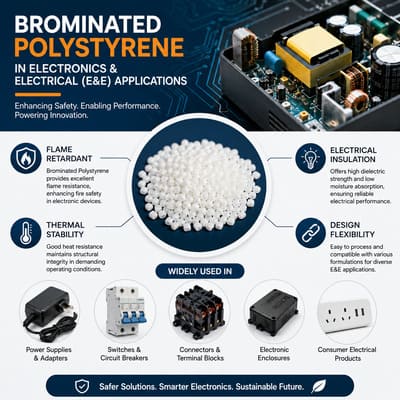
💡 Chiefly flame-retardant PBT and glass-reinforced PA6/PA66 - the same connector and housing resins used across the E&E world.
❓ Is BPS used inside EV battery packs?
💡 It's used in many high-voltage connectors, housings and structural parts. For sealed battery enclosures, designers weigh fire effluent carefully, and some favour halogen-free systems - the choice is application-specific.
📚 Related Articles
⚡ End Use
Brominated Polystyrene in Electronics & Electrical (E&E) ApplicationsThe closely related E&E market and its shared connector requirements.
📈 Market
Brominated Polystyrene Market Trends & Buyer's GuideHow EV growth and demand drivers are shaping the BPS market.
📘 Start Here
Brominated Polystyrene (BPS) Flame Retardant: The Complete GuideThe hub article covering everything about BPS in one place.
💬 Developing Automotive or EV Parts?
Sinolook Chemical supplies brominated polystyrene for automotive and EV flame-retardant plastics - heat-stable, permanent, reliable to V-0. Request a quote, sample or technical discussion. 🚀
📱 WhatsApp: 0086 18150362095
💬 WeChat / Tel: 0086 13400715622
✉️ Email: sales@sinolookchem.com
View the BPS Product Page →