
🔥 Flame Retardant Guide
Brominated Polystyrene (BPS) Flame Retardant: The Complete Guide
The polymeric brominated flame retardant that keeps engineering plastics safe - without blooming, migrating or breaking down. ⚗️
In the world of polymer science, achieving reliable flame retardancy without compromising the plastic's mechanical performance is a constant balancing act. Brominated polystyrene (BPS) has become a go-to answer for engineers who need fire safety in high-temperature engineering plastics. Its secret is simple: because the bromine is built into a polymer backbone rather than a small molecule, it stays exactly where you put it - through compounding, moulding and years of service. 💡
This guide is the hub of our BPS knowledge base. Below you'll find a plain-English overview of every important topic, with links to deeper articles on each. If you're evaluating BPS for a specific resin or need pricing, you can jump straight to our brominated polystyrene product page.
⚗️ What Is Brominated Polystyrene?
Brominated polystyrene is an additive flame retardant made by brominating a polystyrene backbone, giving an off-white to pale-yellow powder or pellet. It belongs to the family of aromatic brominated polymers and is prized for combining a high bromine content - around 66–68% bromine (see full specifications) - with the stability of a polymer. You can review its identity and structure on PubChem.
Because it is additive rather than reactive, BPS is blended into the polymer melt during compounding - it does not need to react with the polymer chains. And because it is polymeric and high in molecular weight, it resists the two problems that plague many small-molecule flame retardants: blooming (migration to the surface) and volatilisation during hot processing.
🔬 How BPS Stops Fire
BPS works mainly in the gas phase. As the plastic heats, BPS releases bromine radicals that interrupt the chain reactions feeding a flame - effectively "starving" the fire of the reactive species it needs to keep burning. This is why it is almost always paired with a synergist (antimony trioxide) that amplifies the effect.
💡 Want the chemistry in detail? Read our deep-dive on how brominated polystyrene works (flame-retardant mechanism).
✅ Why Formulators Choose BPS
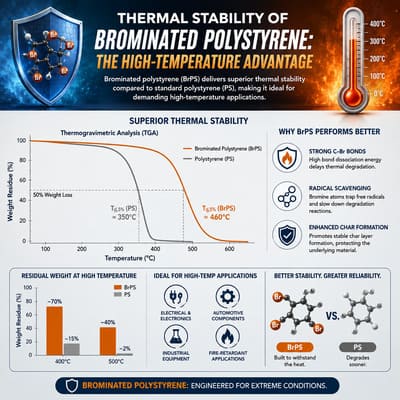
✅ Outstanding thermal stability - survives the high melt temperatures of engineering plastics where many flame retardants degrade.
✅ Non-blooming - the polymeric structure stays locked in the matrix, so surfaces stay clean and properties stay stable.
✅ Low migration & low volatility - high molecular weight means it doesn't leach or evaporate readily.
✅ Excellent electrical properties - a key reason it's chosen for demanding electrical & electronic parts.
✅ Good melt flow & colour retention - helps maintain processability and appearance in moulded parts.
🏭 Where BPS Is Used
BPS is particularly suited to high-temperature engineering thermoplastics. The most common homes for it are:
- 🧱 PBT - one of its flagship applications, especially glass-filled grades. See BPS as a flame retardant for PBT.
- 🧵 PET and reinforced polyester - read BPS in PET flame-retardant applications.
- 🔩 Nylon (PA6 / PA66), especially glass-fibre reinforced - see BPS in nylon flame retardancy.
- ⚙️ PPO/PPE, HDPE, ABS and other engineering plastics - explore BPS in other engineering plastics.
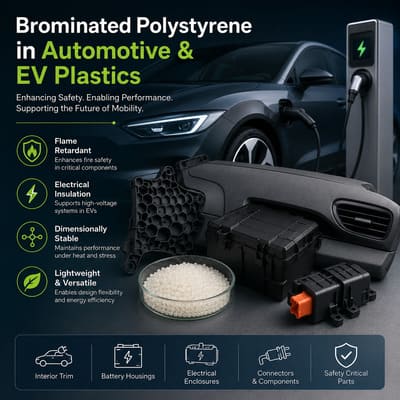
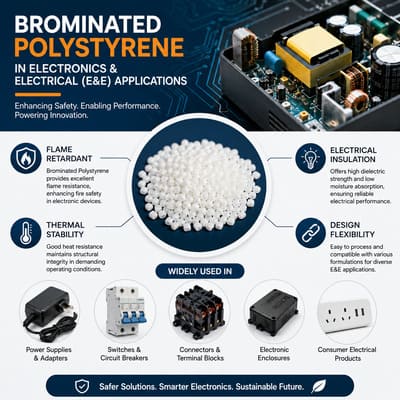
Those resins end up in two big end-markets: electronics & electrical (E&E) parts such as connectors and housings, and automotive & EV components exposed to under-hood heat and high voltage.
🎚️ Grades: Matching BPS to Your Process
BPS is offered in different softening-point grades - broadly, a lower-softening grade for easier dispersion and a higher-softening grade for the hottest processing windows. The right choice depends on your polymer, processing temperature and target properties. For exact grade specifications and a recommendation for your resin, see the product page or our BPS buyer's guide.
⚖️ How BPS Compares
BPS isn't the only flame retardant on the shelf. Two comparisons matter most:
- 🔁 Versus other brominated flame retardants (such as decaBDE, DBDPE, HBCD and TBBPA): BPS's polymeric structure gives it lower migration and a more favourable regulatory profile. See BPS vs other brominated flame retardants.
- 🌿 Versus halogen-free flame retardants (phosphorus and mineral systems): an honest trade-off on cost, loading level and performance. Read brominated vs halogen-free flame retardants.
🧪 Formulating with BPS and Antimony Trioxide
BPS is almost always used together with antimony trioxide (Sb₂O₃), which acts as a synergist and lets you hit a target rating at a lower total loading. Getting the bromine-to-antimony ratio and overall dosage right is the heart of a good formulation. Our BPS + antimony trioxide synergy & loading guide walks through typical ratios and dosing. The reason BPS tolerates aggressive compounding in the first place is its exceptional thermal stability.
🛡️ Fire Testing & UL94
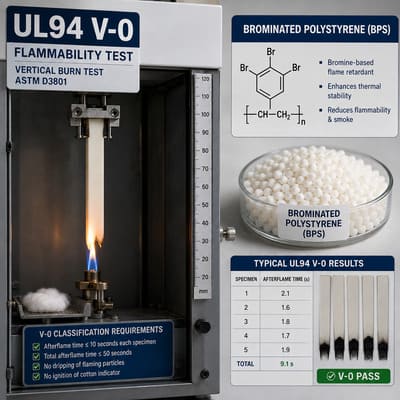
The goal for most parts is a UL94 V-0 rating - the benchmark for self-extinguishing plastics in electrical and electronic products. BPS formulations are widely used to reach V-0, and are also evaluated with glow-wire and limiting-oxygen-index (LOI) tests. Learn what the ratings mean in our UL94 V-0 flammability testing guide, and see the classification framework at UL Solutions.
📋 Regulatory & Safety - An Honest View
⚠️ Let's be straight about the trade-offs. BPS is a brominated flame retardant, so it is used with an antimony trioxide synergist (which carries its own occupational-exposure precautions), and like all halogenated systems it can release corrosive hydrogen bromide and smoke under fire conditions. Always follow the SDS and consult OSHA/ECHA guidance for handling.
✅ The favourable side is real too. Unlike some legacy brominated flame retardants, BPS is polymeric, high molecular weight and low-migration. It is not a PBDE and not HBCD, and it is not listed as a Persistent Organic Pollutant under the Stockholm Convention. It is generally not among the brominated substances restricted under EU RoHS.
That said, regulations evolve and vary by region and application - so verify the current status for your market before you specify. We cover this in full in Is BPS RoHS & REACH compliant?, with primary references from EUR-Lex and the US EPA.
📈 Market Snapshot
Demand for BPS is driven by flame-retardant engineering plastics in electronics, automotive and construction - with Asia-Pacific as the dominant production and consumption region. For demand drivers, grade selection and sourcing tips, see our BPS market trends & buyer's guide. Sinolook is part of the Sinolook group, supplying specialty chemicals to 50+ countries.
❓ Frequently Asked Questions
❓ Is brominated polystyrene the same as ordinary polystyrene?
💡 No. It's a polystyrene backbone that has been brominated to act as a flame retardant - a functional additive, not a structural plastic.
❓ Which plastics is BPS best for?
💡 High-temperature engineering thermoplastics - most notably PBT, PET, and glass-reinforced nylon (PA6/PA66), plus PPO/PPE, HDPE and ABS.
❓ Does BPS need antimony trioxide?
💡 In practice, yes. Sb₂O₃ acts as a synergist so you can reach the target rating at a lower total loading.
❓ Will BPS bloom or migrate to the surface?
💡 No - its polymeric, high-molecular-weight structure resists blooming and migration, which is one of its main advantages.
❓ Is BPS a restricted substance like decaBDE or HBCD?
💡 BPS is not a PBDE or HBCD and is not listed as a POP, but regulations differ by region and application - always confirm the current status for your market.
📚 Related Articles
🧱 Application
Brominated Polystyrene in PBT: Flame Retardant for Polybutylene TerephthalateWhy BPS is a leading flame retardant for PBT and glass-filled PBT.
⚖️ Comparison
BPS vs Other Brominated Flame Retardants (decaBDE, HBCD, TBBPA)How polymeric BPS compares on migration, stability and regulatory profile.
📋 Regulatory
Is Brominated Polystyrene RoHS & REACH Compliant?An honest look at BPS's regulatory status and environmental profile.
💬 Need Brominated Polystyrene for Your Formulation?
Sinolook Chemical supplies BPS and specialty flame retardants to 50+ countries, with technical support on grade selection and loading. Get a quote or a sample today. 🚀
📱 WhatsApp: 0086 18150362095
💬 WeChat / Tel: 0086 13400715622
✉️ Email: sales@sinolookchem.com
View the BPS Product Page →