
🛡️ Testing & Standards
UL94 V-0 & Flammability Testing with Brominated Polystyrene
What the rating on your datasheet really certifies - and how BPS earns it. ✅
"UL94 V-0" is one of the most quoted specifications in plastics, yet one of the least understood. It isn't a measure of how "fireproof" a material is - it's the result of a specific, standardised test with precise pass criteria. If you formulate, specify or buy flame-retardant plastics, knowing exactly what the rating means (and doesn't mean) is essential. This article explains the key tests and how a brominated polystyrene (BPS) formulation is engineered to pass them. 🛡️
This article is part of our BPS knowledge base. For the overview, start with the complete guide to brominated polystyrene.
🔥 What UL94 Is
UL94 is the "Standard for Safety of Flammability of Plastic Materials for Parts in Devices and Appliances," maintained by UL Solutions. It classifies how a plastic behaves when exposed to a defined flame under controlled conditions. The most cited ratings come from the vertical burn test, which produces the V-2, V-1 and V-0 classifications - V-0 being the most stringent of the three.
💡 Crucial detail: a UL94 rating is always tied to a specific thickness. "V-0 at 0.8 mm" is a stronger claim than "V-0 at 3.0 mm," because thinner walls are harder to pass. A rating without a thickness is incomplete.
📋 How V-0 Is Actually Judged
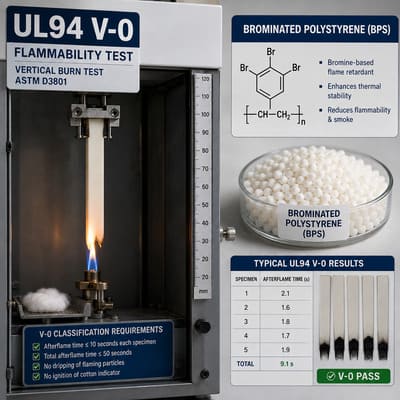
In the vertical test, a bar-shaped specimen is clamped vertically and a defined flame is applied to its lower end for two 10-second applications. Inspectors then measure how the specimen responds. To reach V-0, the material must satisfy all of the following (the criteria that separate V-0 from the lesser ratings):
- ⏱️ Short afterflame per specimen - flaming must stop quickly after each flame application (no lingering burning).
- 📊 Short total afterflame - the combined flaming time across the set of specimens must stay within a tight limit.
- 🚫 No burning to the clamp - the specimen must not be consumed up to the holding point.
- 💧 No flaming drips - drips that ignite the cotton indicator below cause an automatic downgrade. (This is why an anti-drip additive is so often decisive.)
The difference between V-2 and V-0 frequently comes down to that last point - flaming drips - which is exactly why formulation matters so much. See how it's handled in the antimony trioxide synergy & loading guide.
🔌 Glow-Wire Testing (Why Connectors Care)
UL94 isn't the only test that matters. For electrical and electronic parts - especially connectors and housings that sit near live current - glow-wire tests are often mandatory. Here an electrically heated wire is pressed against the specimen to simulate a fault condition such as an overloaded contact or glowing element.
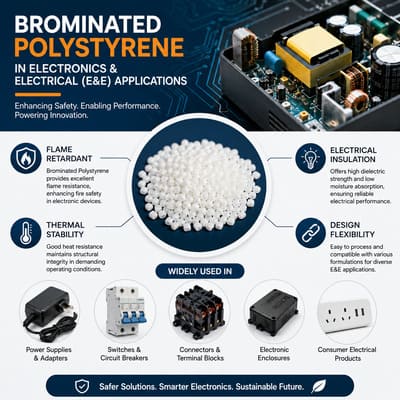
The key metrics are the GWFI (glow-wire flammability index) and GWIT (glow-wire ignition temperature). These methods are defined in the IEC 60695 series, published by the IEC. Because BPS supports good electrical properties alongside flame retardancy, it's well suited to parts that must clear both UL94 and glow-wire requirements - see BPS in electronics & E&E applications.
📈 Limiting Oxygen Index (LOI)
The limiting oxygen index (LOI) is a useful ranking tool used in development. It measures the minimum oxygen concentration (as a percentage) needed to just sustain combustion of a material. Ambient air is about 21% oxygen, so:
- 🟢 LOI above ~21% means the material needs more oxygen than air provides to keep burning - a sign of self-extinguishing behaviour.
- 📊 Higher LOI = harder to burn. Adding a BPS/antimony system raises a compound's LOI, and formulators track it as a quick, quantitative indicator during development before running full UL94 bars.
LOI is standardised in methods such as ISO 4589, published by ISO. It's a development aid, not a substitute for the actual rating a product must carry.
✅ How a BPS Formulation Is Designed to Pass
Reaching V-0 with BPS is a matter of assembling the whole system correctly:
1️⃣ BPS as the bromine source, chosen for heat stability so it survives compounding intact.
2️⃣ Antimony trioxide at the right Br:Sb ratio to maximise gas-phase efficiency.
3️⃣ PTFE anti-drip to eliminate the flaming drips that fail V-0.
4️⃣ Total loading set to the thinnest rated wall, with margin for production variation.
5️⃣ Good dispersion so every bar performs consistently.
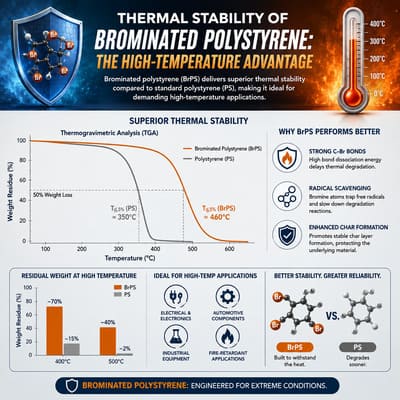
Get these right and a glass-filled engineering plastic will clear V-0 reliably. The formulation detail lives in the synergy & loading guide, and the heat-stability foundation in BPS thermal stability.
⚖️ What a Rating Does - and Doesn't - Tell You
A UL94 V-0 rating is valuable, but it's important to be honest about its scope:
✅ It tells you how a small specimen of a specific thickness behaved under a defined lab flame - a reproducible, comparable benchmark.
⚠️ It doesn't tell you everything about a real fire: smoke density, toxicity and corrosivity of the effluent are separate matters. Brominated systems, BPS included, produce corrosive HBr and smoke - so where those factors are critical, they must be assessed with additional tests and weighed against halogen-free options.
❓ Frequently Asked Questions
❓ What's the difference between V-0, V-1 and V-2?
💡 All three self-extinguish, but V-0 has the tightest afterflame limits and - critically - allows no flaming drips. V-2 permits flaming drips; V-0 does not.
❓ Why must a UL94 rating state a thickness?
💡 Because thinner walls are harder to pass. "V-0 at 0.8 mm" is a stronger result than the same rating at 3.0 mm - always formulate and specify to the thinnest rated wall.
❓ Is glow-wire the same as UL94?
💡 No. Glow-wire (IEC 60695) simulates an electrical fault with a heated wire and is often required for E&E parts in addition to UL94's flame test.
❓ Does UL94 V-0 mean the material is completely safe in a fire?
💡 No. It's a specific small-scale benchmark. Smoke, toxicity and corrosivity are separate considerations that may need their own tests, especially for enclosed spaces.
📚 Related Articles
🧪 Formulation
BPS + Antimony Trioxide Synergy: Loading & Formulation GuideExactly how to build a compound that passes V-0.
🧱 Application
Brominated Polystyrene in PBT: Flame Retardant for Polybutylene TerephthalateA flagship V-0 application in glass-filled engineering plastic.
📘 Start Here
Brominated Polystyrene (BPS) Flame Retardant: The Complete GuideThe hub article covering everything about BPS in one place.
💬 Targeting a UL94 V-0 Rating?
Sinolook Chemical supplies brominated polystyrene and can help you design a formulation to reach V-0 at your target wall thickness. Request a quote, sample or technical discussion. 🚀
📱 WhatsApp: 0086 18150362095
💬 WeChat / Tel: 0086 13400715622
✉️ Email: sales@sinolookchem.com
View the BPS Product Page →