
🌡️ Performance
Thermal Stability of Brominated Polystyrene: The High-Temperature Advantage
The unglamorous property that decides which flame retardant actually survives your process. 🔥
Ask a compounder what goes wrong with flame retardants, and the answer is rarely "it didn't stop the fire." Far more often it's a processing failure: the additive fumed off, plated onto the mould, discoloured the part, or bloomed to the surface weeks later. Almost all of these problems trace back to one property - thermal stability - and it is the property brominated polystyrene (BPS) was designed to deliver. 🌡️
This article is part of our BPS knowledge base. For the overview, start with the complete guide to brominated polystyrene.
🌡️ What "Thermal Stability" Actually Means
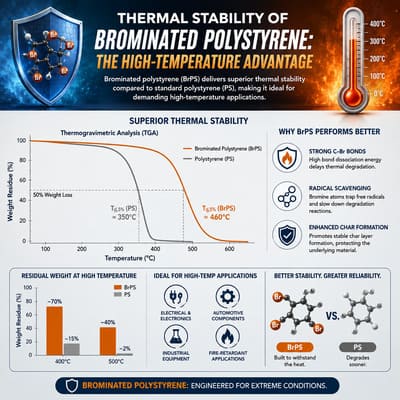
For a flame retardant, thermal stability has a very specific meaning: the additive must stay chemically intact at the polymer's processing temperature, yet still release its bromine when the finished part is exposed to the much higher temperatures of an actual fire. In other words, it needs a decomposition point comfortably above the melt temperature but within reach of flame conditions.
This gap is the whole game. If an additive starts to break down during compounding or moulding, three things happen at once: it loses potency (some bromine is spent before the part ever sees a fire), it releases corrosive by-products that attack tooling, and it discolours the polymer. A flame retardant that can't hold this line simply isn't usable in high-temperature engineering plastics.
💡 The window that matters: PA66 is processed near 280–300 °C and PET near 270–290 °C. A flame retardant for these resins must be stable across that entire range - see how it plays out in BPS in nylon and BPS in PET.
🧬 Why BPS Is So Heat-Stable
The answer is its polymeric, high-molecular-weight structure. Two mechanisms are at work:
- 🔗 Aromatic backbone strength. The bromine sits on aromatic rings within a stable polystyrene chain. Aromatic carbon–bromine bonds are more thermally robust than many aliphatic equivalents, so they don't cleave prematurely at processing temperatures.
- ⚖️ High molecular weight. A large polymer molecule has negligible vapour pressure, so it doesn't evaporate or "boil off" the way a small molecule can at 280–300 °C. It stays in the melt where it belongs.
This is the same structural advantage that underlies BPS's non-blooming behaviour and low migration, discussed across the library and rooted in the chemistry described in how brominated polystyrene works.
🔬 The Contrast With Small-Molecule Flame Retardants
The value of BPS's stability is clearest by contrast. Small-molecule brominated additives, however efficient, are more prone to:
- 💨 Volatilisation - fuming off during compounding, creating fogging and losing active ingredient.
- 🏭 Mould plate-out - depositing on tool surfaces, forcing production stops for cleaning.
- 🌫️ Blooming - migrating to the part surface over time, leaving haze and reducing long-term fire protection.
- 🎨 Discolouration - early decomposition yellowing or greying the compound.
BPS's polymeric permanence sidesteps these - a major reason it is chosen over cheaper alternatives where reliability matters. The wider comparison is in BPS vs other brominated flame retardants.
✅ The Concrete Processing Benefits
✅ Cleaner tooling - minimal plate-out means longer runs between mould cleanings and less downtime.
✅ Better colour - no early decomposition means brighter, more consistent colour, including lighter shades.
✅ Non-blooming parts - surfaces stay clean through service life; critical for connectors and visible housings.
✅ Consistent performance - full bromine content is preserved for the fire, so ratings are reliable batch to batch.
✅ Wider processing window - more tolerance for the high temperatures and shear of demanding resins.
📐 How Thermal Stability Is Assessed
Compounders and suppliers evaluate an additive's heat stability with established analytical methods, most commonly:
- 📉 TGA (thermogravimetric analysis) - tracks weight loss versus temperature to pinpoint where decomposition begins.
- 🔥 Heat-ageing / oven tests - hold the compound at processing temperature to observe colour shift and any volatile loss.
- 🎨 Colour (yellowness index) - before and after processing, to quantify any thermal discolouration.
Analytical fundamentals for thermal and combustion behaviour are documented by NIST. For the exact stability data and grade specifications of our material, see the BPS product page.
⚠️ Stable in Processing - But It Still Does Its Job in a Fire
It's worth being precise: "thermally stable" does not mean inert. BPS is engineered to stay intact at processing temperatures and then release bromine under fire conditions - that release is exactly how it protects the part. And like all brominated systems, that fire-phase action produces corrosive hydrogen bromide and smoke. Stability is about surviving the process, not about being unreactive in a fire. The trade-offs are covered honestly in brominated vs halogen-free flame retardants.
❓ Frequently Asked Questions
❓ Why is thermal stability the most important property for a flame retardant?
💡 Because if the additive can't survive processing, everything else is moot - it loses potency, fouls tooling and discolours the part before it ever protects against fire.
❓ What makes BPS more heat-stable than small-molecule flame retardants?
💡 Its aromatic-brominated polystyrene backbone and high molecular weight give strong bonds and negligible vapour pressure, so it neither cleaves nor evaporates at 280–300 °C.
❓ Does heat stability mean BPS won't work in a fire?
💡 No. It's tuned to stay intact at processing temperatures and release bromine at the higher temperatures of a fire - that controlled release is how it stops the flame.
❓ How do I verify a flame retardant's thermal stability?
💡 TGA to find the decomposition onset, plus heat-ageing and yellowness-index tests at your processing temperature to check for volatile loss and discolouration.
📚 Related Articles
🔩 Application
Brominated Polystyrene in Nylon (PA6/PA66): Glass-Fibre Flame RetardancyThe hottest processing window - where heat stability matters most.
🔁 Comparison
BPS vs Other Brominated Flame Retardants (decaBDE, HBCD, TBBPA)How permanence and stability separate BPS from small-molecule types.
📘 Start Here
Brominated Polystyrene (BPS) Flame Retardant: The Complete GuideThe hub article covering everything about BPS in one place.
💬 Need a Heat-Stable Flame Retardant?
Sinolook Chemical supplies brominated polystyrene engineered for high-temperature engineering plastics - clean processing, non-blooming, reliable performance. Request a quote or sample. 🚀
📱 WhatsApp: 0086 18150362095
💬 WeChat / Tel: 0086 13400715622
✉️ Email: sales@sinolookchem.com
View the BPS Product Page →