
🧵 Application: PET
Brominated Polystyrene in PET: Flame-Retardant Polyester Applications
A hotter, trickier polyester than PBT - and a job that rewards a truly heat-stable flame retardant. ⚗️
Most people know polyethylene terephthalate (PET) as the plastic in drink bottles and fibres. But in its glass-reinforced, engineering-grade form, PET is a high-performance structural material used in electrical parts, automotive components and appliances - and there it usually needs to be flame-retarded. The challenge is that PET is a demanding host: it runs hotter than PBT, it is sensitive to moisture, and it crystallises slowly. A flame retardant has to cope with all of that. Brominated polystyrene (BPS) is one of the few that comfortably does. 🧵
This article is part of our BPS knowledge base. For the full picture, start with the complete guide to brominated polystyrene, and if you're weighing PET against its cousin, see BPS in PBT.
🌡️ Why PET Is a Tougher Host Than PBT
PET and PBT are both thermoplastic polyesters, and they share a similar flame-retardant logic - but PET raises the difficulty in three concrete ways:
- 🔥 Higher melting point. PET melts around 250–260 °C and is typically processed near 270–290 °C - noticeably hotter than PBT. Any flame retardant that softens, volatilises or decomposes in that window is disqualified before it starts.
- 💧 Hydrolytic sensitivity. PET readily undergoes hydrolysis at melt temperature if it isn't properly dried, cleaving the polymer chains and dropping molecular weight (and mechanical strength). An additive that introduces moisture or acidity makes this worse.
- 🧊 Slow crystallisation. Engineering PET crystallises more slowly than PBT, so it usually needs nucleating agents and a hot mould - and the flame-retardant package must not interfere with that delicate balance.
💡 The takeaway: PET punishes flame retardants that aren't genuinely heat-stable. This is precisely the property that makes BPS a natural fit.
✅ Why Brominated Polystyrene Suits PET
BPS answers PET's demands directly, because the very features that define it map onto PET's pain points:
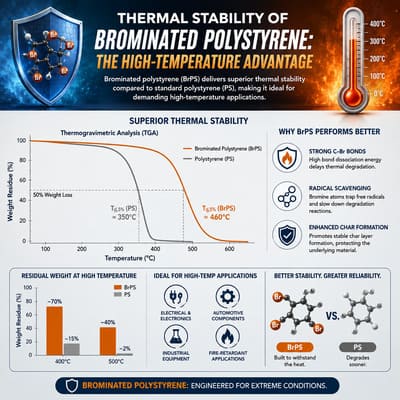
✅ High thermal stability. Its decomposition point sits well above PET's processing window, so it does its job when the part burns - not while you're compounding it. The details are in the thermal stability of brominated polystyrene.
✅ Low volatility. The polymeric backbone means it doesn't fume off or plate out on the mould at 280 °C, keeping tooling cleaner and output consistent.
✅ Non-blooming. High molecular weight keeps it locked in the matrix, so reinforced PET parts stay free of surface haze over their service life.
✅ Good electrical & colour performance. It supports the insulation properties and colour consistency that electrical PET parts require.
The mechanism behind all of this - gas-phase radical trapping - is the same one described in how brominated polystyrene works.
🧪 Building a Flame-Retardant PET Compound
A practical FR-PET formulation is a small system, not a single ingredient. The main players are:
- ⚗️ Brominated polystyrene - the primary flame retardant, chosen for its heat tolerance.
- 🤝 Antimony trioxide (Sb₂O₃) - the synergist that lets you hit the rating at lower total loading. The ratio is central; see the antimony trioxide synergy & loading guide.
- 🧊 Nucleating agent - helps PET crystallise at a workable rate for demoulding.
- 🧵 Glass fibre - typically 15–30% for structural grades, adding stiffness (and the candlewick challenge shared with PBT).
- 💧 Chain extenders / stabilisers - used in some grades to offset any molecular-weight loss and protect against hydrolysis.
💡 Process discipline is half the battle. Dry PET thoroughly before compounding and moulding, keep residence time short at high melt temperature, and validate the mould temperature for crystallisation. Even the best flame retardant can't rescue a wet, over-cooked PET melt.
🔩 Reinforced PET and the Candlewick Effect
As with PBT, most engineering PET is glass-reinforced, and the exposed fibres can wick molten polymer and carry a flame along the part - making a UL94 V-0 rating harder to reach. Because BPS acts in the vapour phase, it suppresses combustion above the surface regardless of the fibre "wick," which is why bromine–antimony systems remain the reliable route to V-0 in reinforced polyester.
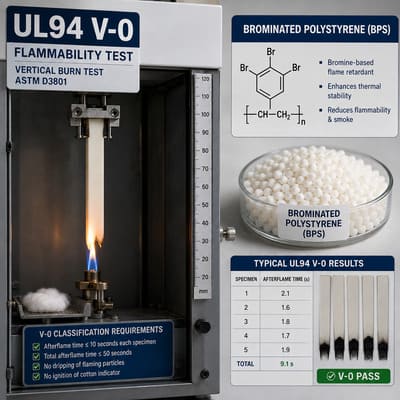
An anti-drip additive (typically PTFE) is normally included, since polyester melts and drips as it burns. To understand exactly what the rating means and how it's tested, see our UL94 V-0 flammability testing guide, referencing the classification framework from UL Solutions.
⚖️ Honest Trade-offs in FR-PET
Choosing BPS for PET is a strong default, but it's an engineering decision with real trade-offs to weigh:
- 🌫️ Combustion by-products. Like every brominated system, it releases corrosive hydrogen bromide and smoke under fire conditions. Where low smoke/low acid-gas is mandatory, weigh the alternatives in brominated vs halogen-free flame retardants.
- 📉 Property balance. Any additive package displaces polymer; keeping total loading efficient with the right synergist ratio protects strength and toughness.
- 💧 Moisture discipline. FR-PET is unforgiving of poor drying - this is a processing responsibility, not a flaw in the flame retardant.
- 📋 Regulatory diligence. BPS has a favourable profile among brominated FRs, but you should still confirm regional requirements - see is BPS RoHS & REACH compliant?
🔌 Where Flame-Retardant PET Is Used
Reinforced, flame-retardant PET shows up wherever stiffness, heat resistance and fire safety all matter at once:
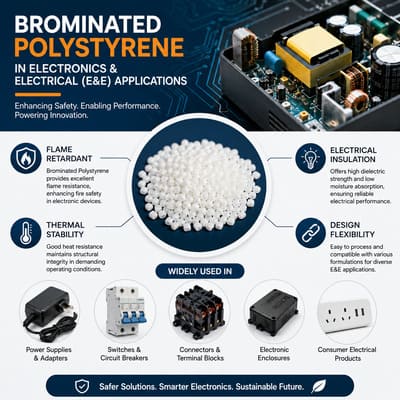
- ⚡ Electrical & electronic - connectors, switch components, coil bobbins and housings. These drive our electronics & E&E applications.
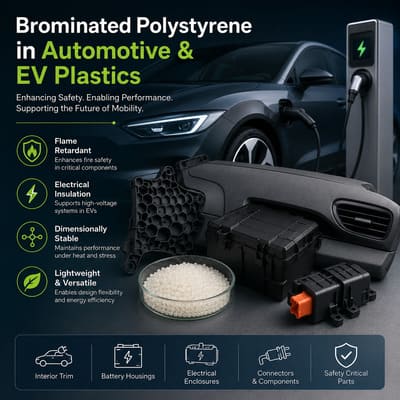
- 🚗 Automotive - under-hood parts and structural components where heat resistance is prized; see automotive & EV applications.
- 🏠 Appliances & industrial - housings and load-bearing parts near heat sources.
For exact BPS grade specifications suited to PET's temperature window, see the product page, or our BPS buyer's guide for grade selection help.
❓ Frequently Asked Questions
❓ Is flame-retarding PET the same as flame-retarding PBT?
💡 The chemistry is similar, but PET runs hotter, is more hydrolysis-sensitive and crystallises slower - so BPS's heat stability matters even more, and drying discipline is critical.
❓ Why not use a cheaper flame retardant in PET?
💡 Many lower-cost additives soften or volatilise in PET's ~280 °C melt, causing mould plate-out and inconsistent parts. BPS's high decomposition temperature avoids this.
❓ Does BPS cause PET to degrade or lose molecular weight?
💡 BPS itself is stable and non-acidic. Molecular-weight loss in FR-PET is almost always a drying/hydrolysis or over-heating issue - control moisture and residence time.
❓ Can BPS-modified PET reach UL94 V-0?
💡 Yes. With the right BPS–antimony ratio and a PTFE anti-drip additive, reinforced FR-PET routinely achieves V-0.
📚 Related Articles
🧱 Application
Brominated Polystyrene in PBT: Flame Retardant for Polybutylene TerephthalateThe closely related polyester case - and how the two compare.
🌡️ Performance
Thermal Stability of Brominated Polystyrene: The High-Temperature AdvantageThe property that makes BPS suitable for PET's hot processing window.
📘 Start Here
Brominated Polystyrene (BPS) Flame Retardant: The Complete GuideThe hub article covering everything about BPS in one place.
💬 Working on Flame-Retardant PET?
Sinolook Chemical supplies heat-stable brominated polystyrene for PET and reinforced polyester compounds, with technical support on grade and loading. Request a quote or sample. 🚀
📱 WhatsApp: 0086 18150362095
💬 WeChat / Tel: 0086 13400715622
✉️ Email: sales@sinolookchem.com
View the BPS Product Page →