🔬 The Chemistry of Fire
How Brominated Polystyrene Works: Flame-Retardant Mechanism & Chemistry
The fire never gets stopped in the plastic - it gets stopped in the flame. Here's the chemistry. ⚗️
It's a common misconception that a flame retardant works by making a plastic "harder to melt." In reality, the most important action of brominated polystyrene (BPS) happens in the gas phase - in the invisible zone of reacting gases just above a burning surface. Understanding this mechanism explains almost everything about how BPS is formulated and why it performs the way it does. 🔬
This article is part of our BPS knowledge base. For the big-picture overview, start with the complete guide to brominated polystyrene.
🔥 First, What Actually Keeps a Fire Burning?
Combustion of a polymer is a self-sustaining free-radical chain reaction. When plastic gets hot enough, it breaks down and releases flammable gases. In the flame, these fuel gases react with oxygen through highly reactive intermediates - chiefly the hydrogen radical (H•) and hydroxyl radical (OH•). These radicals are the engine of the fire: they propagate the reactions that release heat, which decomposes more plastic, which feeds more fuel. Break that cycle and the flame goes out.
💡 Key idea: A gas-phase flame retardant doesn't try to cool the plastic - it poisons the chain reaction that keeps the flame alive.
⚗️ The BPS Mechanism, Step by Step
Here's what happens when a BPS-protected part is exposed to fire:
- 🌡️ Thermal release of bromine. As temperature rises, carbon–bromine bonds in the BPS break, releasing bromine radicals (Br•) into the decomposing gas stream.
- 💨 Formation of hydrogen bromide. The bromine radical grabs hydrogen from the fuel to form hydrogen bromide (HBr).
- 🛑 Radical trapping. This is the critical step. HBr reacts with the high-energy H• and OH• radicals, converting them into far less reactive species and water - and regenerating Br• to do it all again. The fire's most reactive intermediates are being continuously scavenged.
- 🕯️ Flame starvation. With its chain-carrying radicals depleted, the combustion reaction slows, releases less heat, and the material self-extinguishes.
Because bromine is regenerated during radical trapping, a relatively modest amount of bromine can quench a great many radicals. This catalytic character is what makes bromine chemistry so efficient. You can review bromine's fundamental properties on PubChem, and the science of combustion and fire is documented extensively by NIST.
🤝 Why Antimony Trioxide Is Always in the Picture
BPS is rarely used alone. Its near-constant partner is antimony trioxide (Sb₂O₃), a synergist that dramatically boosts the gas-phase effect. On its own, Sb₂O₃ is not a strong flame retardant - but in the presence of bromine it forms volatile antimony tribromide (SbBr₃) and antimony oxyhalides.
These antimony–bromine species do two useful things: they carry bromine into the flame zone more effectively, and they provide additional radical-trapping surfaces. The practical result is that a bromine–antimony system reaches a target flammability rating at a lower total additive loading than bromine alone - which protects the plastic's mechanical properties.
🧪 Getting the ratio right matters. The bromine-to-antimony ratio and overall dosage are the levers that decide performance and cost. See our BPS + antimony trioxide synergy & loading guide.
🧬 Why the "Polystyrene" Part Matters
Many brominated flame retardants are small molecules. The bromine chemistry is similar, but small molecules bring problems: they can volatilise during hot compounding and bloom (migrate to the surface) over time, taking their fire protection with them.
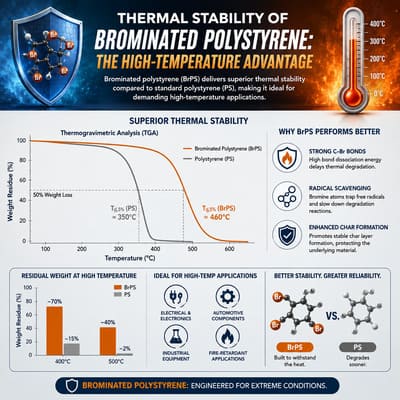
BPS solves this by hanging the bromine on a high-molecular-weight polymer backbone. The bromine is still available to do its gas-phase job when the part actually burns - but under normal processing and service conditions, the large polymeric molecule stays locked in the matrix. That's why BPS is described as non-blooming and low-migration, and why it tolerates the aggressive melt temperatures of engineering plastics.
This thermal robustness is a topic in its own right - read the thermal stability of brominated polystyrene for the processing implications. For the substance identity and grade specifications, see the BPS product page.
⚠️ An Honest Word on Combustion By-products
The same HBr that traps flame radicals is also corrosive, and halogenated systems generate more smoke and acidic gas under fire than some halogen-free alternatives. This is an inherent trade-off of bromine chemistry, not a flaw unique to BPS. Where low smoke and low acid-gas are hard requirements, a halogen-free system may be the better fit - we compare them honestly in brominated vs halogen-free flame retardants. Always follow the SDS for safe handling.
❓ Frequently Asked Questions
❓ Does BPS work in the solid plastic or in the flame?
💡 Primarily in the gas phase - in the flame. It releases bromine species that trap the reactive radicals sustaining combustion.
❓ What is the role of hydrogen bromide (HBr)?
💡 HBr is the active radical-trapping agent. It converts high-energy H• and OH• radicals into low-energy species and water, while regenerating bromine to continue the cycle.
❓ Why add antimony trioxide?
💡 It's a synergist. Forming volatile antimony bromides carries bromine into the flame more effectively, so you reach the target rating at a lower total loading.
❓ Why use a polymeric flame retardant instead of a small molecule?
💡 The high-molecular-weight backbone resists volatilisation and blooming, so the fire protection stays in the part and survives high-temperature processing.
📚 Related Articles
🧪 Formulation
BPS + Antimony Trioxide Synergy: Loading & Formulation GuideOptimal bromine-to-antimony ratios and loading levels for V-0 performance.
🌡️ Performance
Thermal Stability of Brominated Polystyrene: The High-Temperature AdvantageWhy BPS survives the high melt temperatures of engineering plastics.
📘 Start Here
Brominated Polystyrene (BPS) Flame Retardant: The Complete GuideThe hub article covering everything about BPS in one place.
💬 Talk to a BPS Specialist
Need help translating flame-retardant chemistry into a working formulation? Sinolook Chemical supplies BPS with technical support on synergist ratios and loading. 🚀
📱 WhatsApp: 0086 18150362095
💬 WeChat / Tel: 0086 13400715622
✉️ Email: sales@sinolookchem.com
View the BPS Product Page →