
🧪 Formulation Guide
Brominated Polystyrene & Antimony Trioxide Synergy: Loading & Formulation Guide
Two additives, one system - and a ratio that decides whether you pass V-0. ⚗️
You can have the best flame retardant in the world and still fail the burn test if the formulation is wrong. With brominated polystyrene (BPS), the formulation is really a two-part system: the bromine source and its synergist, antimony trioxide (Sb₂O₃). Understanding how they work together - and in what proportion - is the most practical knowledge a compounder can have. 🧪
This article is part of our BPS knowledge base and serves as the formulation companion to every application guide. For the overview, start with the complete guide to brominated polystyrene.
🤝 Why Antimony Trioxide Is Essential
On its own, antimony trioxide is a weak flame retardant. On its own, BPS is effective but needs a lot of bromine to carry the load. Together, they are dramatically more powerful than the sum of their parts - the definition of synergy.
The reason lies in the chemistry. As the compound burns, bromine released from BPS reacts with Sb₂O₃ to form volatile antimony tribromide (SbBr₃) and antimony oxybromides. These species are far better than bromine alone at carrying the active radical-trapping chemistry up into the flame zone, where they quench the H• and OH• radicals that sustain combustion. The full gas-phase story is in how brominated polystyrene works.
💡 The payoff: synergy lets you reach a target rating at a lower total additive loading - which means better retained mechanical properties, easier processing and often lower cost than using more bromine alone.
⚖️ The Bromine-to-Antimony Ratio
The most important number in a BPS formulation is the ratio of bromine to antimony (Br:Sb). Too little antimony and the synergy is under-used; too much and you waste additive, add cost, dull colour and can compromise properties.
As a widely used starting point, formulators often target a Br:Sb ratio in the region of 3:1 by weight, then fine-tune from there for the specific polymer and target rating. Because BPS carries a defined bromine content, you back-calculate the BPS and Sb₂O₃ additions needed to land near that ratio at your chosen total loading.
📐 Design sequence: (1) fix the Br:Sb ratio near your starting target → (2) set total loading for your wall thickness and rating → (3) trial and adjust. For the exact bromine content to base your calculation on, use the values on the BPS product page.
📊 How Total Loading Scales
Total flame-retardant loading isn't a fixed number - it moves with the demands of the part. The main drivers:
- 📏 Wall thickness. Thinner sections are harder to rate (less material to self-extinguish), so a 0.4 mm test bar generally needs more FR than a 1.6 mm bar. Always formulate to the thinnest rated wall.
- 🧵 Glass content. Reinforcement brings the candlewick effect, so glass-filled grades typically need more FR than unfilled ones at the same rating.
- 🎯 Target rating. V-0 demands more than V-2; a firm pass with margin needs a little more than a marginal pass.
- 🧬 Base polymer. Inherently char-forming or high-melting polymers behave differently from easy-burning ones, shifting the loading needed.
This is why the application guides give resin-specific context - see BPS in PBT, BPS in PET and BPS in nylon.
💧 The Third Ingredient: Anti-Drip
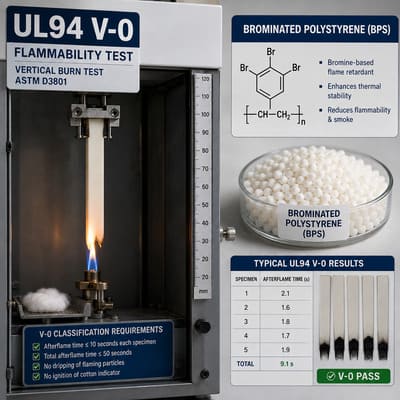
Many thermoplastics - polyesters and nylons especially - melt and drip when they burn. In the UL94 test, flaming drips that ignite the cotton indicator below cause an automatic downgrade, so a formulation that self-extinguishes can still fail purely on dripping.
The standard fix is a small addition (typically a fraction of a percent) of PTFE as an anti-drip agent. It forms a fibrillated network that holds the melt together, preventing flaming drips. It's a small line item that often makes the difference between V-2 and V-0.
🌀 Dispersion & Processing
A correct recipe still fails if it isn't mixed well. Both BPS and antimony trioxide must be dispersed uniformly for consistent performance:
- 🔩 Twin-screw compounding with a well-designed screw profile gives the distributive mixing these additives need.
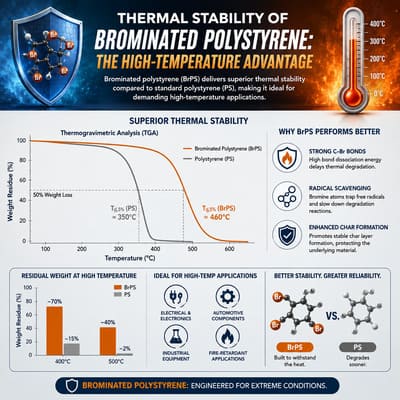
- 🌡️ Respect the melt window - BPS's heat stability tolerates high temperatures (see thermal stability), but keep residence time sensible to protect the base polymer.
- 📦 Feed consistency - accurate gravimetric feeding keeps the Br:Sb ratio on target batch to batch.
- 💧 Dry hygroscopic resins (PET, PA) before compounding to avoid property loss unrelated to the FR system.
🔧 Troubleshooting a Formulation That Won't Rate
🔴 Fails on flaming drips? → add or increase PTFE anti-drip; check dispersion.
🟠 Self-extinguishes too slowly? → raise total loading, or re-check the Br:Sb ratio (often too little antimony).
🟡 Passes at 1.6 mm but fails thin-wall? → formulate to the thinnest wall from the start; increase loading.
🟢 Inconsistent bar-to-bar? → dispersion or feeding issue; verify compounding and gravimetric feeders.
🔵 Colour dull or grey? → antimony may be over-dosed; trim toward the target ratio.
Once the formulation is dialled in, confirm it against the actual standard - see our UL94 V-0 flammability testing guide.
⚠️ A Word on Antimony Trioxide
Antimony trioxide is effective but carries its own handling precautions - it is classified as a suspected carcinogen and generates a respirable dust, so follow the SDS and control workplace exposure per OSHA and NIOSH guidance. Some formulators explore reduced-antimony or antimony-free synergist routes for this reason. This is a genuine consideration to weigh, not a detail to gloss over.
❓ Frequently Asked Questions
❓ What Br:Sb ratio should I start with?
💡 A bromine-to-antimony ratio around 3:1 by weight is a common starting point; fine-tune for your polymer, wall thickness and target rating from there.
❓ Can I use BPS without antimony trioxide?
💡 You can, but you'll need much more bromine to hit the same rating, which raises cost and can hurt properties. The synergist is what makes the system efficient. Antimony-free routes exist but change the formulation.
❓ Why does my compound self-extinguish but still fail V-0?
💡 Almost always flaming drips. Add a small amount of PTFE anti-drip agent and re-test - self-extinguishing and drip control are separate requirements.
❓ Does more flame retardant always mean better?
💡 No. Over-loading wastes cost, dulls colour and degrades mechanical properties. The goal is the minimum loading that gives a firm pass with margin - which is exactly what the synergy enables.
📚 Related Articles
🔬 Chemistry
How Brominated Polystyrene Works: Flame-Retardant Mechanism & ChemistryThe gas-phase mechanism the antimony synergy amplifies.
🛡️ Testing
UL94 V-0 & Flammability Testing with Brominated PolystyreneHow to confirm your formulation against the standard.
📘 Start Here
Brominated Polystyrene (BPS) Flame Retardant: The Complete GuideThe hub article covering everything about BPS in one place.
💬 Need Formulation Support?
Sinolook Chemical supplies brominated polystyrene and can advise on Br:Sb ratio, loading and anti-drip for your resin and target rating. Request a quote, sample or technical consultation. 🚀
📱 WhatsApp: 0086 18150362095
💬 WeChat / Tel: 0086 13400715622
✉️ Email: sales@sinolookchem.com
View the BPS Product Page →